
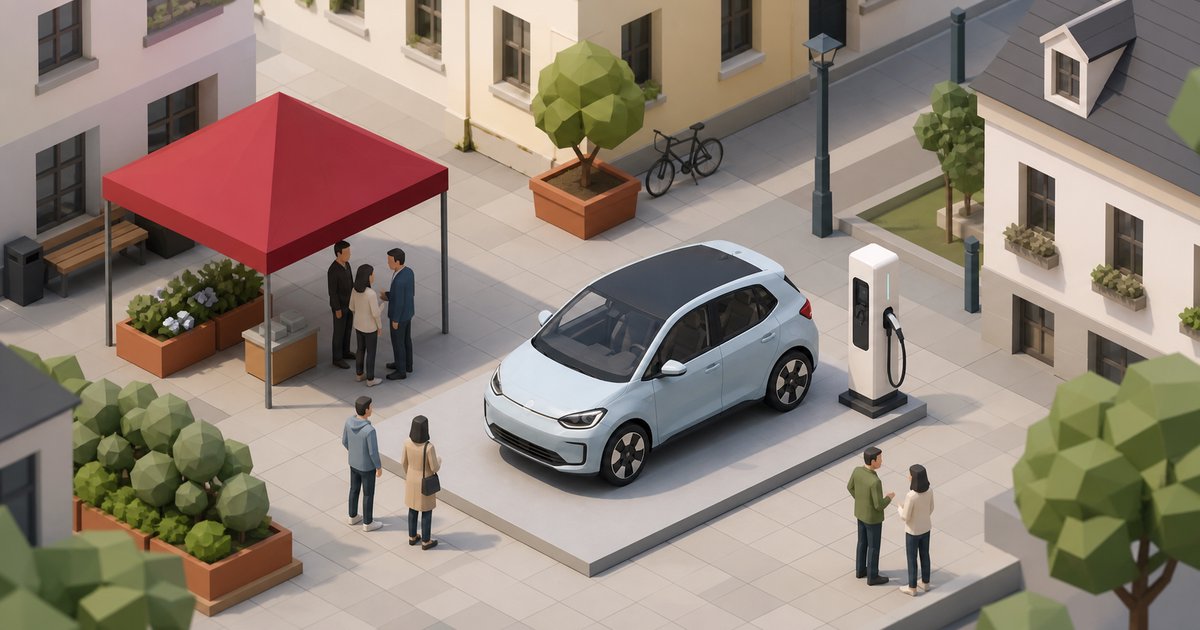
Geely opened non-binding German reservations on 8 August 2026 for the E2, a small electric hatchback that starts at €19,990. It is the brand's second battery-electric model for Germany after the EX5, and it moves Geely's German range down a segment — the E2 is 4,135 mm long, roughly the footprint of a Volkswagen Polo. First deliveries are planned for the end of September.
What the money buys
| Trim | Price | Battery | WLTP range | Motor | DC peak |
|---|---|---|---|---|---|
| Pro | €19,990 | 35.35 kWh LFP | 252 km | 60 kW / 150 Nm | 60 kW |
| Max | €23,990 | 47.14 kWh | 345 km | 85 kW / 150 Nm | 80 kW |
| Ultra | €26,990 | 47.14 kWh | 345 km | 85 kW / 150 Nm | 80 kW |
Leasing starts at €99 per month. Every version covers 30-80% on a DC charger in 19 minutes; on AC, a 10-100% fill takes 5.3 hours in the Pro and 7.1 hours in the Ultra. The body measures 4,135 × 1,805 × 1,580 mm on a 2,645 mm wheelbase, with a 9.9-metre turning circle.
The honest reading of the entry car is that 252 km is a WLTP figure, and a 35 kWh pack in December will not deliver it. The Pro is a second car, a commuter, or a city car for someone who charges at home. The €23,990 Max is the version most buyers who want one car will actually need.
The charging credit is a discount with conditions
Geely is bundling an EnBW charging voucher worth €621 during the reservation phase, and it has shown its arithmetic: 10,000 km a year at 15.9 kWh/100 km is about 1,590 kWh, which at 39 cents per kWh comes to €621. That is a fair description of a year of public charging at public-charging prices.
It is worth being clear about who that helps. A driver with a wallbox pays a fraction of 39 cents and will never convert the voucher into €621 of value they would otherwise have spent. A driver without home charging — the buyer most likely to be looking at a €19,990 car in a city — will use all of it. The incentive is aimed squarely at the second group, and for them it is real money.
Where it lands in the European market
The E2 arrives into the narrow band of sub-€25,000 electric cars that Europe has spent years waiting for. Volkswagen's ID. Polo is orderable from €24,995 with a 37 kWh battery, which makes the Geely's entry price roughly €5,000 lower for a comparable pack — and its 47 kWh version cheaper than the base Polo while carrying more energy.
That is the pattern European manufacturers have been warning about, and it is arriving faster at the bottom of the market than at the top, where the Xpeng L03 undercuts the Model Y from €34,990. Cheap small electric cars are the segment European brands abandoned first and are struggling hardest to return to.
What the E2 does not yet have is a track record. Geely is new to German retail, and a €19,990 car lives or dies on servicing, parts availability and residual values — none of which can be judged from a price list.