
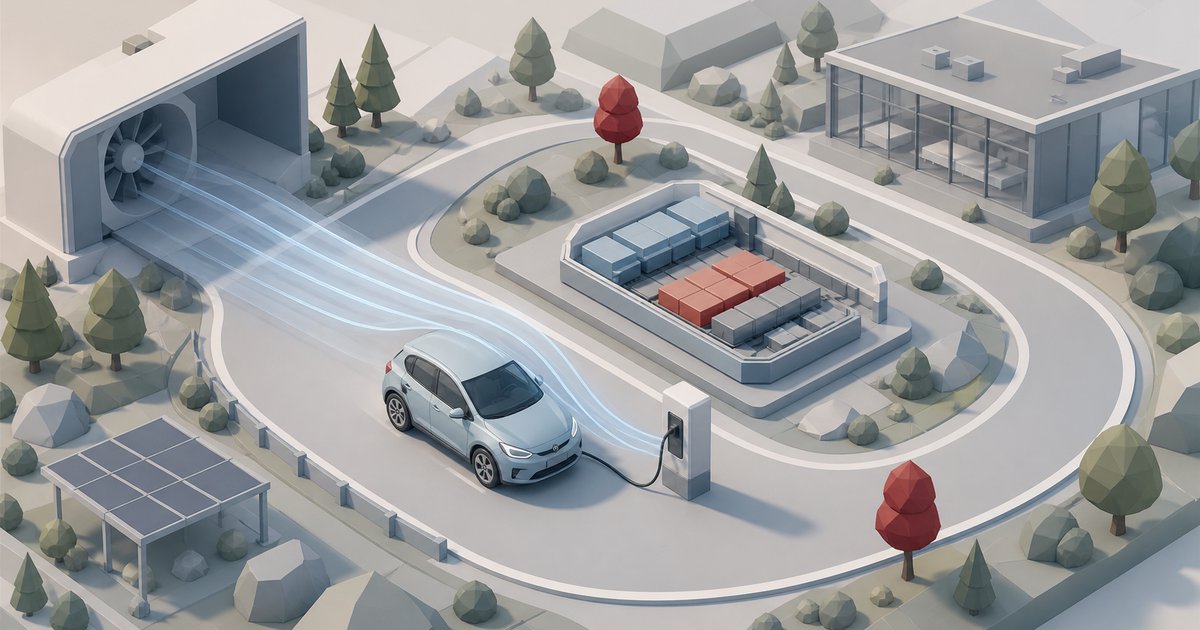
Audi has released the first technical data for the A2 e-tron, and the number the company is leading with is 12.8 kWh/100 km on the WLTP cycle. That is a preliminary figure for the 140 kW version fitted with the efficiency package, and it makes the A2 e-tron the most efficient car Audi has built — combustion or electric.
The name is deliberate. The original A2, sold from 1999 to 2005, was an aluminium-bodied compact built around aerodynamics and mass reduction at a time when nobody was asking for either. It sold poorly and is now a cult car. The electric one revives the premise with the drivetrain it always wanted.
The specification so far
| Item | Figure |
|---|---|
| Consumption (WLTP, preliminary) | 12.8 kWh/100 km |
| Drag coefficient | 0.24 |
| Battery | 61 kWh LFP |
| Motor | 140 kW (190 PS), rear-mounted |
| DC peak charging | 105 kW |
| DC 10–80% | 26 minutes |
| AC charging efficiency at wallbox | 89.6% |
| Range | not yet published |
| Price | not yet published |
Where the efficiency comes from
Three things are doing the work, and none is exotic.
The 0.24 drag coefficient is the best in Audi's compact line-up. On a small car, aerodynamic drag dominates consumption at motorway speed, and a hundredth of a point of cd is worth more than most component-level optimisation.
The single rear motor avoids the parasitic drag of a permanently connected front axle. Rear-drive single-motor layouts are consistently the efficiency champions of any EV range — the same reason Tesla's Long Range rear-wheel-drive variants beat their dual-motor siblings.
The third is thermal strategy. Audi quotes 89.6% charging efficiency at the wallbox, attributing it to adaptive cooling — a good number against the ADAC's charging-loss measurements, which found wallbox losses under 7% across the cars it tested.
LFP in a premium compact
The 61 kWh battery is lithium iron phosphate, not the nickel-based chemistry Audi uses in its larger EVs. LFP is cheaper per kilowatt-hour, tolerates being charged to 100% daily, and lasts longer in cycle terms. It is also less energy-dense and behaves worse in the cold.
Putting LFP in the entry EV is less a compromise than an admission of what the segment needs: a car that costs less to build, charges to full every night without a maintenance ritual, and does not need 90 kWh to be useful. It is the logic that put LFP in the standard-range Model 3 and Model Y.
The 105 kW DC peak is modest against premium rivals, but 26 minutes from 10 to 80% is competitive, because a smaller pack needs fewer kilowatt-hours to fill. Time at the stop is what matters, not peak power.
Where it lands in the European market
Efficiency is worth more in Europe than almost anywhere else. Electricity costs more here than in the US or China, motorway speeds are higher, and a large share of buyers charge on public infrastructure at public prices. A car needing 12.8 kWh per 100 km rather than 18 saves real money in a way a bigger battery does not.
It also changes what the car must carry: at that consumption a 61 kWh pack does the work an 80 kWh pack would do in a less efficient rival — less weight, cost, raw material and tyre wear. The segment it enters is Europe's most contested, where Chinese manufacturers have concentrated and where European carmakers are lobbying to restrict subsidies to local production.
What Audi has not said
Two things are conspicuously absent: range and price. A 61 kWh pack at 12.8 kWh/100 km implies something in the high 400s of kilometres on WLTP, but Audi has published no figure, and preliminary consumption numbers move before homologation.
Price matters more. The A2 e-tron is Audi's future entry model, arriving into a European market where VW's own ID. Polo is orderable from €24,995 and Chinese compacts undercut both. Audi has confirmed a world premiere in autumn 2026; the number that decides whether the efficiency headline matters will come with it.