
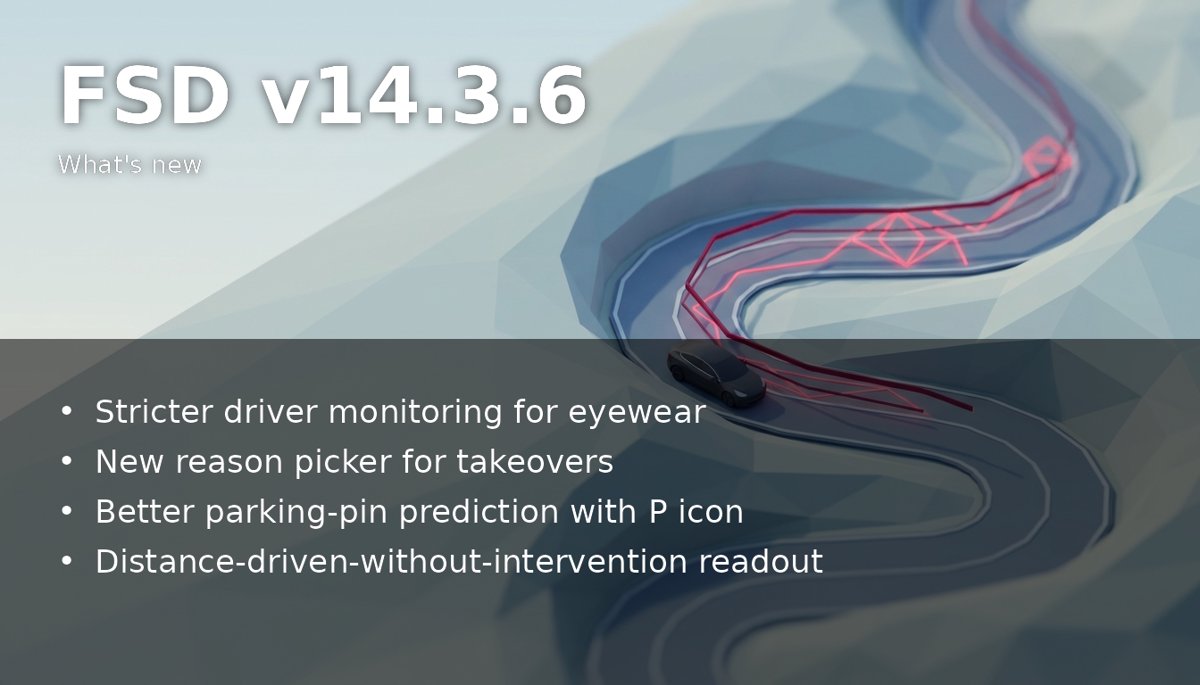
Tesla has taken FSD (Supervised) v14.3.6 to wide release on Hardware 4 cars, shipping inside firmware 2026.20.6.11. The build first appeared on HW4 vehicles on 21 July and widened in daily waves across the United States and Canada, with Cybertruck owners now reporting it alongside the rest of the HW4 line-up. It is a short list of genuinely new behaviour attached to a long list of restatements — and, unusually for this branch, a wave of complaints.
What is actually new in v14.3.6
Three items in the release notes are worth reading closely:
- Stricter driver monitoring. Sensitivity is up, with better eye-gaze tracking and improved handling of glasses and sunglasses. Owners who have been nagged by the cabin camera through eyewear should notice the difference first.
- Intervention reporting. You can now tell Tesla why you took over, picking an intervention reason on the main screen — turning disengagements into labelled training data instead of an anonymous count.
- Traffic lights and parking pins. Improved handling at complex intersections with compound lights and curved roads, plus better parking-location pin prediction, now drawn on the map with a P icon. There is also a new readout for distance travelled under FSD without an intervention.
What is not new, despite appearing in the notes
Release notes restate the branch's history, and this one restates a lot of it. Three examples matter, because each has been reported elsewhere this week as though it were new:
- The MLIR compiler rewrite and its claimed 20% faster reaction time, the reinforcement-learning training upgrade and the vision-encoder improvements all landed with v14.3 in April, and were already covered in the v14.3.5 release.
- The line about unifying the model behind Actually Smart Summon, FSD and Robotaxi describes work that shipped in v14.3.2 back in April, when Tesla merged the three previously separate inference stacks into one.
- The 8 mph (13 km/h) Actually Smart Summon speed cap is carried forward too — and Summon support for the Cybertruck itself arrived in v14.3.4 in June, not here.
Worth noting as well: the SLOTH speed profile and the Parking Lot / Street / Driveway arrival options that circulated widely with this build belong to the Hardware 3 v14 Lite branch, which shares the same 2026.20.6.11 firmware number. They are not HW4 features. Read the notes as a list of this month's work and you will overestimate it considerably.
The regressions are the real story
Most owners reporting on v14.3.6 describe it as a step back from v14.3.5, concentrated in braking. Brake-stuttering — the car hesitating and re-applying the brakes rather than committing — and shadow braking, where it slows for nothing, have both returned after earlier point releases had largely settled them. Owners also flag worse parking behaviour, left-lane camping and missed highway exits.
That is a poor showing for a build Tesla pushed to wide release rather than held back, and it is the reason this version has drawn more criticism than either of its predecessors.
What European owners should expect
Not much, yet. The v14.3.6 waves have run in North America; European Hardware 4 cars sit on the merged EU software branch Tesla established with v14.2.2.6 and have not received this build. Treat it as a preview of what is heading to Europe — and given the braking reports, a build worth letting others test first.