
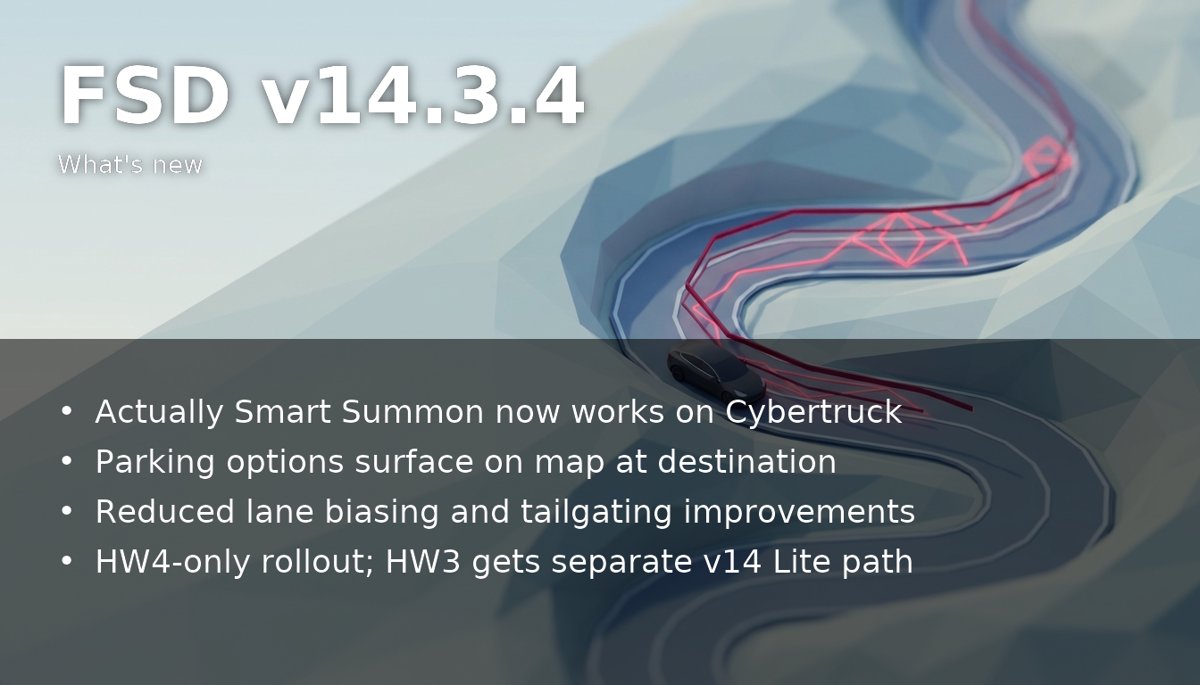
Tesla has begun seeding FSD (Supervised) v14.3.4, packaged in firmware 2026.14.6.10, to a small group of vehicles. The build started reaching cars on 11 June 2026 with a minimal early-access footprint — fleet-tracking site Not a Tesla App logged only a handful of vehicles at launch — and is the newest point release on the v14.3 branch that began rolling out in April.
What's new in v14.3.4
Two changes are specific to this build rather than inherited from earlier v14.3 releases:
- Actually Smart Summon comes to Cybertruck. The low-speed driverless retrieval feature, already available on Model 3, Y, S and X, now works on Cybertruck, with a maximum Summon speed of 8 mph (13 km/h).
- Parking options on the map. When you arrive at a destination, the map now surfaces nearby parking, and Tesla says the car is more decisive when selecting and manoeuvring into a spot.
The release notes also restate a set of model-wide refinements: reduced unnecessary lane biasing, less minor tailgating, better responses to emergency vehicles and school buses, and improved handling of small animals and temporary sensor degradation.
Built on the v14.3 foundation
Most of the heavy lifting in this branch landed earlier. FSD v14.3, which began rolling out in early April, rewrote Tesla's AI compiler and runtime around MLIR — the open compiler framework associated with LLVM creator Chris Lattner — for a claimed 20% faster reaction time and quicker model iteration. That release also upgraded the reinforcement-learning training stage and the neural-network vision encoder for better performance in rare and low-visibility scenarios, stronger 3D geometry understanding, and wider traffic-sign recognition. Those gains carry into v14.3.4; they are not new to this point release. We covered the prior step in the 2026.14.6.7 / v14.3.3 update.
Hardware and availability
v14.3.4 requires Hardware 4 (HW4) and is offered across the compatible line-up — Model S, 3, X, Y and Cybertruck. HW3 cars are not part of this rollout; Tesla has confirmed those vehicles will follow a separate, lighter "v14 Lite" path. At launch the build sat at roughly 0% of the fleet, consistent with Tesla's usual staged release in which a versioned build seeds to a few cars before a wider push over the following days.
Why it matters for Europe
European owners are watching the v14 roadmap more closely than ever. With Belgium becoming the fifth European country to approve FSD Supervised, the distance between the bleeding-edge North American builds and the version European cars actually receive has become the region's central question. v14.3.4 is the current high-water mark in the US; the firmware reaching newly approved European markets still trails on the v14.2 line. As approvals spread, the practical question for owners is how quickly these v14.3 driving improvements — not the headline Cybertruck feature, which Europe does not sell — reach the cars on European roads.
Update: 2026-06-13
On 12 June 2026, Not a Tesla App documented several user-facing additions in v14.3.4 beyond the Cybertruck Summon feature, all limited to AI4 (HW4) vehicles. The build adds a trip editor: a new "Pin +" button beside End Trip lets you insert a stop between your current location and destination without re-entering the route. The destination menu now slides up from the bottom of the screen whenever a destination is set or edited, and the previous "Curb-side" arrival option has been renamed Pull Over. The update also introduces FSD streak celebrations — at intervention-free milestones of 250, 500, 1,000 and 5,000 miles, a glowing "X mi Streak Reached" banner appears in the centre of the driving visualization. See Not a Tesla App's coverage of the new UI features and streak celebrations.
Update: 2026-06-15
On 15 June 2026, Tesla pushed firmware 2026.14.6.11, a bug-fix build of FSD v14.3.4 that follows the feature-carrying 2026.14.6.10 release rather than adding new capabilities. Early driver impressions, collected by Not a Tesla App, are mixed: testers report noticeably more confident low-speed driving, with the steering-wheel jitter seen in earlier builds largely resolved and less hesitation in tight manoeuvres — but some also flag regressions in specific scenarios. The rollout remains staged, expanding gradually across the HW4 fleet.