
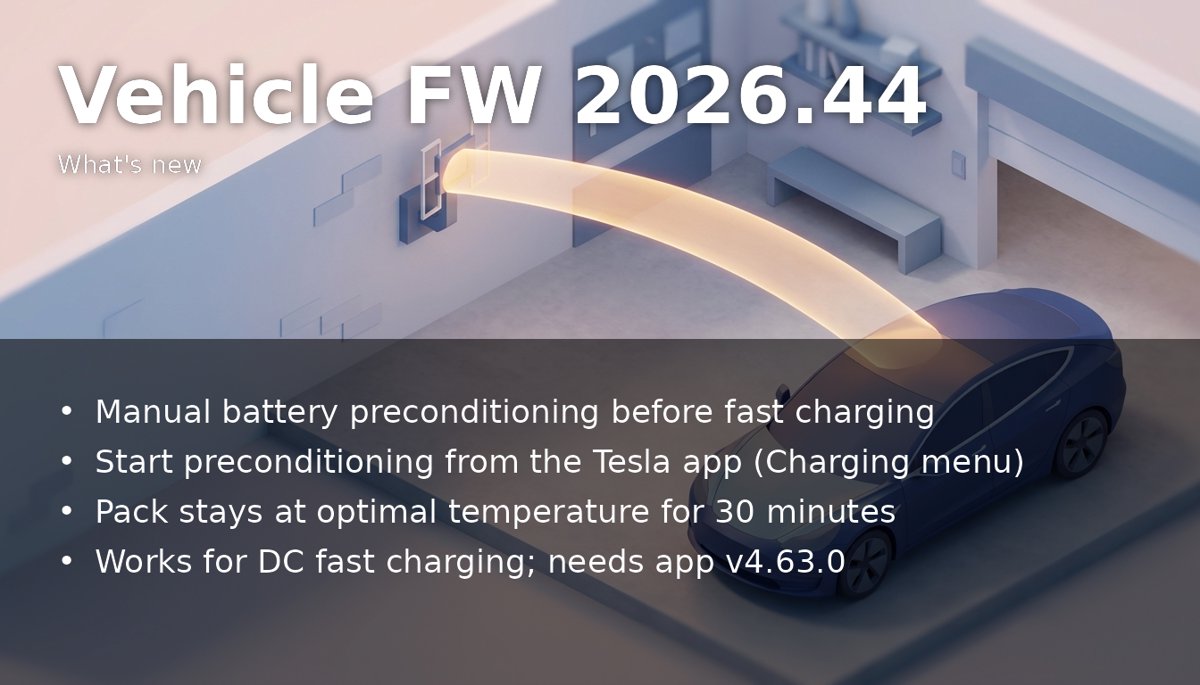
Tesla began rolling out firmware 2026.44.3.1 on 26 November 2026, and it switches on a feature that had sat unused in Tesla's phone app for a week: manual battery preconditioning. Until now, a Tesla warmed its battery for a fast charge only when its own navigation was taking it to a Supercharger or to a third-party fast charger the car recognises. Owners can now start the process themselves, in the car or from their phone.
What the release notes say
The release notes carry two entries that 2026.44.1 did not. The first reads: "You can now manually precondition your battery to reach its optimal temperature before fast charging to save time. Start preconditioning about one hour before you plan to charge. Once the optimal temperature is reached, it will be maintained for thirty minutes."
The second covers the phone: "You can now also precondition your battery via the Mobile App before driving to a fast charger. To start, go to Charging > Precondition for Fast Charging. Requires Mobile App v4.63.0."
Apart from a line promising "minor fixes and improvements", every other section, from the clustered charger map to the FSD (Supervised) notes, repeats the 2026.44.1 notes word for word.
From code to car
When app 4.63.0 came out on 18 November, Not a Tesla App found buttons labelled "Precondition Battery" and "Stop Preconditioning" in its code, with the same one-hour and thirty-minute wording, but owners could not use them. The car update is what switches the feature on, so owners who have already installed app 4.63.0 need nothing else.
The notes do not say which models get it. Tesla is late to this: Frandroid lists Audi, Ford and Nissan models that already have a manual button, and says Volkswagen added one to older ID.3, ID.4 and ID.5 cars with a software update in early November.
Why it matters in winter
A cold lithium-ion battery cannot accept a fast charger's full power, so the car limits the current until the pack is warm. Preconditioning through navigation works on long trips, but it needs the charger set as the destination, and a short drive to a charger near home gives the pack too little time to warm up. The text found in the app code says preconditioning "does not noticeably improve charge rates at AC chargers", so the feature is meant for DC stops, not for a home wallbox.
Heating the pack also costs energy. Drive Tesla Canada notes that warming it to fast-charging temperature can use more energy than everyday driving needs, so the button belongs before a charging stop. It does not replace ordinary cabin preconditioning on a cold morning.
Who has it
The first car on the build is European. TeslaFi, which logs updates on cars whose owners use its service, recorded the first installation at 11:08 UTC on 26 November, on a 2025 Model Y Performance with Hardware 4 in Lower Austria that came from 2026.38.3.2. By 18:05 UTC it was still the only car on 2026.44.3.1 among TeslaFi's users, with five more waiting to install it. The build it follows, 2026.44.1, released on 17 November, was on 5,387 cars, or 43.7% of the TeslaFi fleet.