
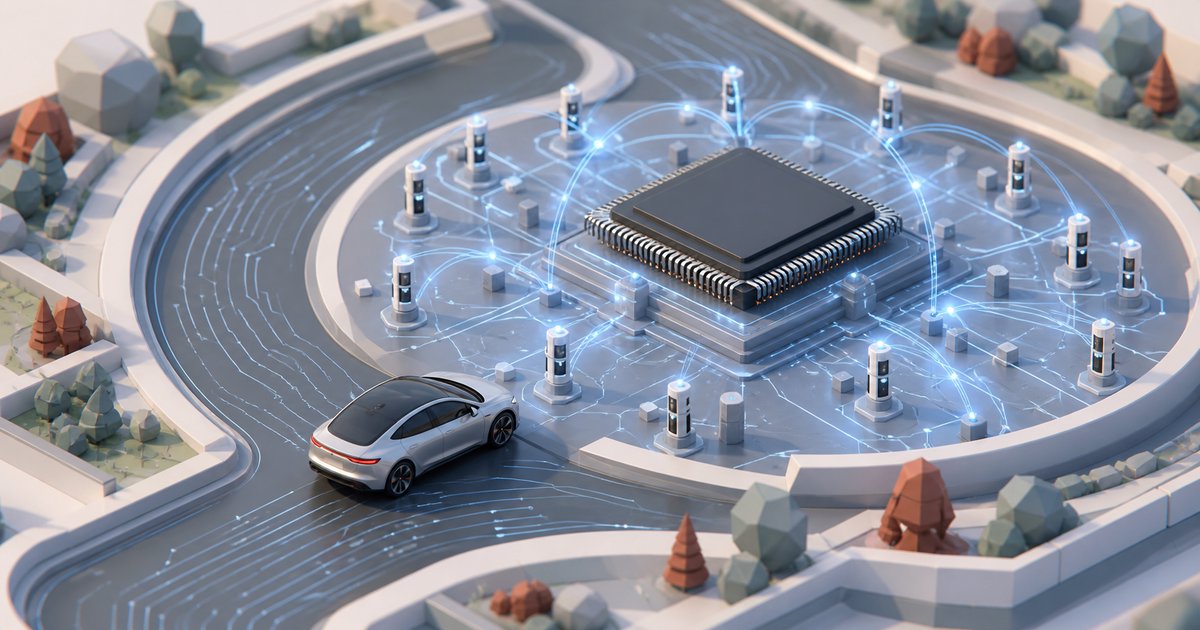
Xiaomi announced three custom chips on 24 August. Two are for phones and AI accelerators. The third, the Xring D100, is for driving — and it is the one that matters to anyone tracking Tesla.
The D100 is built on a 3 nm process at TSMC. Xiaomi describes it as China's first in-house smart-driving AI chip at that node, says validation is complete, and puts commercial deployment in vehicles in 2027.
What Xiaomi says is in it
| Specification | Xring D100 |
|---|---|
| Process node | 3 nm (TSMC) |
| CPU | 20 cores |
| NPU | 16 cores |
| Unified memory | up to 160 GB |
| On-device model size | up to 200 billion parameters |
| Status | validation complete |
| In cars | 2027 |
The 160 GB unified-memory figure and the 200-billion-parameter claim are the interesting ones: they describe a part meant to run a large model locally rather than a compact, heavily quantised perception network. Treat them as the manufacturer's own — none has been independently benchmarked, and a validated chip is not a shipped one.
Why this is a Tesla story
Tesla is the company that made in-house autonomy silicon a strategy. It dropped Nvidia's Drive platform for its own FSD computer in 2019, iterated to AI4, and has AI5 in development. The argument was that a chip designed for one software stack, in one company's cars, beats a general-purpose part bought from a supplier — and that owning the roadmap means nobody else sets your compute ceiling. For years the counter-argument was that almost nobody else could afford to do it.
Xiaomi is not a distant competitor either. It sells against the Model 3 and Model Y in China, Tesla's second-largest market, and its SU7 has passed 500,000 deliveries.
What it does not mean
It does not mean Xiaomi has caught Tesla on autonomy. Silicon is the easiest part of the stack to specify and the hardest to make useful; Tesla's advantage has always been claimed to rest on fleet data and the training loop, not transistor count. A chip arriving in cars in 2027 will be judged on what the software does with it in 2028.
It does mean the moat is narrower. Tesla's compute story assumed rivals would stay dependent on Nvidia's roadmap and pricing, and in China that assumption is now wrong.
What this means in Europe
Two Xiaomi timelines converge on 2027: the D100 is slated to reach cars that year, and Xiaomi has said it will enter the European market in 2027, opening showrooms first and leaving local manufacturing open for later. Models and countries have not been confirmed.
So the first Xiaomi a European buyer can order should arrive roughly alongside the company's own driving silicon — and the SU7, benchmarked by its maker against the Model S and the Taycan, aims squarely at Tesla's part of the market.
Regulators are the harder audience. Whatever the D100 computes, the functions it enables here must still clear UNECE type-approval, the process that has kept FSD Supervised waiting. Compute is not the European constraint; permission is.
The practical read is not that a better chip is coming. It is that by 2027 there should be a rival in European showrooms running its own custom silicon, on the same argument Tesla has made for seven years — and Tesla will no longer be the only company able to make it.