
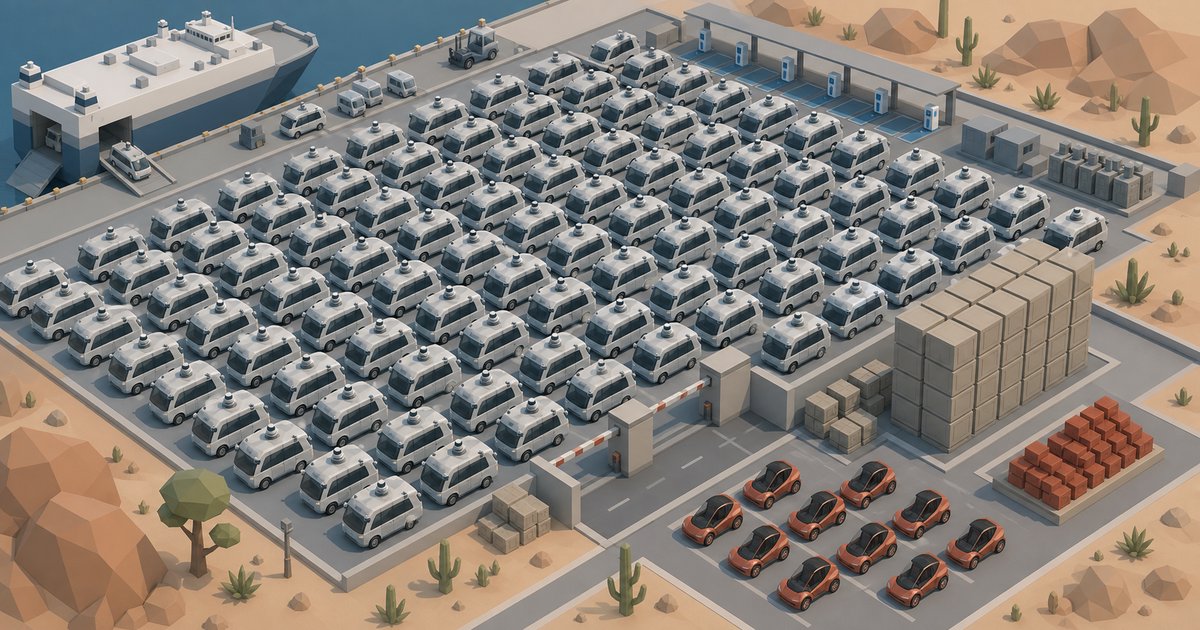
Waymo has imported more than 3,200 Chinese-built robotaxis into a country where private buyers are effectively locked out of the same vehicles, paying a tariff that roughly doubles the price of every one. Strip out the politics and what is left is the clearest public accounting yet of what a robotaxi fleet costs per vehicle — and the sharpest available contrast with the bet Tesla has placed on Cybercab.
The import numbers
More than 3,200 Ojai robotaxis have arrived cumulatively, over 2,600 of them during 2026. In August more than 500 were photographed together at Waymo's integration facility in Mesa, Arizona. The vehicle is built by Zeekr, Geely's EV brand, in Ningbo, and it is already carrying passengers in San Francisco, Phoenix and Los Angeles.
What one costs by the time it can take a fare
| Component | Reported figure |
|---|---|
| CM1e chassis, ex-factory | $38,000–38,500 |
| Landed after tariff at 102.5% | ~$78,000 |
| Landed after tariff at 127.5% | ~$86,500 |
| Waymo Gen 6 sensor and compute package | ~$25,000 |
| Complete vehicle, Morgan Stanley estimate | ~$125,000 |
| Jaguar I-PACE it replaces | ~$200,000 |
One caveat on that table. Outlets do not agree on the duty stack: carnewschina and CleanTechnica report 102.5%, while Forbes puts it at 127.5%. The difference appears to be which additional duties are counted on top of the base EV tariff. Both figures land in the same place directionally — the chassis roughly doubles before a single sensor is fitted.
Why Waymo pays it anyway
Because the alternative was worse. The Ojai cuts sensor count by about 42% and comes in roughly $75,000 per unit below the Jaguar I-PACE it replaces. A company willing to absorb a tariff of more than 100% and still bank a $75,000 saving is telling you something about the economics of the era it is leaving — retrofitting luxury SUVs with hand-built sensor stacks was extraordinarily expensive, and everyone doing it knew the model could not scale.
Where Cybercab sits on the same axis
Tesla went at the cost problem from the opposite end. Cybercab is purpose-built rather than adapted: no steering wheel, no pedals, no charge port — inductive charging instead — and an "unboxed" assembly process meant to cut build cost rather than trim it. The target price is under $30,000, which Musk has narrowed toward $25,000 on earnings calls. The first unit came off the line at Giga Texas in February 2026.
Treat that number as a target, not an achievement. Tesla has not published a verified build cost, and the company's history of hitting price targets on schedule is mixed at best. But the strategic difference is real and it is not subtle: Waymo buys the cheapest competent vehicle available and adds an expensive perception stack to it, while Tesla is designing a vehicle around not needing that stack. The stated target is roughly a quarter of what a Waymo vehicle costs today.
Per-mile economics is where robotaxi services are won or lost, and fleet capital cost sets the floor under every fare.
Why this lands in Europe too
Waymo has registered a German subsidiary and is preparing service in 2027, with commercial launch expected on the cheaper Gen6 system. The EU levies its own duties on Chinese-built EVs, so a European fleet inherits a version of the same arithmetic. When robotaxi pricing arrives in Munich or Zagreb, the number in that table — not the software — is what sets the floor under the fare.
Update: 2026-08-21
On 20 August 2026 Waymo opened the Ojai to all riders in San Francisco, Los Angeles and Phoenix, ending the early-access phase that had run since 28 May, with Denver, San Diego and Las Vegas named as next. The fleet arithmetic behind the tariff figures above is now visible: roughly 1,000 Ojai units are staged against about 3,700 Jaguar I-PACE still in service, so the cheaper vehicle is beginning to displace the expensive one rather than merely supplement it. Waymo is running around 500,000 paid rides a week and targeting one million. Source: You can now ride a Chinese EV in the US as Waymo opens Zeekr Ojai to all.