
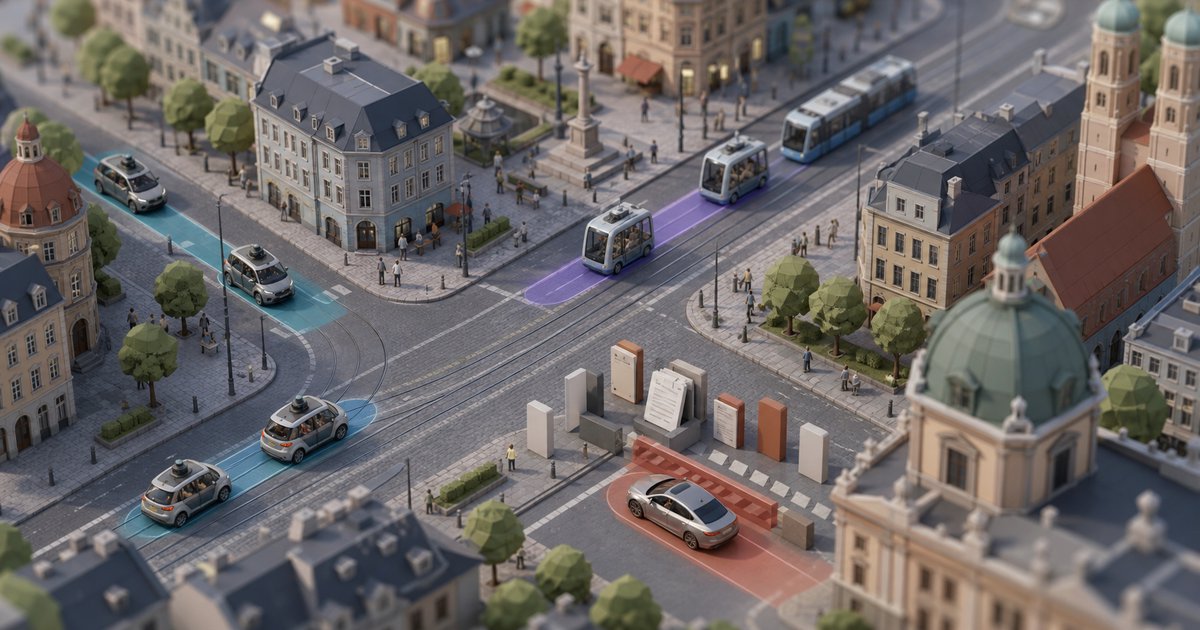
Two separate announcements landed on the same morning, and together they describe something European drivers have not had to think about before: driverless taxis with dates attached.
Waymo has registered Waymo Germany GmbH in Munich and is preparing for service in 2027. Pony.ai and Uber are extending a partnership that already runs in Zagreb to more than 2,000 vehicles across five European cities. Neither company is Tesla, and that is the point worth sitting with.
What Waymo has actually put in place
Waymo's German preparations are further along than the company's public line suggests. The subsidiary was registered in Munich in May 2026. Fleet operator Transdev is recruiting test drivers in Berlin and Munich, and Waymo is hiring an autonomous-driving operations manager in Munich. Those contracts run a year, which points at mapping and validation work continuing into the second quarter of 2027.
Mapping drives could start late this year, using electric Jaguar I-Pace cars on the fifth-generation Waymo Driver. The commercial launch is expected to use the cheaper Gen6 system in vehicles such as the Hyundai Ioniq 5 and the Zeekr RT.
Waymo itself is playing the timing down. A spokesperson told Automobilwoche that a claim from the Federal Transport Ministry — that the company would shortly be carrying customers in two German cities — was unzutreffend, inaccurate. Read alongside the hiring, that reads less as a denial of the programme than as a correction of its schedule.
What Pony.ai and Uber are building
The partnership is structured to scale faster than a single operator could, splitting the work three ways.
| Element | Who provides it |
|---|---|
| Level 4 autonomous driving | Pony.ai |
| Booking, payment, support | Uber |
| Financing, fleet ownership, operations | Local partners (Verne in Zagreb) |
Zagreb has been running since spring 2026. Four further European cities are planned but not yet named, alongside Middle East deployments. Pony.ai separately runs a Luxembourg pilot using the Peugeot e-Traveller. The companies are explicit that expansion depends on the regulatory position in each market as much as on the technology.
The gap this opens with Tesla
Here is why any of this belongs on a Tesla site. Waymo and Pony.ai are scheduling Level 4 operation in European cities — no driver, the company carries the responsibility. Tesla's European product is a different thing entirely.
FSD (Supervised) is a Level 2 driver-assistance system. The driver remains legally in control and responsible throughout. The Dutch RDW approved it on 10 April 2026 under UN Regulation 171, after 18 months of testing, 1.6 million kilometres of European road data and more than 400 compliance requirements — the first such approval in Europe, and a genuine achievement. As of early August it has full national customer approval in five countries: the Netherlands, Lithuania, Estonia, Denmark and Belgium.
Extending that across the bloc is the unresolved part. Answering written questions on 30 July 2026, the RDW said there is no original internal timeline for EU-wide type approval, described the process as exceptional and complex, and noted that progress depends partly on manufacturer input. The file has gone to the European Commission and member states under the formal Article 39 procedure, where discussions continue.
What it means for owners
For a Tesla owner in Germany, the practical picture in 2027 could be a Waymo carrying passengers with nobody at the wheel in Munich, while their own car — with FSD purchased — still requires hands and attention, if the feature is available to them at all.
That is not a technical verdict on FSD. The systems solve different problems: Waymo operates a mapped, geofenced fleet it controls, while Tesla sells a system meant to work anywhere a customer drives — the harder regulatory case as well as the harder engineering one. But it is a competitive fact. On current schedules the first driverless ride most Europeans take will not be in a Tesla, and the approval calendar rather than the software is what decides that.