
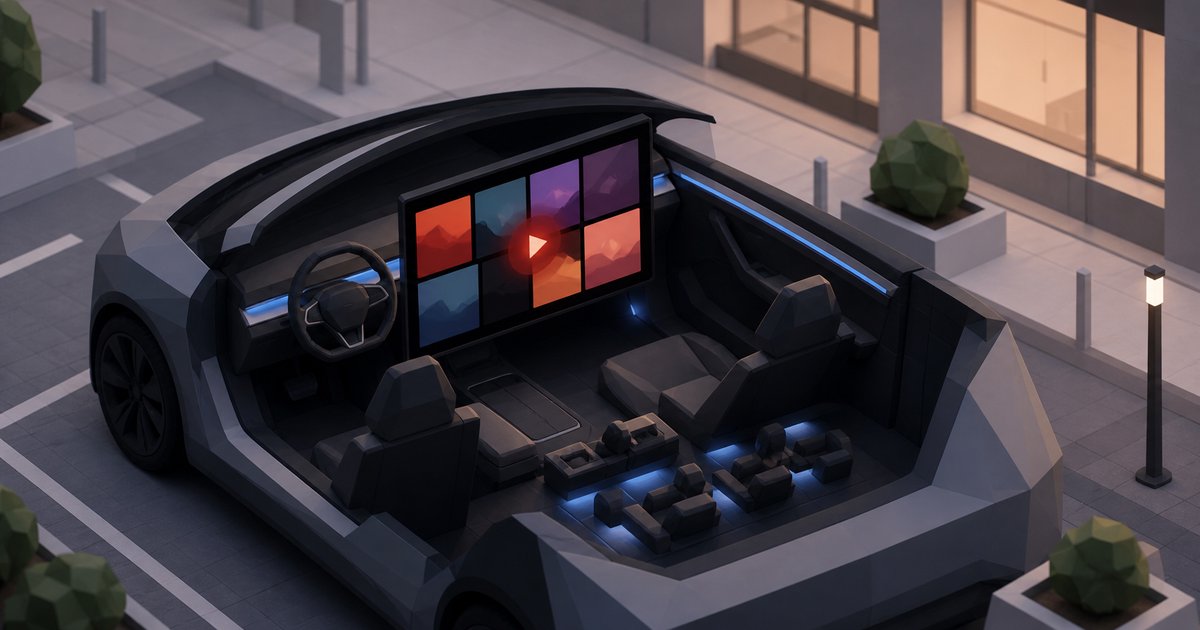
Tesla appears to have widened Tesla Theater without announcing it. Since 22 August 2026, several streaming sites that previously loaded as ordinary web pages now open directly in the chromeless full-screen window Theater uses — no address bar, no browser furniture around the picture.
The change was first spotted by a Tesla owner on X, who posted a screenshot of Apple TV opening as though it were a built-in app. Not a Tesla App then tested a range of services and found the behaviour applied broadly.
Which services now open in Theater
| Newly recognised | Already in Theater |
|---|---|
| HBO Max, Paramount+, Peacock, Apple TV, Disney+, Plex, Prime Video (via the amazonprime.com domain) | Netflix, Hulu, YouTube, Twitch, TikTok |
What this is, and what it is not
It is worth being precise about the mechanism, because the word "app" will get used for this and it would be wrong.
Tesla Theater has never run native applications. It loads a streaming service's website in a browser with the controls stripped away, which is why the result feels like an app while the underlying thing is a web page. What changed is which domains Tesla's software recognises as belonging in that stripped-down window.
The distinction has practical consequences. A browser-based service depends on the site's own web player, so playback quality, subtitle handling and offline support are set by the streaming provider rather than by Tesla. It also means Tesla can extend the list server-side, without a firmware release. No version number has been attached to this change, and none of the outlets covering it identified one — which is consistent with a server-side switch rather than an over-the-air update.
What European owners actually get
The list reads better in Europe than a quick glance suggests, but not uniformly. Disney+, Apple TV, Prime Video and HBO Max operate across most European markets, so those four are the substantive additions here. Peacock and Hulu remain US-only services, and Plex is only as useful as the media library you point it at.
Two constraints are unchanged. Theater runs only with the car in Park, and streaming needs either Wi-Fi or an active Premium Connectivity subscription — which is where the practical value sits, because the realistic use is a Supercharger stop rather than a driveway. Owners of a Model S or Model X can send the picture to the rear display; on the Model 3 and Model Y it is the main touchscreen or nothing.
Treat it as unannounced
Tesla has published nothing about this, which is why we are filing it as a rumour rather than a release. The evidence is a user's screenshot plus hands-on testing by two independent outlets, and that is strong evidence for a behaviour any owner can verify in their own car in about a minute.
It is not a commitment, though. A server-side list can be shortened as quietly as it was extended, and a service that works this week may stop working without an announcement — the same way this arrived. Licensing is the usual reason such lists move.
If it holds, it is a real quality-of-life gain for the part of ownership that consists of sitting in a parked car waiting for electrons.