
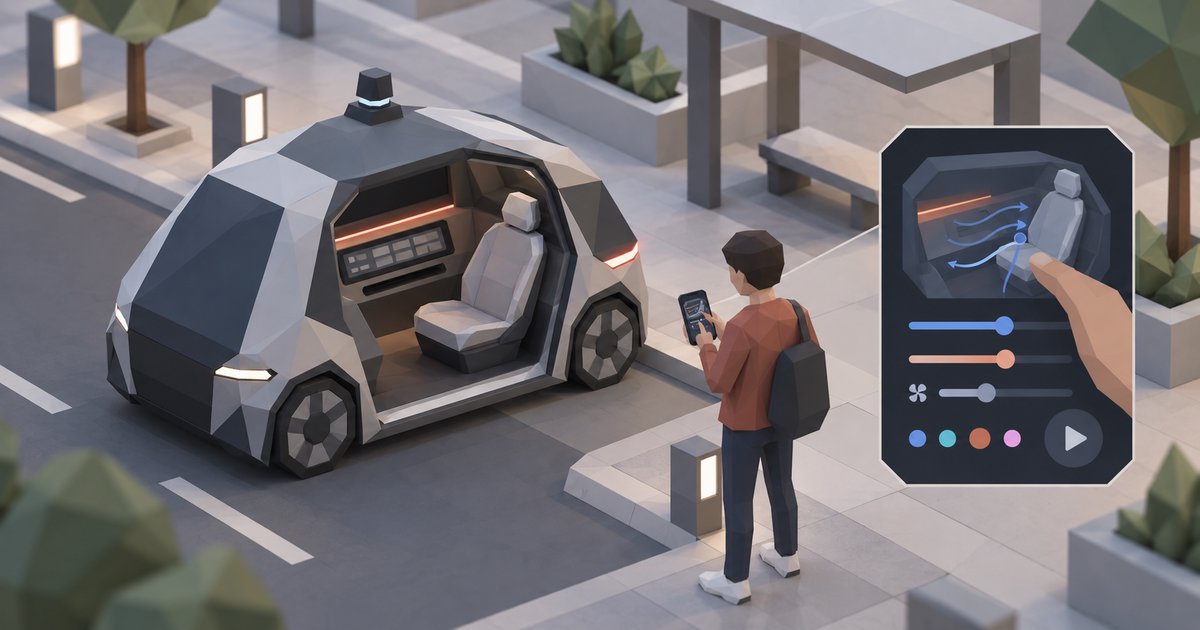
The most advanced passenger interface Tesla ships is not in the Tesla app. It is in the separate Robotaxi app, and the gap between the two is now wide enough to be worth listing.
Not a Tesla App catalogued the difference on 15 September 2026, after a set of features appeared in the Robotaxi app earlier in the month as Tesla prepares for Cybercab rides. None of them is in the mainline Tesla app that owners use for their own cars.
What the Robotaxi app can do that yours cannot
| Feature | What it does |
|---|---|
| Vent airflow control | A 3D cabin view; drag a finger across the screen to aim the air vents |
| Seat position | Sliders to move the seat fore and aft and recline the backrest |
| Ambient accent lighting | A colour palette for the interior accent lights |
| YouTube | Browse and scroll video in-app, then cast to the 22-inch display |
| Grok | A dedicated tap-to-talk button for the assistant |
| Music | Spotify and Apple Music integration |
The vent control is the one that stands out, because it is a software answer to a hardware question. Tesla deleted the physical air vents years ago in favour of a continuous slot aimed from the touchscreen; doing the same from a phone, on a car you have just stepped into, is the logical end of that decision. The seat sliders follow the same logic: a rider has no seat controls to reach for, so the phone becomes the control surface.
Why the newest features land here first
A robotaxi passenger has no steering wheel, no stalks and — in the Cybercab — no driver-side controls at all. Every comfort adjustment a driver would make by hand has to exist somewhere else, and the phone is the only surface a rider brings with them. Tesla has been building toward this for months: the Cybercab's own screen already moves the car with on-screen buttons, and the Robotaxi app started asking riders which vehicle they wanted on 3 September.
That makes the Robotaxi app Tesla's testbed for in-car control from a phone, with a small, geofenced user base and a low cost of getting it wrong. The mainline Tesla app, by contrast, has tens of millions of users and controls cars that people are driving.
What is confirmed and what is not
The features are confirmed — they are in the shipping app and have been demonstrated publicly. What is not confirmed is any plan to bring them to the Tesla app. Tesla has made no statement about merging the two, and the suggestion that it will is an inference from the code being written once, not something the company has said.
There is a reason to be sceptical about a straight port. Aiming a vent or reclining a seat from a phone is useful when you are a passenger about to be collected. In your own car, on your own driveway, most of it is a solution looking for a problem — the exceptions being pre-conditioning cases, where setting the airflow direction before you get in has obvious value on a cold morning.
For European owners
Nothing here is available in Europe. The Robotaxi app is tied to Tesla's US ride-hailing service, there is no European robotaxi operation to use it with, and FSD (Supervised) approval in the EU is still pending. What the feature list does tell a European owner is where Tesla's app development effort is going, and which controls are likely to reach the Tesla app if and when the company decides they belong there.
The practical read for now: if a future Tesla app update lets you aim the vents from your phone, this is where that code was written.