
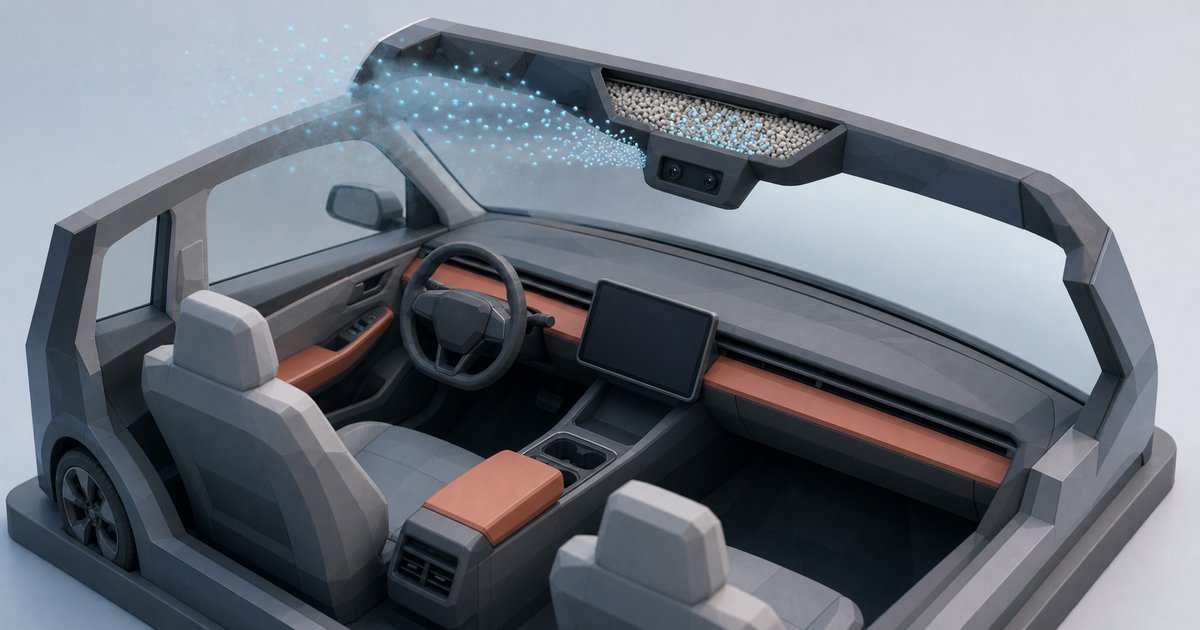
If you have ever cleaned the outside of your windshield, got back in, and still been told the cameras cannot see, the problem was probably on the other side of the glass. A newly surfaced Tesla patent goes after the cause rather than the symptom.
What the haze actually is
The plastics, adhesives and foams inside a car keep releasing volatile and semi-volatile organic compounds long after assembly — off-gassing, the source of new-car smell. In a closed cabin those compounds condense on the coolest large surface available, which is the inside of the windshield.
The result is a thin, even film: easy to miss on glass you look through, hard to miss on a camera that looks through it, because the forward cameras sit in a housing pressed against that exact patch. Owners who have chased it down report the same discovery — cleaning it properly means pulling the rearview mirror and camera housing off to reach the glass underneath, and it recurs.
What the patent proposes
Rather than removing the film after it forms, Tesla proposes stopping the compounds before they reach the glass — by making the parts nearest the cameras absorb their own emissions.
| Element | Detail in the filing |
|---|---|
| Base material | Polypropylene |
| Additive | Microporous crystalline aluminosilicate (zeolite-like) particles |
| Loading | roughly 70% by weight in some examples |
| Pore size | approximately 3 to 10 angstroms |
| Placement | built into the housing surrounding the front cameras |
The pore-size range is the clever part: different compounds have different molecular sizes, so the filing describes mixing pore sizes to trap several classes rather than tuning for one. This is not a coating or a serviceable filter — it is the housing itself, sized to keep absorbing across the years the surrounding plastics keep off-gassing.
Why it matters more now than it used to
Tesla removed radar and ultrasonic sensors and runs on cameras alone, so a degraded forward camera is not a weaker input to a sensor mix — it is the input. When visibility falls below threshold, Autopilot and FSD become unavailable: the feature disappears in traffic for a reason the driver cannot see.
It matters more still for a driverless car. Nobody rides in a Cybercab to notice the film, or to pull a mirror housing off and wipe it.
Why European owners see it more
Condensation needs a cold surface and a warm, damp cabin, and northern Europe supplies both for much of the year. That is why the film gets noticed in autumn and winter rather than in July, and why owners blame the weather rather than the interior.
A European Model 3 or Model Y runs the same camera-only stack, so the consequence is not cosmetic: a visibility warning takes Autopilot away on the motorway commute, in the season a driver most wants it, with no radar to fall back on. No cabin-air setting prevents it, because the source is inside the car.
Until something like this ships, the workable habit is to clean the inside of the windshield — the strip in front of the mirror housing especially — as normal upkeep, and not to read a camera-obstruction message as dirt on the outside.
The usual caveat
This is a patent, not a product. Tesla patents a great deal it never builds, the filing describes examples rather than a committed specification, and nothing here has been announced for any vehicle or model year.
What the document does confirm is that Tesla has characterised the problem precisely — down to the chemistry and the geometry — and treats interior windshield haze as an engineering defect in a camera-only system rather than an owner's cleaning chore.