
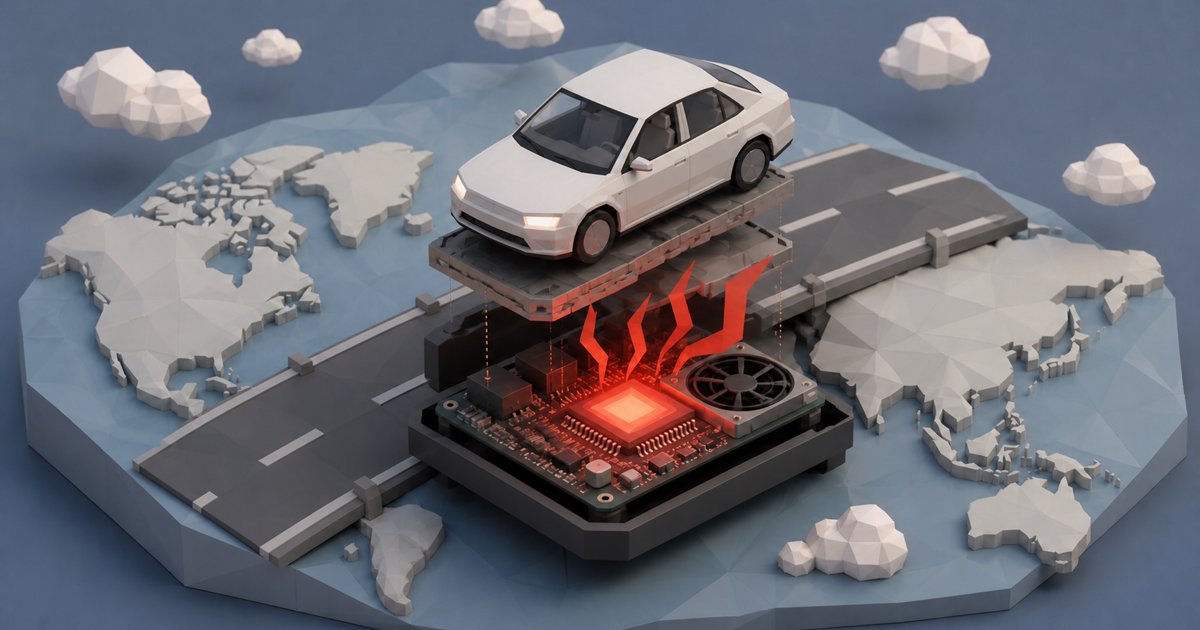
Tesla owners running older Hardware 3 cars are reporting that their Autopilot computer is running hot enough to fault out — and in a number of cases, hot enough to die. The reports have accumulated since Tesla widened the FSD v14 Lite release to HW3 vehicles in July, and Tesla has not commented publicly on a link.
What owners are seeing
The HW3 Autopilot computer is specified to operate between 0 °C and 90 °C. Once the board crosses 90 °C, it raises a thermal fault — owners have posted service-mode screenshots showing an APP_w141_ECU_Thermal_Issue code — and some have measured board temperatures of 96 °C to 99 °C.
From the driver's seat the failure presents in a familiar sequence:
- The steering-wheel red hands warning appears.
- FSD force-disengages mid-drive.
- The car enters a self-driving-unavailable state and refuses to re-enable until the computer cools.
That is the recoverable case. The more serious reports describe the computer shutting down entirely and not coming back — owners say Tesla Service has told them the unit needs replacing.
Why v14 Lite is the suspected trigger
v14 Lite exists because HW3 cannot run the full v14 stack. The chip is several generations old and carries roughly 15% of the memory bandwidth of an HW4 board. Even the cut-down model is substantially heavier than the v12 software HW3 shipped with, so the silicon works harder for longer stretches, and heat is the direct consequence.
The timing is what owners point to. Complaints track the widening rollout rather than a particular firmware branch or climate, and they come from drivers who saw no thermal warnings on v12. That is circumstantial — a correlation across owner reports, not a Tesla engineering statement — and it is worth being explicit that no root cause has been confirmed by the company.
What it means for HW3 owners in Europe
European HW3 cars are in an awkward position. FSD (Supervised) is only legal in five EU countries, so most owners here run Autopilot rather than the full stack — which limits, but does not eliminate, exposure to the heavier v14 Lite model shipped in the same firmware.
The bigger issue is what this says about the platform's remaining runway. Tesla sold FSD to HW3 owners on a promise of eventual capability, and it still has no firm plan for how those cars get there. A retrofit has been discussed for years without a committed programme. If the cut-down build that was supposed to bridge the gap is instead cooking the computer, the practical answer for HW3 owners narrows to a hardware swap Tesla has not committed to funding.
For now the mitigation is unsatisfying: owners seeing repeated thermal faults are logging service visits, and a replacement board is the only fix on offer once a unit has failed. Anyone on HW3 who has taken v14 Lite and is seeing red hands on warm days should document the fault codes in service mode before booking — several owners report that the evidence is what moved the conversation forward.
Update: 2026-08-14
On 8–9 August 2026 Tesla began a limited rollout of FSD v14.1 Lite to HW3 cars, carried in firmware 2026.21.6 — the same branch as v14.3.7 on newer hardware, after Tesla merged the two. The company has published no changelog distinguishing v14.1 Lite from v14 Lite; the release notes are identical, and Tesla has still made no public statement linking either build to the thermal faults described above. What owners are reading is the sequence: a new build for the affected hardware arriving days after the overheating reports accumulated. Whether it actually lowers board temperatures is not established, and Tesla is holding the release limited while it gathers data. Anyone on HW3 seeing repeated thermal faults should keep documenting the fault codes.