
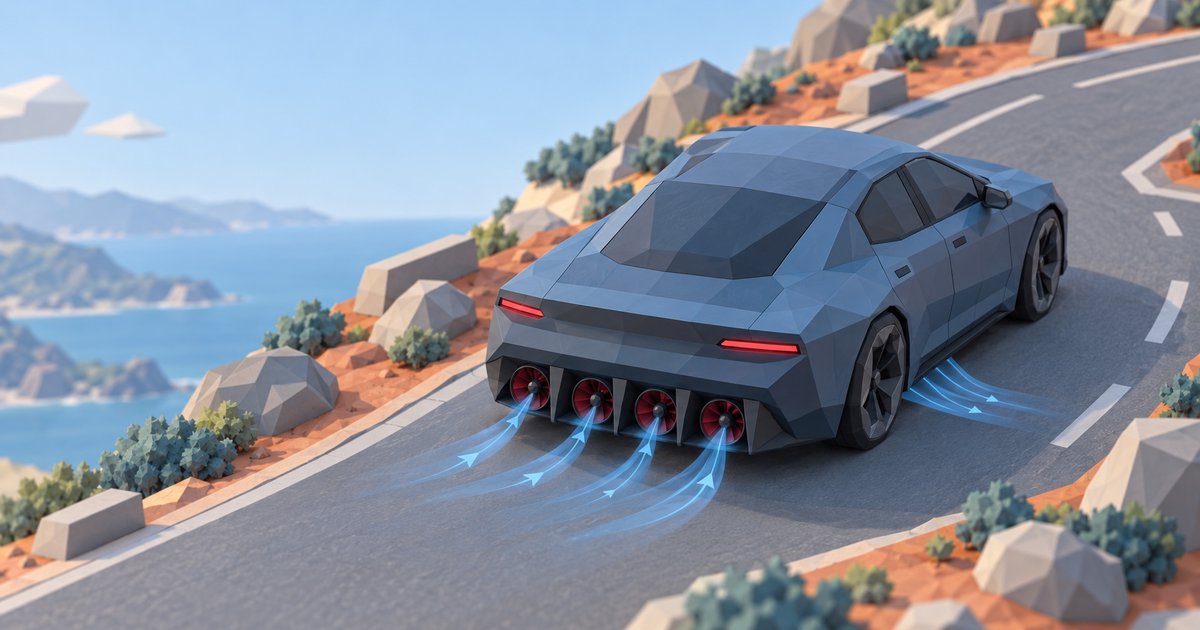
The US Patent and Trademark Office granted Tesla a patent on 29 September 2026 titled "Electric Fan Car". It describes four electrically driven ducted fans in a car's rear diffuser, pulling air out from under the floor to pin the car to the road. The drawings show a Model S — a car Tesla stopped building in April — and the grant lands about two weeks before the Roadster reveal.
Why fans instead of a wing
Every conventional aerodynamic device needs airflow, which means it needs speed. Downforce rises roughly with the square of velocity, so a wing that presses a car down hard on a straight does close to nothing in a slow corner.
The patent removes that dependency. Air enters through an inlet in the underbody, passes through internal ducts, and is expelled through a larger rear outlet that doubles as a diffuser. Four fans, separated by strakes and driven by the high-voltage battery, set the flow rate. Because the fans do the pulling rather than the car's motion, the low-pressure zone under the floor exists whenever they are spinning.
| Detail | |
|---|---|
| Patent | US 12,746,987 B1, granted 29 September 2026 |
| Fans | Four electric ducted fans in the rear diffuser, separated by strakes |
| Airflow path | Underbody inlet, internal ducts, enlarged rear outlet |
| Power source | Vehicle high-voltage battery |
| Downforce | Independent of vehicle speed |
| Vehicle in drawings | Model S |
A second version adds two smaller side inlets behind the main one, solving a specific problem: a single central inlet can start drawing air forward from behind the car instead of from under the floor, cancelling the effect the system exists to create.
The idea is old and kept getting banned. Chaparral ran the fan-driven 2J in Can-Am in 1970; Brabham's BT46B won the 1978 Swedish Grand Prix and was withdrawn straight afterwards. In both cases the objection was competitive, not technical — the cars worked.
This is not the wing patent
Four days before this grant, TeslAnt covered a Tesla filing describing an active rear wing worth up to 700 kg of downforce. They are separate documents describing opposite solutions to the same problem.
| Rear wing | Fan car | |
|---|---|---|
| Status | Published application, 24 September | Granted patent, 29 September |
| Mechanism | Two-element deployable wing | Four ducted fans under the floor |
| Downforce from | Airflow over the wing | Air extracted from beneath the car |
| Speed dependence | Yes; the filing cites above 160 km/h | None |
Electrek notes this is Tesla's second fan-car patent in just over a year, so the approach has survived at least one iteration inside the company.
Why this is filed under rumours
A granted patent is better evidence than a leak — an examiner has agreed the claims are novel. It is still not a product. Tesla does not name a vehicle, commit to a specification, or promise any of it reaches a showroom, and the car in the drawings left production five months ago. The inference that this points at the Roadster comes from the timing, not from anything Tesla has said.
What Europe gets, so far
Nothing announced. Roadster reservations reopened in the United States and Canada only, the reveal is in Texas, and there is no European pricing, allocation or timing.
There is also a type-approval question the patent raises on its own. A device that actively generates downforce is not a passive aerodynamic part, and EU whole-vehicle approval has no settled category for one that can fail with the car at speed. Ground-effect fans also move air and debris rearward, which is the kind of thing UN regulations tend to notice. None of that is a barrier today, because there is no car — it is a reason not to assume a feature shown in Texas would arrive here unchanged.
What to watch on 15 October
If the Roadster's rear deck is clean and something rises out of it, the rear-wing filing is the relevant one. If the diffuser has ducts in it, this is. And if Tesla demonstrates downforce at a standstill, only this patent explains how.