
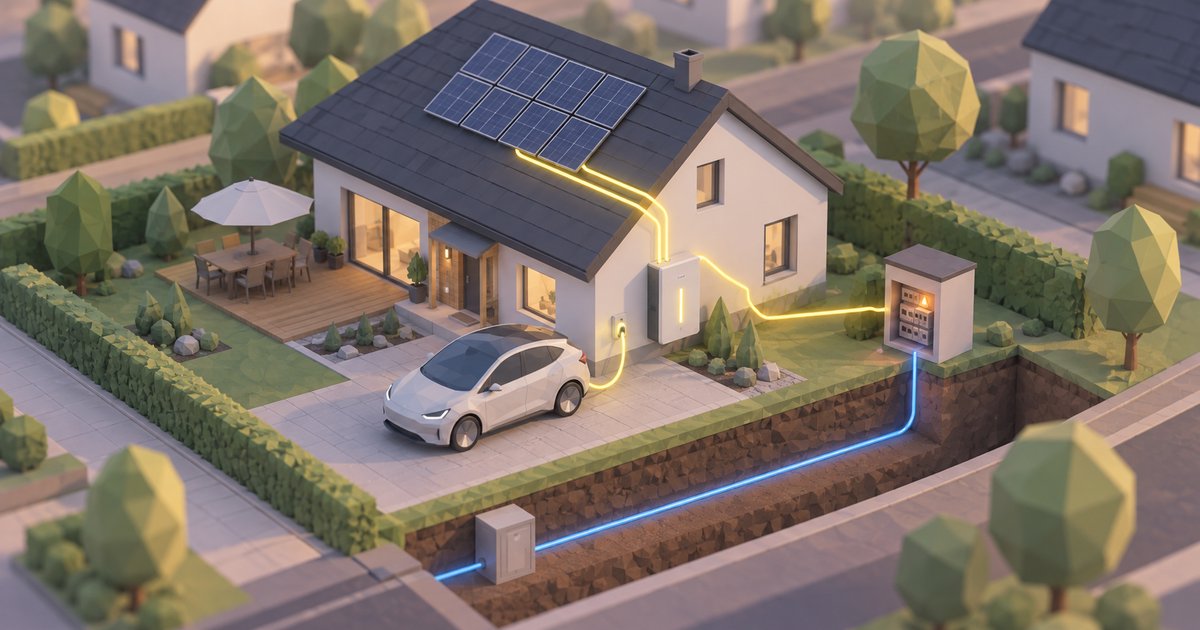
Charge on Solar has one persistent weakness: it can leave you short. The feature waits for surplus solar and charges the car with it, which is exactly what you want in June and exactly what strands you in February. Strings found in Tesla's latest app build suggest Tesla is about to give it a floor.
What was found
A decompile of Tesla app 4.60.5, released on 4 September 2026, surfaced an unreleased Charge on Solar setting described as a minimum commute floor. The behaviour it points to: when solar output falls short, the car pulls just enough grid power to meet a daily driving target, then reverts to waiting on excess solar for anything above that.
Two related energy strings turned up in the same build:
- Third-party smart breakers — smarter behaviour during a grid outage, for hardware Tesla did not make.
- Staged V2H overload warnings — graduated alerts when a Powershare vehicle is backing up a house that also has a Powerwall, rather than a single failure state.
The same decompile carried non-energy items too: the sv_transport_robotaxi string behind Robotaxi rides offered in place of service loaners, a wheel-cover toggle for the 3D visualiser, and wheel strings for the long-wheelbase Model Y L.
Why a floor matters
Today Charge on Solar is deliberately passive. It requires a Powerwall alongside the solar array, holds off until there is at least 1.2 kW of stable surplus, and then trims the car's charge rate roughly every ten seconds to track what the house is not using. Backup reserve is served first; the car only sees what is genuinely left over. Owners set a minimum and maximum charge level, and Tesla recommends Self-Powered mode to get the most out of it.
That design is sound and it is why people turn the feature off in winter. A system that will not touch the grid cannot promise you a state of charge, so an owner facing a fixed commute either disables Charge on Solar or babysits it. A commute floor changes the contract: solar first, grid only to the extent needed to make tomorrow work.
Who this lands on in Europe
Charge on Solar is a Powerwall feature, and it has been live in Europe for some time — the UK, Germany, Italy, Portugal, Spain and Switzerland among them. Those are markets with high domestic solar penetration and, increasingly, feed-in terms that make self-consumption the better economic choice.
That is what makes the floor more than a convenience. Where exporting surplus pays poorly, the incentive is to put every kilowatt-hour into the car or the wall battery — and the reason not to is the risk of waking up without enough range. Germany is the sharpest case, where TeslAnt has covered a draft EEG 2027 clause that would cap what small solar can feed back at the grid connection.
The V2H strings sit in the same picture. Powershare has been appearing in app decompiles for a while — 4.60.0 carried code for Cybertruck Powershare alongside Powerwall — and staged overload warnings are what you build when you expect real houses to be running off a car for long enough to hit a limit.
What Tesla has said
Nothing. These are strings in a shipped app that the shipped app does not use. Two outlets working from the same decompile agree on what the strings describe, but there is no announcement, no timeline, no market list and no guarantee any of it ships. Read it as a direction of travel, not a feature you can plan around.