
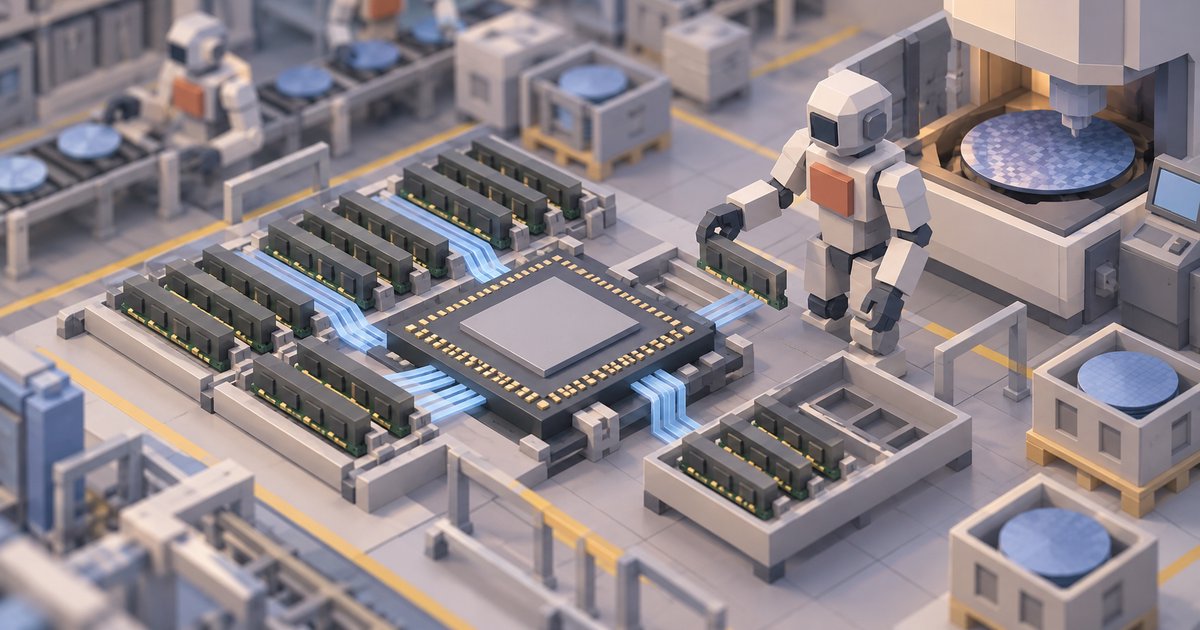
Tesla is cutting the memory on its next two generations of AI chip, and the reason is not the cars. It is Optimus — and a memory market that has become the binding constraint on building humanoid robots in volume.
Elon Musk set out the change this week, then revised part of it within the same news cycle. Both numbers matter, because the first one is the figure that circulated fastest.
What actually changed
| Chip | Original spec | First announced cut | Where it landed |
|---|---|---|---|
| AI5 | 144 GB LPDDR5 | 72 GB, a 50% cut | 96 GB LPDDR5 |
| AI6 | 216 GB LP6 | 144 GB, a 33% cut | 144 GB LP6, unchanged |
The AI5 reduction was announced as a halving. Musk then nudged it back up, and gave a notably practical reason for doing so: Tesla would otherwise have been "the only company using the min RAM version of LP5" — a position nobody wants to occupy with a supplier, because it means carrying the cost of a part configuration no one else is buying.
Anyone who saw the 72 GB figure quoted on its own was looking at a plan that had already been changed.
Why a robot programme is setting chip specs
The stated purpose is scale. Memory is in a prolonged supply crunch, and Musk's argument is that trimming per-unit capacity is the only way to get enough parts to mass-produce Optimus, while cutting cost per chip at the same time.
On the performance question Musk's claim is that the effect should be "negligible", because memory bandwidth rather than total capacity is the limiting factor for the workload. That is a defensible engineering position and it is also unverifiable from outside: no third party has benchmarked an AI5 at either configuration, and Tesla has published no figures behind the claim. Treat it as the company's view, not as a result.
This is not your car's chip
The detail that keeps this from being a story about vehicles is one Tesla established months ago: AI5 is aimed primarily at Optimus and training infrastructure rather than at cars. Vehicles continue on AI4. A Tesla being delivered this quarter is unaffected by any of this, and so is a car already on the road.
It does, however, say something about how the hardware roadmap is being prioritised. AI5 only entered trial production at Samsung's Taylor fab in September; its specification is being revised while the first wafers are being run, and it is being revised in the direction the robot programme needs. Owners still waiting on a clear answer about what happens to HW3 cars can reasonably read that as a statement of where the silicon is going.
What a European owner should take from it
Nothing about your car changes, and no FSD capability in Europe depends on AI5. What changes is the context around Tesla's next retrofit or upgrade conversation: the company is trimming memory on unreleased chips to protect robot volumes, during a shortage it does not control. That is the environment any future hardware upgrade offer would be priced in.