
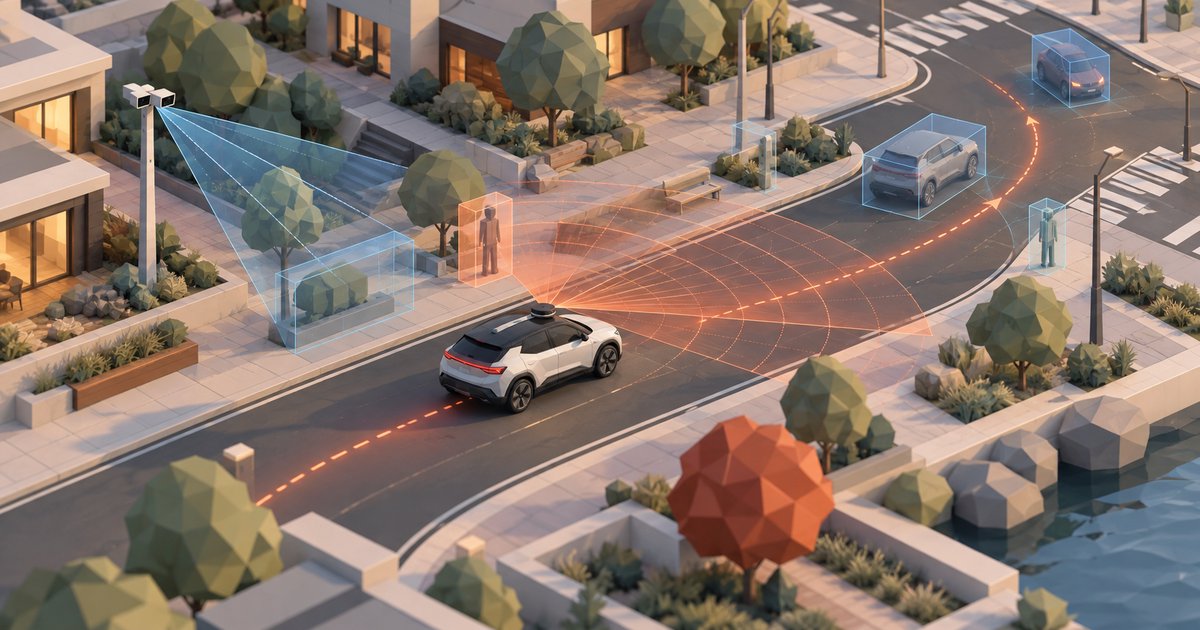
Rivian's investor relations chief told a conference room of analysts on Tuesday that the sensor Tesla spent a decade arguing against now costs his company a few hundred dollars per car. That single number does more damage to the case for camera-only driving than any demo does.
Who said what, and where
Chip Newcom, Rivian's VP of investor relations, and James Philbin, its SVP of autonomy and AI, spoke at Evercore ISI's 9th Annual ADAS, AV & AI Forum in New York on 30 September 2026. Newcom's framing was that lidar used to cost thousands or tens of thousands of dollars per unit and now costs a few hundred.
Why the price is the argument
Tesla removed radar, then ultrasonic sensors, and has run vision-only since. The public reasoning has had two strands: that a system good enough to drive on cameras makes the extra sensor redundant, and that lidar was too expensive to put on a mass-market car. Elon Musk made the second point bluntly at Tesla's 2019 Autonomy Day, calling lidar a fool's errand.
The redundancy argument is a question about engineering, and it is still open. The cost argument is a question about a bill of materials, and a bill of materials moves. If a competitor is fitting lidar for the price of a set of tyres, the cheapness defence of camera-only stops being a defence and becomes a preference.
What Rivian actually committed to
| Item | Timing |
|---|---|
| Point-to-point autonomy, early adopters | End of 2026 |
| Point-to-point autonomy, wider fleet | Later in 2027 |
| R2 with lidar + RAP1, employees | Late 2026 |
| R2 with lidar + RAP1, paying customers | 2027 |
| Uber robotaxi service target | Late 2028 |
Philbin called the year-end point-to-point rollout "on track", with caveats attached: it goes to early adopters first, it runs on Gen 2 R1 and later hardware, and the launch version has operational limits — parking lots are excluded. That is a hands-off highway-and-road feature, not a car that finishes the journey for you.
The RAP1 computer behind it is rated at 1,600 sparse INT8 TOPS and pairs with the lidar on R2. On the Uber deal, a second 250 million dollar tranche is expected in the fourth quarter of 2026, with an order for 10,000 vehicles conditional on reaching Level 4 and revenue coming from usage-linked software licensing.
The part that slipped
Buying an R2 with lidar this year is off the table. Employees get those cars in late 2026; customers wait until 2027. Measured against Rivian's earlier communication, that is a delay, and it is worth holding against the year-end autonomy promise sitting next to it.
What a European reader should take from this
Nothing you can buy. Rivian sells no cars in Europe, the point-to-point feature is a North American rollout, and anything approaching hands-off driving here runs into the same approval machinery that has kept FSD waiting on a European vote now scheduled for December.
What is worth watching is the sensor question, because Europe is where it gets decided by regulators rather than by preference. Approval authorities ask what a system can perceive and how it degrades, and a cheap redundant sensor is an easier answer than a confident one. Tesla's bet is that it will not need that answer. Rivian has just made declining to give it look more like a choice than a constraint.