
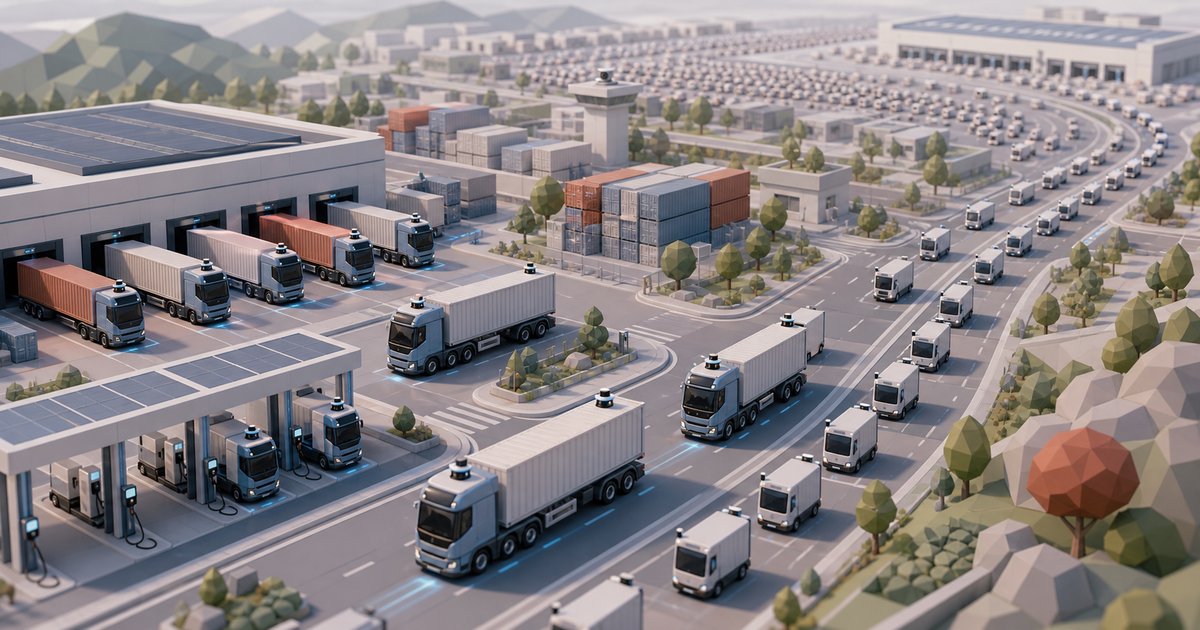
Chinese autonomy company Pony.ai has set out a deployment plan for self-driving electric trucks that runs to six figures: between 500 and 1,000 fourth-generation heavy trucks on the road by 2027, and 100,000 lighter Level 4 autonomous trucks by 2030, built with truck manufacturer SANY.
Targets that far out are cheap to announce. What makes this one worth reading is the fleet that already exists underneath it.
The trucks are already working
More than 200 Gen-4 trucks have been operating since November 2025, and they have moved enough freight to have a meaningful operating record — over 685 million short-ton-miles by the company's count. Pony.ai reported more than $10 million of revenue from the truck business in the first quarter of 2026 alone, up about 30% year on year.
That is the distinction between this and most autonomy roadmaps. The trucks are not in a pilot; they are carrying paid loads on long-haul, bulk-commodity and port-logistics routes across China, with a separate line of autonomous truck development running in the Middle East since 2018.
Cost is what unlocked the scale-up
The fourth-generation hardware is reported to have cut the cost of the autonomous driving stack by roughly 70% against the previous generation. That is the number that turns a demonstration fleet into a production plan — at Gen-3 economics, 100,000 units would not be a business.
The vehicles are expected to be based on SANY's e263 4×2 electric tractor, a specification that has not been confirmed in detail by either company. If it holds, the platform brings a dual-motor electric drive axle rated at 420 kW continuous, a 636 kWh LFP battery pack and an 800V architecture.
| Milestone | Target |
|---|---|
| Gen-4 heavy trucks on the road | 500–1,000 by 2027 |
| Light-duty L4 trucks | 100,000 by 2030 |
| Fleet operating today | 200+ since November 2025 |
| Freight moved to date | 685m+ short-ton-miles |
| Q1 2026 truck revenue | $10m+, up ~30% year on year |
What it means for Europe
Nothing in the announcement points at Europe. There is no European deployment, no European partner and no timeline that includes the continent — and the regulatory route for driverless heavy vehicles on European roads barely exists yet, which is a far larger obstacle than the technology.
The relevance is competitive rather than immediate. Autonomous electric freight is the segment where the economics work first: fixed routes, professional operators, high utilisation and a driver cost that autonomy removes directly rather than indirectly. It is also the segment where European manufacturers have invested in electrification while treating autonomy as a later problem — a sequencing choice that looks different once a competitor is running paid autonomous freight at scale.
For readers watching Tesla specifically, the contrast is instructive. The Tesla Semi remains a driver-operated electric truck with volume production repeatedly pushed back, while its autonomy effort is concentrated on passenger cars and robotaxis. Pony.ai is approaching the same intersection of electrification and autonomy from the freight side, and is getting there with vehicles that are already earning revenue.
Whether 100,000 trucks by 2030 arrives on schedule is a separate question, and the honest answer is that autonomy targets of this shape have a poor record. The 2027 figure of up to 1,000 trucks is the one to judge it by.