
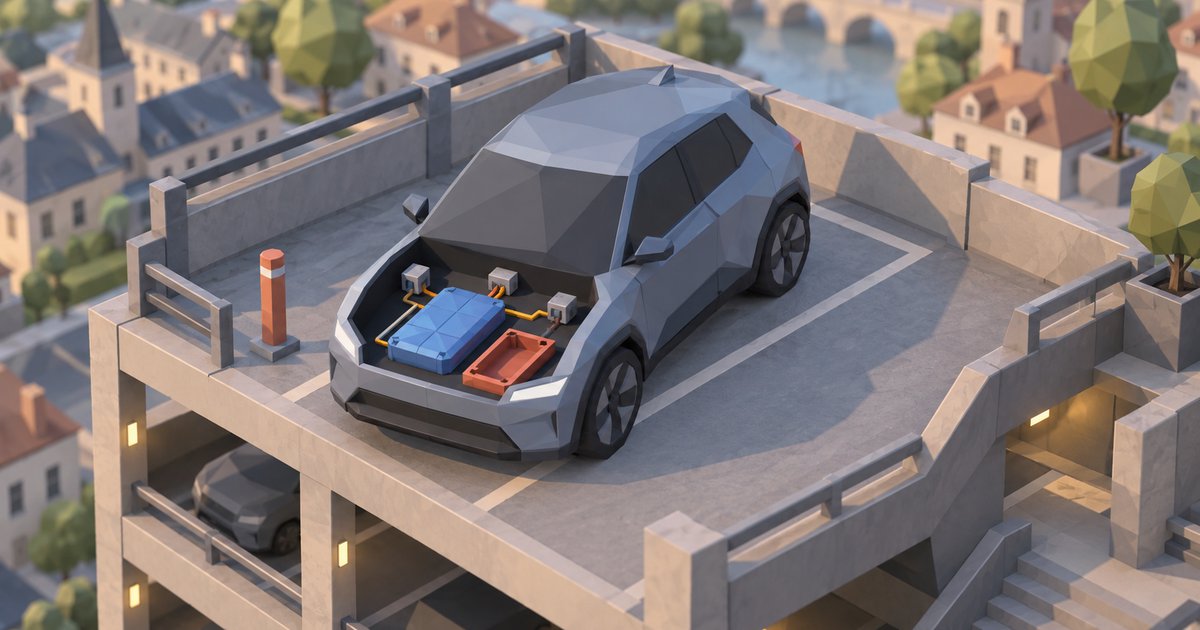
Every electric car on sale, Teslas included, carries a second small battery that has nothing to do with driving range. It runs the lights, the locks, the computers and the contactors that connect the traction pack. It is also, by a wide margin, the single most common reason a car stops working.
Leapmotor says its next generation will not have one.
What the ADAC data actually says
The ADAC breakdown statistics published on 23 April 2026, covering 2025 across 158 models from 27 manufacturers, attribute 45.4% of all callouts to the starter battery — by some distance the most frequent cause of any kind.
That is not a combustion-car problem electric cars escaped. Electric cars carry their own separate low-voltage battery for the same jobs, and when it dies the car is immobile whether or not the traction pack is full. The same statistics do show electric cars breaking down considerably less often than combustion cars at every age, with roughly 40% fewer callouts at five years old. The low-voltage battery follows them anyway.
What Leapmotor announced
At its Tech Day on 16 September 2026, Leapmotor showed the CTC 3.0 High-Low Fusion Battery. Instead of a separate lead-acid unit, high- and low-voltage functions share the same cells, modules, thermal management and energy distribution. The company claims a sevenfold increase in low-voltage capacity over the previous generation, output matching a conventional 12-volt battery, and maintenance-free operation for the life of the car.
Its headline claim is that these will be the first road-going vehicles in more than 70 years to run without a conventional lead-acid auxiliary battery. Production models are due from 2027.
| Conventional layout | Leapmotor CTC 3.0 | |
|---|---|---|
| Low-voltage supply | Separate 12 V battery | Shared with the traction pack |
| Cells | Its own, usually lead-acid | The same cells as the main pack |
| Servicing | Periodic replacement | Claimed maintenance-free for life |
| Low-voltage capacity | Baseline | Claimed 7x previous generation |
| In production | Today | From 2027 |
Alongside it the company showed LEAP 5.0, an architecture that merges the air-conditioning system with a rear-mounted powertrain: 19% more cabin length, 18% fewer parts, 30% less piping, 37.5% more front-row lateral legroom and 63.7% more interior height over a flat floor.
What it means for a Tesla owner in Europe
Tesla moved off lead-acid earlier than most. From around 2021 the Model 3 and Model Y switched to a compact lithium-ion low-voltage battery of roughly 15.5 volts, considerably longer-lived than the lead-acid unit it replaced and normally changed by Tesla rather than by the owner.
What Tesla did not do is delete the component. A Tesla still carries a separate low-voltage battery, and it can still leave a car dead in a car park — which is why Teslas appear in the ADAC figures alongside everything else. Leapmotor is proposing a category change rather than a better version of the same part.
That matters here rather than only in China, because Leapmotor sells in Europe through its distribution joint venture with Stellantis, and the ADAC statistics that make the case are European data about European cars. If the 2027 cars arrive and the claim holds, the comparison a European buyer makes will include a car with one fewer thing to fail — and the low-voltage battery is the thing that fails most.
The caveats
This is an announcement, not a product. The claims are Leapmotor's own, no independent testing exists, and the company published no voltage or current figures behind the sevenfold number.
A shared low-voltage supply also raises a redundancy question Leapmotor did not address publicly: what wakes the car if the traction pack is disconnected, isolated after a fault, or deeply discharged? A separate battery is a crude answer to that problem, but it is an answer. Until a car ships in 2027, the better one is a claim.