
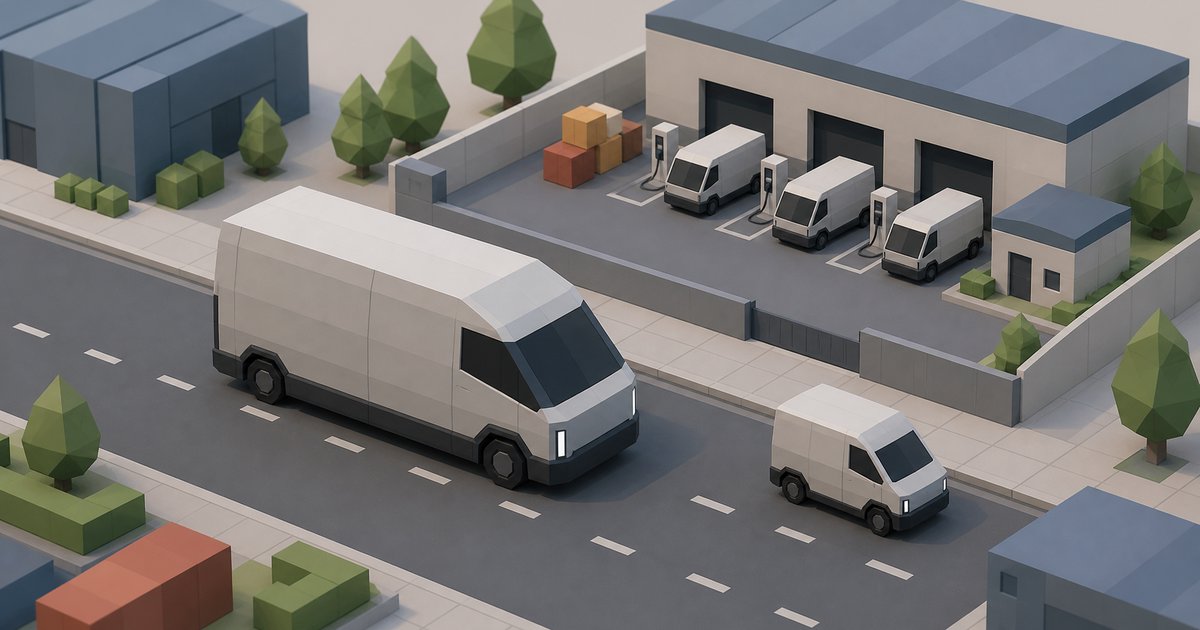
Kia's second electric van has been photographed on public roads with most of its camouflage stripped off. The PV7 is expected in 2027, and the new images are the clearest look yet at a vehicle Kia has so far shown only as a 2024 concept.
Nothing here is official. Kia has not confirmed a launch date, a battery, a range figure or a production site, and everything below that is not a concept dimension is inference from photographs.
It is a lot bigger than the PV5
The scale is the immediate takeaway. In one of the videos the prototype's wheelbase looks close to that of the car transporter carrying it — an unflattering comparison for anything calling itself a van.
The concept figures explain why. Against the PV5 Passenger, the PV7 concept shown at CES 2024 was larger in every dimension:
| Dimension | PV5 Passenger | PV7 Concept |
|---|---|---|
| Length | 4,695 mm | 5,270 mm |
| Width | 1,895 mm | 2,065 mm |
| Height | 1,915 mm | 2,120 mm |
| Wheelbase | 2,995 mm | 3,390 mm |
Almost 60 cm more length and nearly 40 cm more wheelbase puts the PV7 into a different competitive set — against the large end of the European electric van market rather than the compact end the PV5 occupies. Kia has said the PV7 offers the greatest interior space in its line-up, without quantifying it.
The prototype is expected to carry Hyundai Motor Group's Pleos infotainment and fleet software, as the PV5 does. That is a reasonable expectation rather than a confirmed specification.
The PV5 is why this matters in Europe
The PV7 would be a footnote if its smaller sibling had not worked. It did. The PV5 is the best-selling small electric van in Europe and the UK, and it now holds 37% of the segment — with shares above 50% in five separate markets:
| Market | PV5 share of small electric vans |
|---|---|
| Denmark | 63% |
| Ireland | 62% |
| Sweden | 59% |
| Finland | 58% |
| United Kingdom | 54% |
Those are commercial-fleet numbers, not enthusiast numbers. Fleet buyers pick on total cost of ownership, payload, service network and residuals, and once they standardise on a platform they tend to stay. A larger van on the same platform, with the same software and the same dealer relationships, is the natural next order.
What is still missing
The honest summary is that the interesting numbers do not exist yet. Payload, load volume, battery capacity, charging speed and range are the figures a fleet manager needs, and Kia has published none of them. Nor has it said whether the PV7 will be built alongside the PV5 at Hwaseong or elsewhere, which matters in Europe for tariff exposure and lead times.
Until Kia publishes, the PV7 is a large van-shaped object that is definitely coming and probably in 2027. That is worth knowing if you are planning a fleet cycle — and worth nothing at all if you are trying to compare it against a specific rival today.