
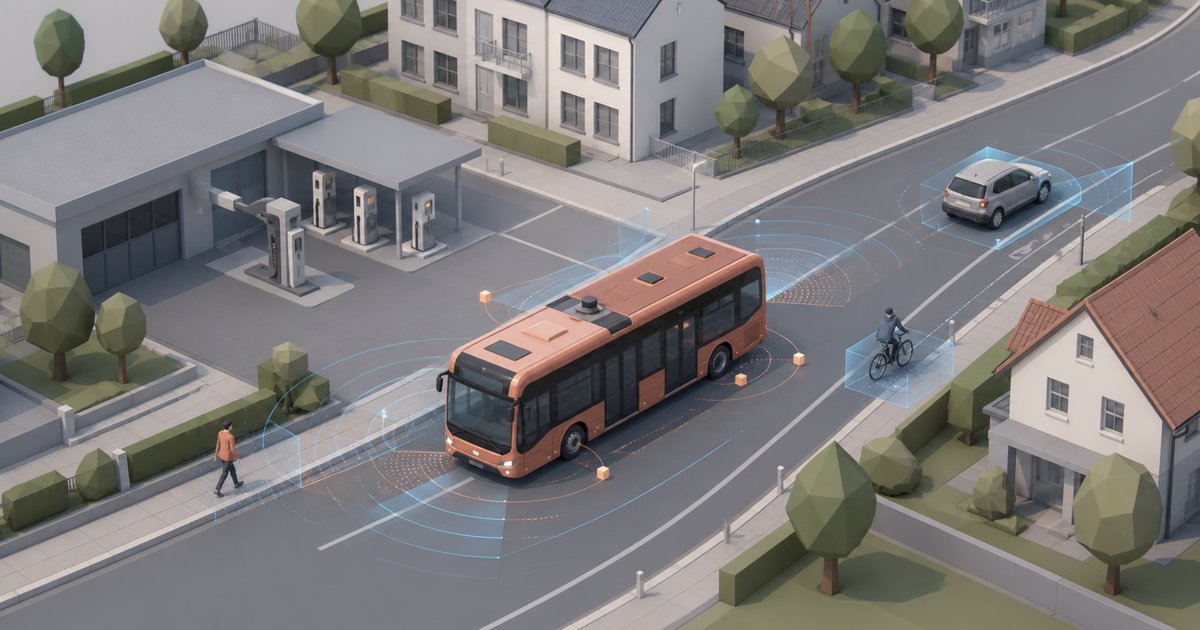
Autonomous driving software specialist Imagry and Spanish bus manufacturer UNVI have announced a partnership to build self-driving electric buses, with the first jointly developed vehicle — a 10.3-metre electric bus — due to enter operation in Germany during the third quarter of 2026.
A map-free approach
The technically interesting part is what the bus does not carry. Imagry's system is HD-map-free: instead of navigating against a centimetre-accurate pre-built map of the route, it perceives and plans from what its sensors see in the moment, in the way a human driver reads an unfamiliar street.
That distinction matters for buses more than for robotaxis. HD maps are expensive to build and, more importantly, expensive to keep current. A bus route that runs through months of roadworks, temporary diversions or a resurfaced junction is exactly the case where a pre-mapped system needs re-surveying before it can be trusted again. A map-free stack is meant to absorb that change without a survey vehicle going out first.
Imagry supplies the full autonomy stack — perception, motion planning and vehicle control — while UNVI contributes the vehicle. The companies say integrating the two took less than three months, which is fast for a road vehicle programme and suggests the bus platform was designed with the interfaces already in place.
Built for European approval
The bus is being prepared for European Whole Vehicle Type Approval in compliance with GSR2, the EU's General Safety Regulation. This is the part European readers should pay attention to. Plenty of autonomous shuttle projects have run on closed campuses or under one-off national exemptions, which proves the software works but produces a vehicle that cannot be sold across the bloc.
Building to WVTA and GSR2 from the start aims at a bus that is homologated as a product rather than permitted as an experiment. It is a slower route, and a considerably more useful one if the goal is fleets rather than pilots.
What has not been said
The two companies have been notably quiet on specifics. They have not disclosed the battery capacity, range or charging performance of the bus. They have not named the German city or operator that will take the first vehicle. And they have not said whether it will run fully driverless from the start or begin with a safety driver on board — the single detail that most determines how significant the deployment actually is.
Until that is clarified, this is a credible programme with an unproven headline. UNVI has said it intends to extend the collaboration to other vehicle configurations, pointing at airports, universities and hospitals — the enclosed, repetitive, low-speed environments where autonomous shuttles have generally made their strongest case.
Why it matters
Autonomy in Europe has advanced faster in public transport than in private cars, and for a straightforward reason: a bus runs a fixed route at low speed under a professional operator, which is a far more tractable problem than a private car going anywhere its owner points it. It is also where the economics are clearest, given the driver shortages many European transport authorities are managing.
A type-approved autonomous electric bus entering service in Germany this quarter would be a real marker of where that path has reached — provided the deployment turns out to be as driverless as the announcement implies.