
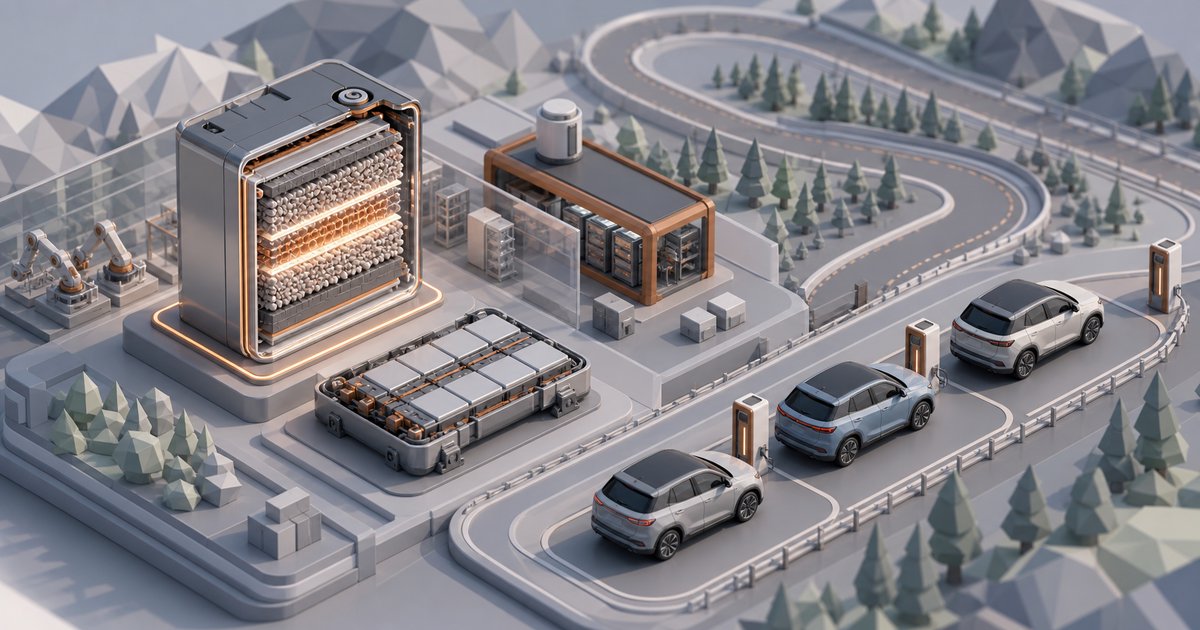
Geely says it will begin pilot deployment of solid-state batteries rated at 500 Wh/kg across its group brands in 2027, with real-world validation already under way this year. For scale, the group's current "Golden Brick" liquid-electrolyte cells sit at roughly 250 Wh/kg — so the claim is a doubling — and Geely puts the resulting range above 1,000 km, which it describes as comparable to a diesel.
The reason this belongs on a Tesla site is the list of badges in the queue. Geely Holding's brands include Volvo, Polestar, Lotus and smart alongside Geely, Zeekr, Lynk & Co, Proton and Farizon. Volvo and Polestar sell against Tesla in European showrooms today, with European dealers and European service networks already built. A cell that outranges a Tesla by a wide margin would not need years to find a route to a European driveway.
What Geely has claimed
| Claim | Figure |
|---|---|
| Energy density | up to 500 Wh/kg |
| Current group cells (Golden Brick) | ~250 Wh/kg |
| Range | over 1,000 km |
| Stated lifespan | up to 1,000,000 km (621,000 miles) |
| Real-world validation | under way, 2026 |
| Pilot deployment across brands | 2027 |
| Materials partner | Dow Chemical |
The Dow tie-up is the most concrete engineering detail released: an adhesive for solid-state cells that stays stable from −40 °C to 120 °C. Unglamorous, and precisely the sort of problem that decides whether a solid-state cell survives a winter in Trondheim.
The third 2027 claim in two weeks
This is now a pattern rather than a scoop. BYD's six solid-state patents showed where the hard problems sit, and CATL joined BYD in targeting 2027 for pilot production — where we made the case that 2030 is the realistic date for anything you could buy. Geely is the third Chinese group to put 2027 on the record inside a fortnight.
Three companies naming the same year is not three times the evidence. It is closer to an industry agreeing on which year is safe to name.
Why this one matters in Europe
Two things. The number is higher than anything BYD or CATL has put on the record, and the distribution is European. That combination is what makes it worth a Tesla owner's attention, where a Chinese-market-only cell would not be.
What to discount
"Pilot deployment" is not a sale, and Geely has not said whether mass production starts next year or whether any buyer will take delivery of one. It is also unclear whether 500 Wh/kg is a cell or a pack figure — read as a pack number it implies a cell density higher still, which would be remarkable enough to want independent confirmation before believing it. The million-kilometre lifespan is quoted without saying whether it means cycle life or total distance, and those are very different promises.
Set against that, Tesla's own cells are in the 250–300 Wh/kg range, and Tesla has made no comparable solid-state commitment. If Geely ships even half of what it has described, on the timeline it has described, the range conversation in Europe changes — and it changes first at Volvo and Polestar, not in China.