
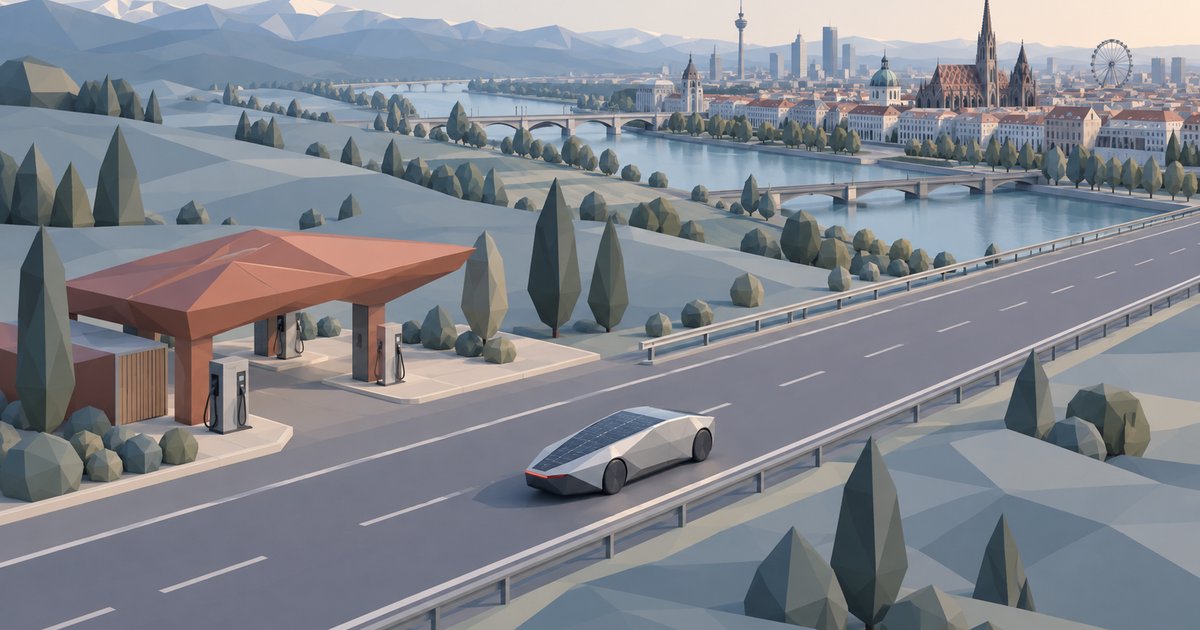
Volkswagen revealed the Mission Efficiency on 14 September 2026, a four-seat aerodynamic concept built on ID.Polo running gear, and backed the reveal with a documented long-distance run: 1,278.36 km from Wolfsburg to Vienna via Poznań and Olomouc, with a single charging stop.
The numbers
| VW Mission Efficiency | Mercedes Vision EQXX | Tesla Model S | |
|---|---|---|---|
| Drag coefficient | 0.158 | 0.17 | 0.208 |
| Consumption on the run | 6.89 kWh/100 km | 8.3 kWh/100 km | — |
| Distance achieved | 1,278 km, one recharge | 1,202 km, single charge | — |
| Usable battery | 54.9 kWh | about 100 kWh | — |
The 6.89 figure excludes charging losses; counting them it becomes 7.51 kWh/100 km. The car averaged 67.72 km/h over the route, touched 138 km/h, and arrived in Vienna with a claimed 164 km still in reserve. Volkswagen quotes a theoretical WLTP range near 654 km.
Where the drag went
0.158 undercuts the 0.189 of the XL1 diesel hybrid that Volkswagen is deliberately invoking, and the 0.17 of the Mercedes Vision EQXX that has held the efficiency-concept crown since 2022.
The shape does most of it. The car is 4.77 m long, sits roughly 14 cm lower than an ID.Polo and is about 7 cm narrower, and the body tapers hard towards the tail, where the rear track is narrowed by a further 17 cm. The wheels are covered, the underbody is completely flat, and active flaps close off cooling airflow when it is not needed. Roof-mounted solar panels add up to about 30 km a day in ideal conditions. At a steady 80 km/h, Volkswagen claims the result is roughly 30% more efficient than the ID.Polo it shares a motor and battery with.
What it is, and what it is not
It is a concept on the MEB+ platform with front-wheel drive, not a product. Volkswagen has announced no production version, no price and no date, and the run was a manufacturer-documented demonstration rather than a homologated figure.
The single-charge distance record also still belongs to Mercedes. The EQXX covered 1,202 km from Stuttgart to Silverstone without stopping; Volkswagen's longer total includes a recharge. What Volkswagen has taken is the efficiency itself — a lower drag coefficient and a lower consumption figure, achieved with a battery a little over half the size.
Why a Tesla owner should care
That last point is the one that matters. Tesla's range advantage has always rested on efficiency as much as pack size, and the Model S at 0.208 Cd was the aerodynamic benchmark for years. A 54.9 kWh car covering the distance that normally needs 80 to 100 kWh is an argument that the next increment of range comes from making the car need less, not from carrying more cells.
It is a concept, and concepts are cheap. What makes this one worth noting is that the motor and battery under it are production ID.Polo parts, not bespoke laboratory hardware, so the gap between the demonstration and a showroom car is aerodynamic work rather than a new drivetrain. That is the kind of gap that closes.