
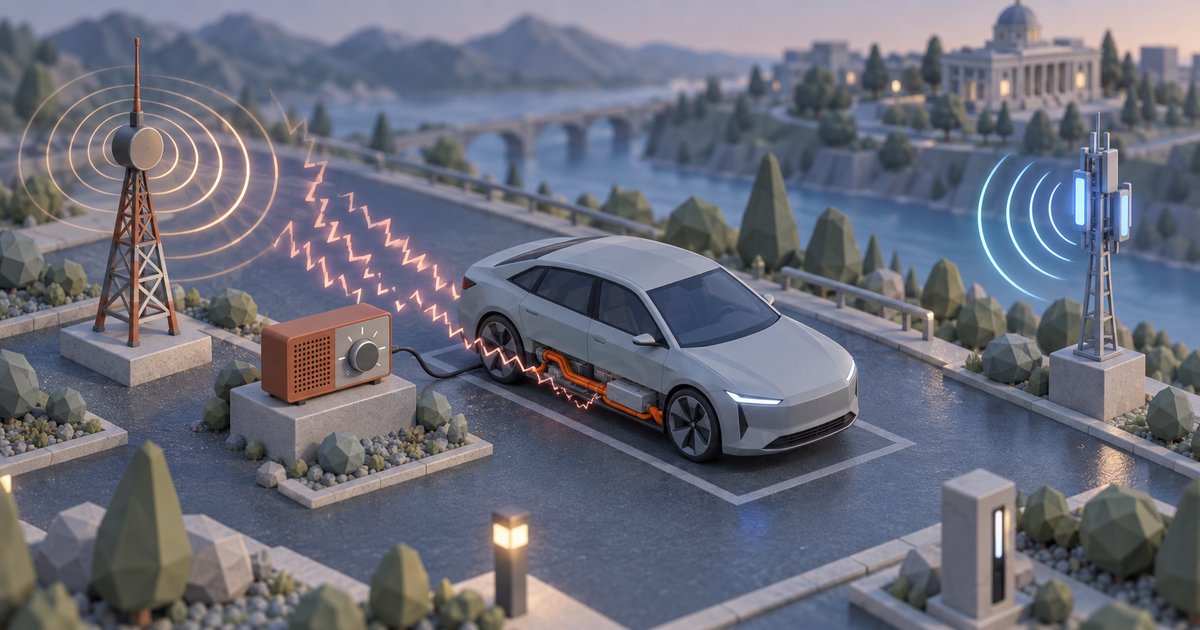
On 15 September 2026 the US House of Representatives passed the AM Radio for Every Vehicle Act, a bill that would direct the Department of Transportation to write a rule requiring AM radio as standard equipment in new passenger vehicles. It is a small piece of legislation with a direct bearing on how Tesla builds cars, because Tesla is one of the manufacturers that took AM out.
What the bill actually does
It does not itself mandate anything. It instructs regulators to issue a rule, and sets the clock that follows.
| Provision | Detail |
|---|---|
| Vote | Passed the House on 15 September 2026 |
| Mechanism | Directs the Department of Transportation to issue a rule |
| Large manufacturers | Comply within two years of the rule being issued |
| Small manufacturers | Four years, for those selling 40,000 vehicles or fewer in 2022 |
| Interim requirement | Clear disclosure to buyers when a vehicle lacks AM |
| Next step | The Senate, where an earlier version of the bill previously failed |
The bill was carried by Frank Pallone and Gus Bilirakis and was first championed by Josh Gottheimer. Its stated rationale is emergency communication: AM carries the national public warning system, and it keeps working when cellular networks and internet services do not.
Why electric cars are the subject
Carmakers have not removed AM out of indifference. The currents in an electric drivetrain generate broadband electromagnetic noise that falls squarely across the AM band, and suppressing it means shielding, filtering and careful cable routing rather than a software fix. Tesla, Volkswagen, Volvo and BMW have all dropped the band from electric models; Tesla went further than most and left both AM and FM out of its entry-level cars.
The cost of undoing that is contested. A study funded by the industry, from the Center for Automotive Research, put the figure at $3.8 billion to mitigate interference between electric powertrains and AM reception across the fleet. Treat that number as an advocacy figure from a party with an interest in the outcome, not as a neutral estimate — but the underlying engineering problem is real, and it is the reason the band disappeared in the first place.
Europe decided the same question differently
This is where the story stops being purely American. The European Union has already legislated on what a new car's radio must receive, and it chose the opposite technology.
Article 113 and Annex XI of the European Electronic Communications Code, Directive 2018/1972, require that any car radio integrated into a new category M vehicle placed on the EU market from 21 December 2020 must be able to receive and reproduce digital terrestrial radio. Europe made digital reception compulsory and said nothing about keeping analogue AM alive. The United States is now moving to make analogue AM compulsory and has no digital equivalent.
So a European Tesla and an American Tesla may end up diverging on a detail neither market thought was a regulatory matter a decade ago. Nothing here obliges Tesla to change a car sold in Germany or Norway, where AM broadcasting has in any case been wound down and DAB carries the traffic. But it is a reminder that "standard equipment" is increasingly a legal category rather than an engineering one, and the two blocs are not converging on what belongs in it.