
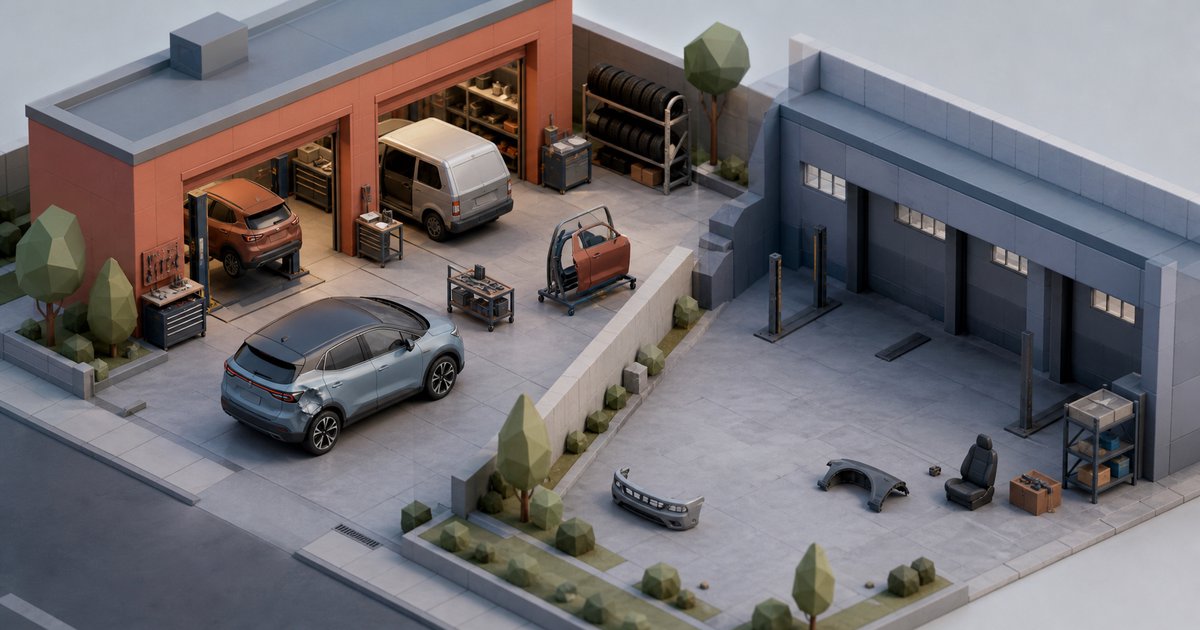
Univé, reported as one of the largest insurers in the Netherlands, has published a list of car brands it will not write a comprehensive policy for. Nine are refused outright; five more get third-party liability only. The reason is not the cars — it is what happens after a crash.
The list
| Univé's position | Brands |
|---|---|
| No new policies at all | Hongqi, Changan, Voyah, KGM, Leapmotor, VinFast, Jaecoo, MHero, Omoda |
| Third-party liability (WA) only | Dongfeng, Lucid, Firefly, NIO, Zeekr |
Read the second row again. Lucid is American. KGM is South Korean, the former SsangYong. VinFast is Vietnamese. The story is being carried almost everywhere as one about Chinese cars, and most of the names are Chinese — but the criterion plainly is not nationality.
What is actually being measured
Univé's test is whether a damaged car can be repaired predictably, and three things decide that: whether spare parts can be obtained, whether the maker publishes technical repair instructions, and whether enough body shops are equipped to do the work.
Where those are missing, a minor collision can leave a car immobile for months and produce a bill nobody could have estimated. That is an unpriceable risk, and an insurer that cannot price a risk declines it.
Univé has been explicit on two points: this is not a verdict on safety or build quality, and it is reversible — build out the parts chain and the repair network, and the cover returns.
Why Tesla is on neither list
Tesla arrived in Europe as an unknown brand with no dealer network, no independent repair trade and no parts distribution, and spent years building service centres, mobile service and a parts chain before the volume arrived. Czech coverage of the list makes the comparison directly, holding Tesla up as the recent entrant that got its service organisation in place relatively quickly.
That is the least glamorous part of Tesla's European story, and the part most easily skipped when a cheaper alternative appears on a price list. TeslAnt has covered Chinese brands taking a record share of the West European market; this is the friction on the other side of that number.
How far this reaches across Europe
One caveat matters: each insurer sets its own underwriting, so this is Univé's list, not a Dutch rule and certainly not a European one.
What is not confined to the Netherlands is the underlying problem: the same brands are expanding into the same European markets on the same timetable, importing the same thin parts supply and the same short list of qualified body shops. A Dutch insurer named it first; the arithmetic does not stop at the border.
The gap buyers do not know about
Research by MarketResponse, cited in the Dutch coverage, shows how little of this reaches the showroom:
| Dutch car buyers who… | Share |
|---|---|
| Weigh insurance cost and insurability when buying | 18% |
| Check parts availability | 12% |
| Did not know parts availability affects insurance cover | 56% |
Omoda and Jaecoo alone registered 2,328 new cars in the Netherlands in the first half of 2026 — close to 400 a month.
What to do with it
If you are weighing a Model 3 or Model Y against a cheaper rival from a brand that arrived recently, add one step before the test drive: ask your own insurer, by brand and model, what cover it will actually write.
A quote you cannot get is a cost, and it appears nowhere on the sticker.