
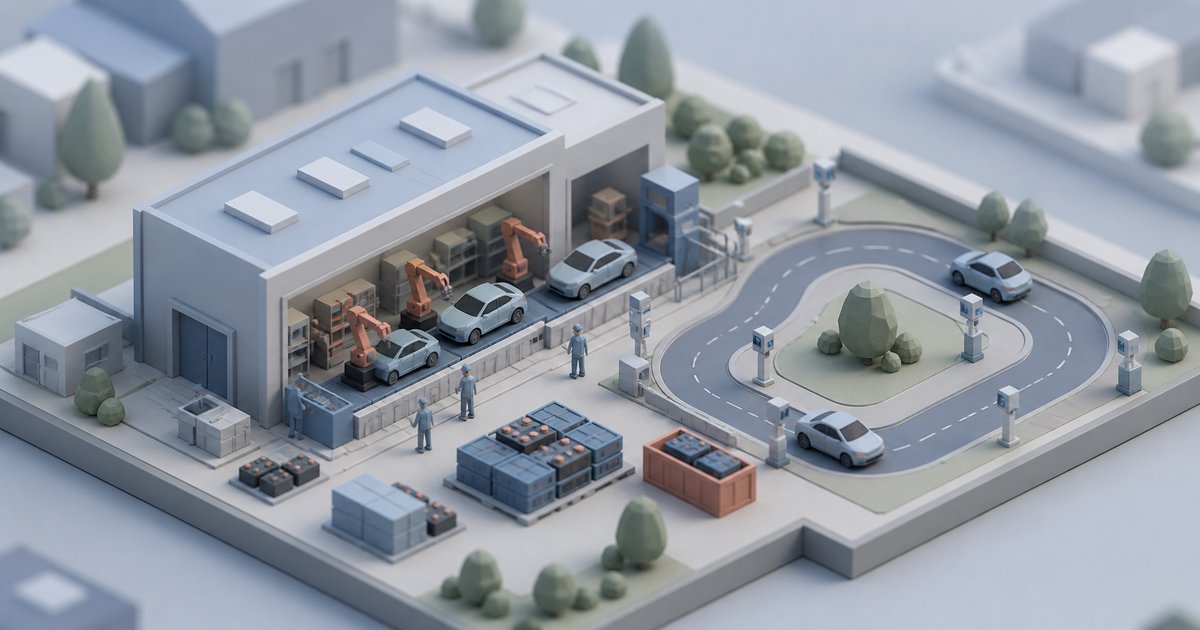
The British government and the country's carmakers are together putting £130 million into electric and autonomous vehicle production. The split is even: £65 million of public money matched by £65 million from industry. It arrives through Drive35, the programme that now carries state support for British automotive manufacturing, and it lands in a sector having its worst run in seven decades.
Where the money goes
Nissan and Bentley are the two named manufacturers in this round, alongside a set of automotive technology firms and supply-chain projects. A separate £17 million is earmarked for nine Connected and Automated Mobility projects — the self-driving half of the announcement. The government puts the number of jobs safeguarded at more than 1,800.
| Element | Amount |
|---|---|
| Government contribution | £65m |
| Industry contribution | £65m |
| Total | £130m |
| of which: 9 CAM (autonomy) projects | £17m |
| Jobs safeguarded | 1,800+ |
This follows £100 million awarded earlier through the Automotive Transformation Fund, itself part of a £2 billion programme. Drive35 is the successor vehicle for that support, and the pattern is consistent: public money conditional on industry putting in the same amount.
The backdrop is a 73-year low
The context matters more than the cheque. Britain built 764,715 vehicles in 2025, its lowest output in 73 years, and the first half of 2026 was down another 7.5%. TeslAnt covered the industry body's warning on that decline in the SMMT's half-year production figures. In the year to May 2026, the UK exported £27.2 billion of vehicles.
So £130 million is being pointed at a manufacturing base that is shrinking while it is being asked to retool. Industry Minister Blair McDougall MP framed it as reindustrialisation: "Britain invented the modern motor industry and we're determined to ensure the next generation of vehicles are designed and built here too. This investment will secure skilled jobs, strengthen our manufacturing heartlands and help drive the reindustrialisation of Britain."
What £130 million does and does not buy
For scale, a single battery gigafactory runs into the billions, and a new vehicle platform is a multi-billion commitment. Money at this level does not reverse a production decline on its own. What it does is keep specific plants and specific supplier lines alive through a transition — which is what "1,800 jobs safeguarded" is describing. The word is safeguarded, not created.
The autonomy share is the more forward-looking part. Nine CAM projects at £17 million is early-stage money, but it is aimed at the segment where Britain has a plausible position: software, sensing and systems integration rather than volume assembly.
Why European owners should care
Two reasons. The first is supply: Britain remains a significant EV and premium-EV producer for European markets, and what survives this period determines what is built in Europe rather than imported into it. The second is regulatory direction — a government funding connected and automated mobility projects is a government preparing to approve them. British EV demand itself is not the problem; the UK's electric share hit a record in July, as covered in the July ZEV mandate gap. The gap is between what Britain buys and what Britain builds, and this is an attempt to narrow it from the manufacturing side.