
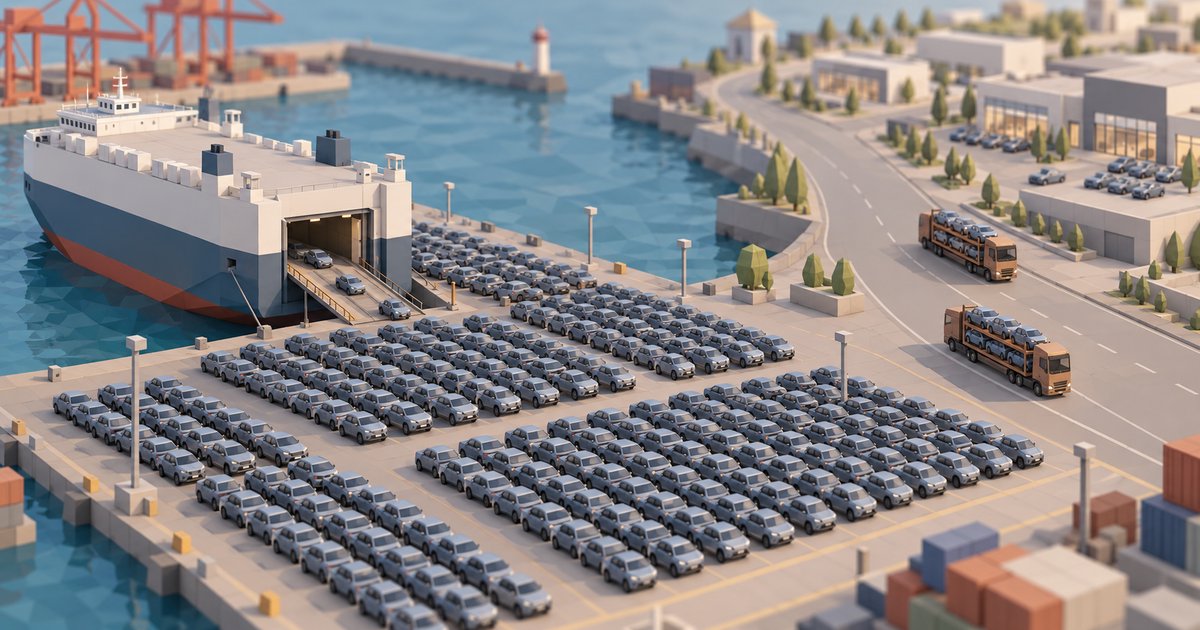
Chinese carmakers are landing roughly twice as many cars in Europe as are being registered, according to UBS — and the bank's reading is that the registration figures everyone is quoting understate what is already on the ground.
The gap
UBS analyst Patrick Hummel puts current Chinese export volumes to Europe at close to double actual new registrations. Sustained, that tempo corresponds to about 20 per cent annual market share. Chinese brands actually booked 9.9 per cent through August.
| Measure | 2026, January to August |
|---|---|
| Chinese-brand registrations | 913,703 |
| Share of the European new-car market | 9.9% |
| Same period a year earlier | 5.2% |
| MG Motor | 179,909 |
| BYD | 172,590 |
A scope check, because several different numbers circulate. The 9.9 per cent is a share of the whole new-car market, combustion cars included — 913,703 cars implies a total market of roughly 9.2 million, which is what Europe has registered so far this year. Shares quoted against battery-electric sales alone are considerably higher and are not the same measurement.
It also sits below the figure we reported a week ago, and it should. Dataforce put Chinese brands at a record 11.7 per cent in August alone, against 11.2 per cent in July and 5.5 per cent a year earlier. A cumulative running total drags on the weaker start to the year, so 9.9 per cent across eight months and 11.7 per cent in the eighth are the same trend measured two ways.
The same distinction reorders the brands. UBS has MG ahead of BYD on the eight-month count, while the monthly data had BYD passing MG during August. MG's lead is banked from earlier in the year; BYD's is the current run-rate.
Why the cars are not being registered
Hummel's explanation is unglamorous: trucks. Chinese manufacturers are struggling to secure enough road-transport capacity to move vehicles from European ports to dealers. The cars arrive, then sit.
That makes the gap a timing problem rather than a demand problem, and it is the reason UBS frames what follows as a registration surge rather than a forecast of new orders. The vehicles behind it have already been built and shipped.
His other point is political. "We are of the opinion that there remains a lack of urgency on the EU side," Hummel said — a judgement about Brussels, not a measurement, and worth reading as such.
Where Tesla sits in this
Tesla does not appear in the UBS note, so the comparison has to come from elsewhere. In the second quarter, Schmidt Automotive Research put Chinese brands at 10.7 per cent of Western European sales and Tesla at 2.6 per cent, with BYD ahead of Tesla at 2.8 per cent.
The two brands named in the UBS figures are the ones taking that ground. MG and BYD between them registered 352,499 cars in eight months — well over a third of the Chinese total, and both selling into the segments Tesla's European volume depends on.
What it means for a European Tesla buyer
Competitive pressure on price, and soon. A registration surge made of cars already sitting at European ports is inventory that has to move, and inventory that has to move gets discounted. Tesla's European share recovery this year was itself bought with price cuts, which makes it particularly exposed to a discounting round it did not start.
One caution on the headline number. The 20 per cent figure is a run-rate implied by shipping volumes, not a forecast UBS says will be realised — the same logistics bottleneck that created the gap also caps how quickly it can close. What is measured rather than projected is the 9.9 per cent, and the near-doubling from 5.2 per cent a year ago.