
The EU regulates car CO2 at the tailpipe. A battery-electric car counts as zero, whatever it took to build it and whatever is burned to charge it. A study published on 1 September by a research consortium at the Technical University of Munich (TUM) argues that this is the wrong place to measure, and that the error is large enough to be steering European industry in the wrong direction.
The researchers did not run a new model. They reviewed 19 previously published studies covering 47 modelled scenarios, which makes this a synthesis of the existing evidence rather than another entry in it.
What the numbers say
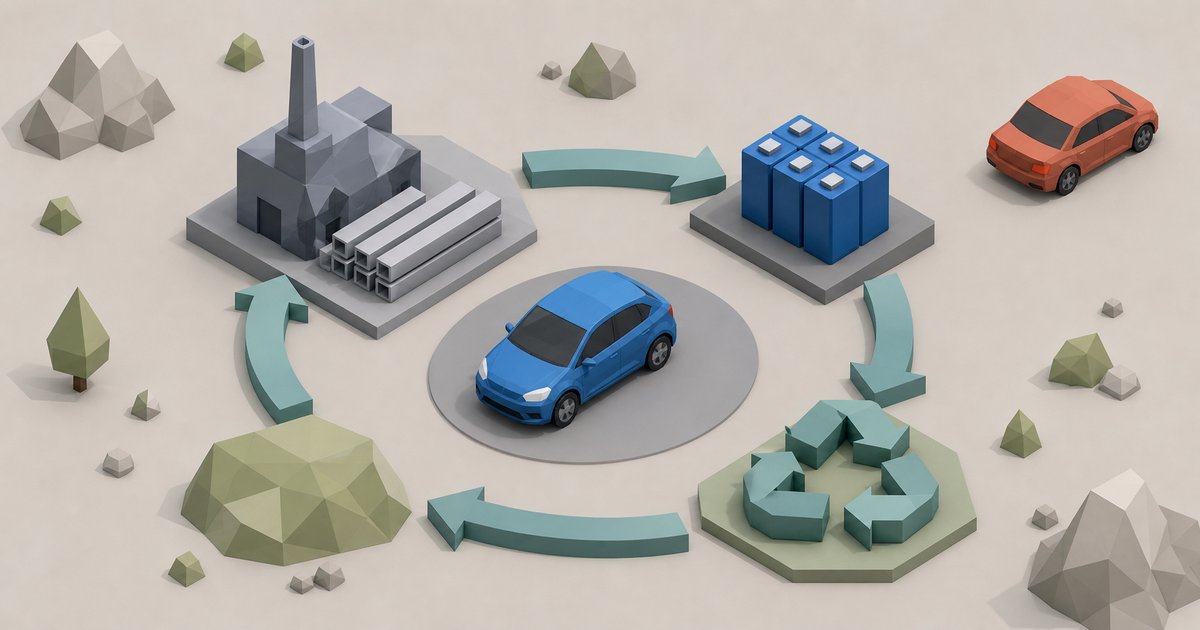
On the central question, the finding is straightforwardly favourable to electric cars. Across the scenarios examined, a battery-electric car emits 41% less CO2 on average than a comparable combustion car over its full lifecycle — production, energy supply, use and recycling included. EVs came out ahead in roughly 92% of the scenarios.
The spread is the interesting part. Depending on how the car is built, where the electricity comes from and what happens to the battery afterwards, results ranged from 89% lower to 21% higher than the combustion equivalent. An EV built on coal-heavy grid power with no recycling pathway can lose the argument outright.
That spread is invisible to current EU rules, and so is any effort to improve it. A manufacturer that decarbonises its steel, its cell production or its recycling gets no regulatory credit, because none of it happens at the tailpipe.
The policy argument
TUM calls the present approach a "substantial misdirection" of European climate policy, and proposes a lifecycle-based standard that recognises emissions cuts wherever they occur in the chain. It suggests starting with steel, as the most tractable first step.
The timing argument behind it is blunt. The researchers project that combustion cars will still make up around 78% of Europe's passenger car fleet in 2030. Fleet limits act only on new registrations, so the overwhelming majority of the cars actually on European roads at the end of this decade sit outside the instrument entirely.
Why this matters for Tesla
EU fleet CO2 limits are the frame Tesla's European business sits inside. They are why other manufacturers have paid Tesla to pool their fleet emissions with its own — revenue that exists purely because the rules count tailpipes and Tesla has none.
A lifecycle standard would change that calculation in both directions. Tesla would have to account for cell production, aluminium and steel, and for the grid mix where its cars are built and charged. It would also be able to claim credit for things it already does and currently gets nothing for: LFP chemistry with no nickel or cobalt, in-house cell production, and battery recycling at Gigafactory scale.
None of this is imminent. A study is not a proposal, and the European Commission has no lifecycle standard in draft. But the 2035 combustion phase-out is already being reopened politically, and lifecycle accounting is the argument most often used to reopen it — sometimes by people who want stronger climate rules, and sometimes by people who want the opposite. The TUM authors are clearly in the first group; the evidence they assembled will be quoted by both.