
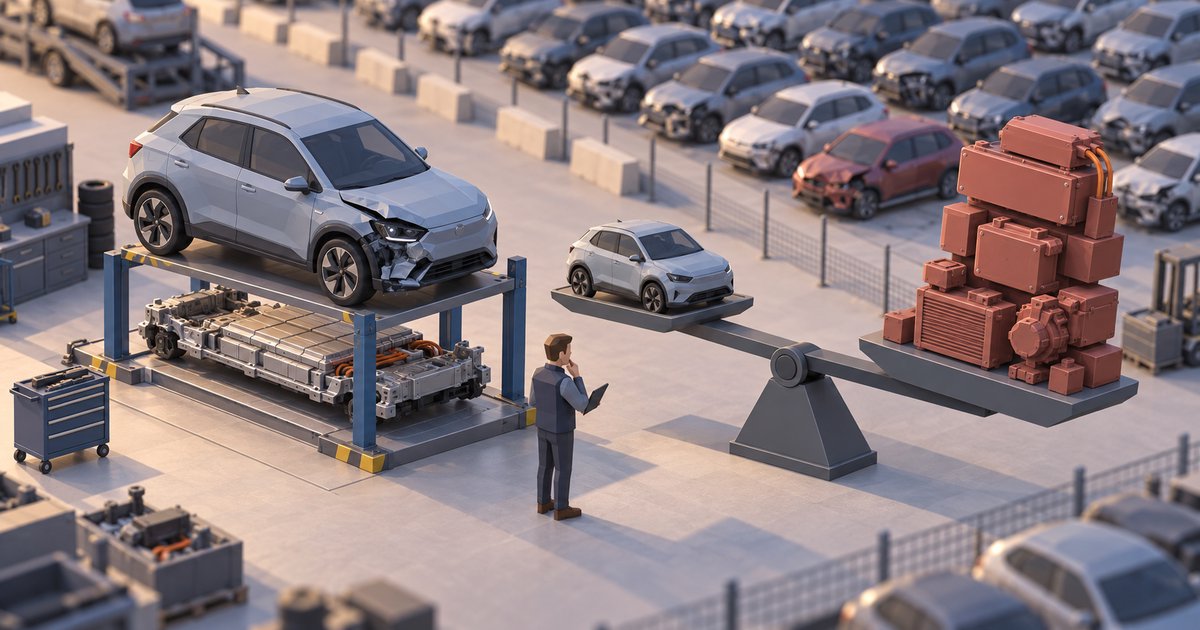
A vehicle-history vendor has put a number on something European insurers have circled for years: Teslas are written off more often than other cars of the same age. EpicVIN says nearly one in five Teslas passing through auction carries a salvage title — roughly twice the rate of the market it sampled.
The figures
EpicVIN says it analysed 273 million VINs across 338 models drawn from auction and sale listings. On its August 2026 cut, 13.7% of all vehicles in the study carried a salvage brand. Tesla sat between 18% and 19%, and held that rate across age groups.
| Model | Salvage-title rate |
|---|---|
| Tesla Model Y | 19.1% |
| Tesla Model 3 | 19.0% |
| Nissan Leaf | 9.5% |
| Hyundai Ioniq 5 | 2.4% |
| Every model in the study | 13.7% |
Age is what makes the gap awkward. The Teslas in the sample averaged 5.2 years old, and the study's salvage rate for cars aged five to eight years is 7.5%. Tesla is running at more than double that on a fleet that is, by the study's own measure, young.
What a salvage title is, and is not
A salvage brand is an insurer's arithmetic, not a verdict on the car. It is applied when the estimated repair cost crosses a set share of the vehicle's value. A car branded at that threshold may have been structurally destroyed or lightly dented; the brand does not distinguish, and it says nothing about reliability or how the car was driven.
That threshold is the mechanism doing the work here. Repair estimates on a Tesla cross it sooner because of how the car is built: large aluminium castings replace what used to be multi-part steel assemblies, and the pack is integrated into the floor, so damage that would be panel work on a conventional body becomes a structural repair. One 2022 Model Y with modest front-end damage carried a retail value near 61,000 dollars against an estimated repair bill above 50,000.
Two caveats worth stating plainly
EpicVIN sells vehicle history checks, so it has a commercial interest in buyers worrying about vehicle history. Read the number with that in mind.
The bigger limit is jurisdictional. "Salvage title" is a United States legal category with no European equivalent. Britain uses the Category S and N write-off markers, Germany records a Totalschaden and puts a disclosure duty on the seller of an Unfallwagen, the Netherlands has its WOK registration. The rate itself does not transfer across the Atlantic.
Why a European buyer should still care
The repair economics do transfer, because they are a property of the car rather than of the paperwork. The same castings and the same floor-integrated pack sit under a Model 3 or Model Y sold in Munich, and European insurers run the same calculation against a lower vehicle value.
What changes is visibility. An American buyer sees a branded title on the document. A European buyer of a repaired import, or of a car quietly settled between an owner and an insurer, may see nothing at all.
That gap is the argument behind the disclosure push already under way — the UK industry's proposed battery health certificate for every used EV, and France putting battery state of health onto used listings. Neither of those covers crash history, and on the evidence of this study crash history is where the money is.
The practical step for anyone buying a used Tesla in Europe is unchanged and unglamorous. Have the history checked in the country where the car was first registered, not the one where it is being sold, and treat an import with a clean local record as unverified rather than clean.