
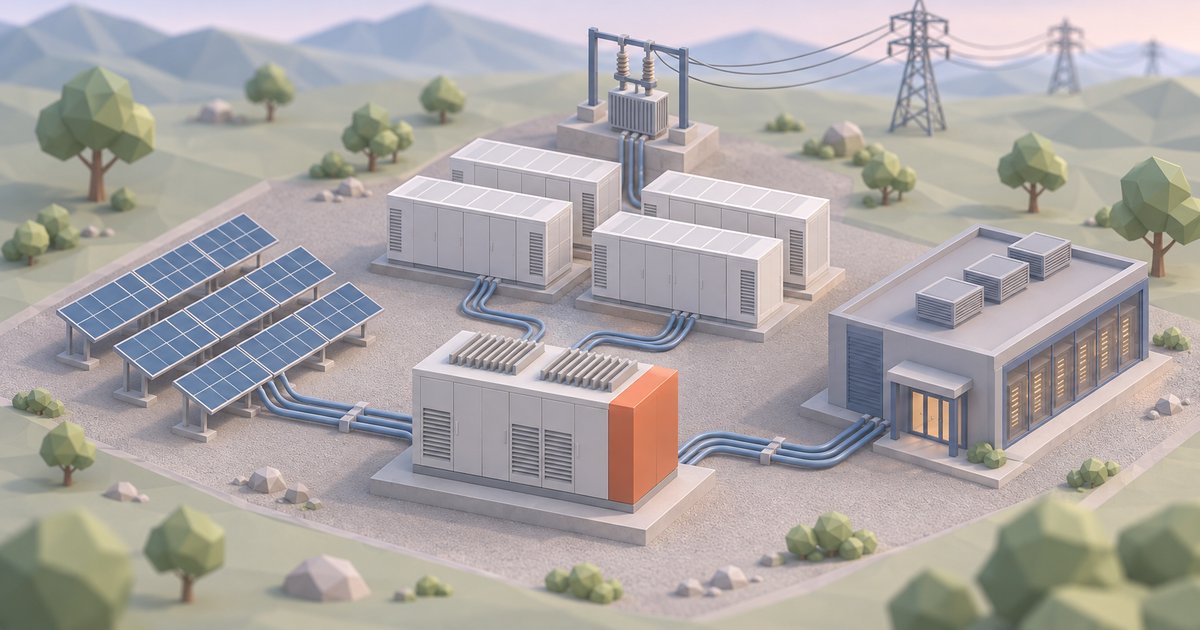
Tesla's energy business unveiled Powercore on 17 November 2026, the opening day of the RE+ trade show in Las Vegas. It is a solid-state, medium-voltage unit that does the work of three pieces of equipment at once: the transformer that steps power up to grid voltage, the inverter that converts between direct and alternating current, and the circuit breaker. Tesla announced it on X at 16:00 UTC and posted the full specifications about an hour later. It will be built in the US, and Tesla says the first units will be operating in 2027. It has not given a price, named a customer or said which factory will make it.
The specifications
| Powercore | |
|---|---|
| Continuous power | 9 MVA (7.4 MW) at 34.5kV |
| Peak power, grid-forming | 10 MVA |
| AC side | 10kV to 34.5kV |
| DC side | 800 V to 2,000 V |
| Peak efficiency | 98.86% |
| Breaker | Solid-state, clears faults up to 1,000 times faster than a conventional one |
| Operating temperature | −40 °C to 55 °C |
| Warranty | Up to 25 years |
| First units operating | 2027 |
AJ Booth, who runs Tesla's energy and charging business, told pv magazine USA that the breaker interrupts a fault in 100 microseconds, and that Tesla has built "3 terawatts of power converters", all of them in-house.
The missing piece of Megablock
Powercore is the transformer Tesla promised when it introduced Megapack 3 and Megablock in September 2025. A Megablock, as TeslAnt described when Megapack 3 production started, is four Megapack 3 cabinets combined with a transformer and switchgear.
Tesla's case rests on conversion steps. Today the inverters inside a Megapack turn the battery's DC into 480-volt AC, and a separate transformer takes that to medium voltage. Powercore does it in one stage, connected directly to the Megapack's DC bus, and Tesla says the old two-step layout had twice the losses. Unlike a conventional transformer, it holds no flammable oil, and its modules can be replaced in the field.
The second argument is supply. Conventional medium-voltage transformers are built to order, and pv magazine puts lead times at up to four years. A unit Tesla makes itself, in volume, lets its storage customers skip that queue.
Solar, data centres and charging
Tesla is pitching one product for three markets. On a solar farm, Powercore works as a central inverter for today's 1,500-volt arrays and the 2,000-volt systems now emerging. In a data centre, it converts the medium-voltage feed straight to 800 V DC for the servers, and Tesla says it is working with Nvidia on 800 V DC power architectures. Megapack is already qualified under Nvidia's DSX Ready programme, and Tesla says 10 GWh of Megapacks already run at data centres. pv magazine adds EV charging to the list of target markets, but neither Tesla's post nor Booth described a Supercharger application.
Behind it sits a storage business that Tesla says has more than 100 GWh operating in 68 countries and can build 140 GWh of Megapacks a year.
A race with a former Tesla executive
Powercore arrives in the same year as a rival built by Tesla alumni. Drew Baglino, who ran Tesla's powertrain and energy engineering until a 2024 restructuring, founded Heron Power to make solid-state transformers. Electrek reports that Heron plans commercial production of its Heron Link in late 2027, at a factory in Morgan Hill, California, designed for 10,000 units a year.
What it means in Europe
Tesla has said nothing about selling Powercore outside the US, and its "Made in America" line carries a footnote: US and imported parts. The AC range it quotes covers the medium-voltage levels used in European distribution grids, but there is no word on European certification or a launch date. For now, Europe's Megapack sites buy that equipment from others. GIGA Storage's 1.2 GWh Leopard battery in Delfzijl, in the Netherlands, pairs its 320 Megapack 2XL units with 80 Siemens Energy string transformers. That is the layer Powercore is built to replace.