
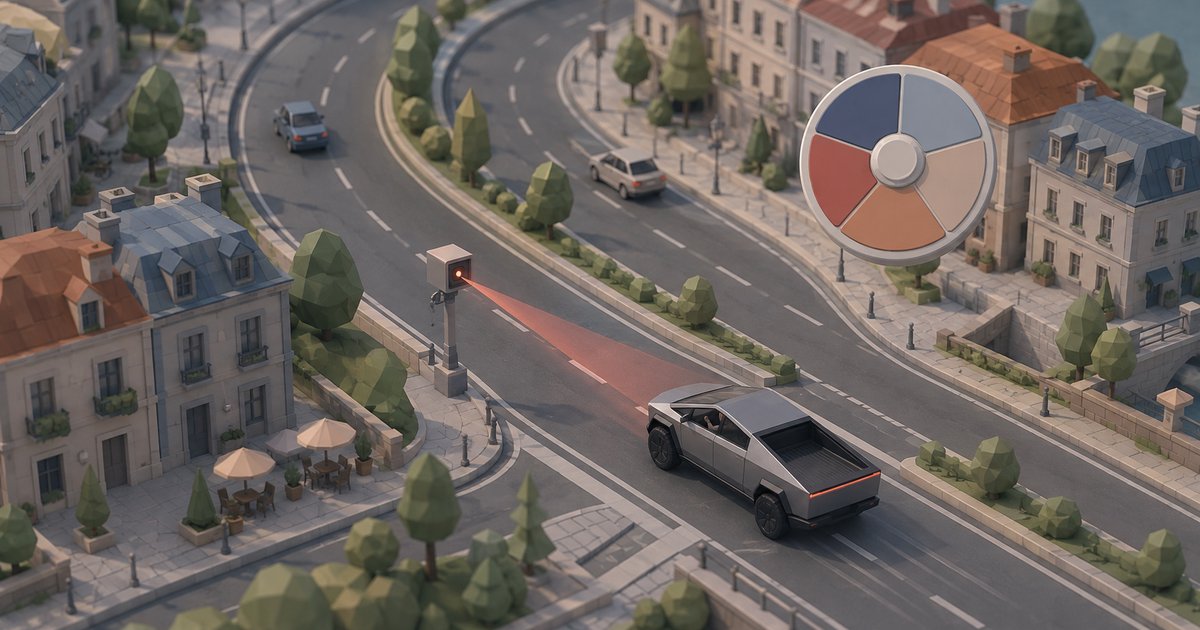
On 2 September 2026 a well-known Tesla content creator did something small and pointed: he forwarded a speeding ticket to Tesla. The citation was issued while he was driving a Cybertruck with FSD (Supervised) engaged, and the creator, who posts as @DrKnowItAll16, framed it as a position he had held for a while — "I've always said if/when I got a speeding ticket while @Tesla FSD was driving — without the ability for me to directly adjust the speed myself — I'd ask Tesla to pay the ticket."
It was described as symbolic rather than an expectation of payment, and Tesla has not responded publicly. The reason it lands at all is the clause in the middle: without the ability for me to directly adjust the speed myself.
Five presets replaced a number
Before FSD v14, a driver could set a custom speed offset — an explicit figure above the posted limit, say 10 km/h, that the car would not exceed. FSD v14 removed that control in October 2025 and replaced it with five named profiles, described by Tesla in these terms:
| Profile | Tesla's description |
|---|---|
| Sloth | Drives under the speed limit |
| Chill | Uses slower lanes, minimal lane changes |
| Standard | Normal speed, adjusts to match the flow of traffic |
| Hurry | Drives faster, more frequent lane changes |
| Mad Max | Quicker than Hurry, with more frequent lane changes |
Only one of the five is defined against the speed limit. The rest are defined against traffic, or against each other. There is no setting that means "never more than X over the limit", which is the setting that used to exist.
This is the second ticket to make the same point
In July 2026 an Electrek writer reported being ticketed with FSD in Standard — the middle profile, not an aggressive one — on a 50 km/h road, where the car ran up to 78 km/h. That is 28 km/h over. His conclusion was about the removed control rather than the driving: "If Tesla still let me set my own offset, I would have dialed it to 15 km/h, like I used to do, and never been in this spot."
So the change itself is not news; it is nearly a year old. What is new is owners beginning to send Tesla the bill for it. Tesla's AI leadership has publicly defended the profile approach rather than restoring the offset.
The liability is not ambiguous
It is worth stating plainly, because the gesture invites confusion: the driver is responsible. FSD (Supervised) is approved everywhere it is approved as a driver-assistance system with a human in charge, and traffic law follows the person behind the wheel. Forwarding the ticket makes an argument; it does not move the liability.
That is exactly the arrangement one legislature is now proposing to change. China's draft road traffic law would make carmakers answer for their autonomous cars' violations — the same question, asked by a regulator rather than by an owner on X.
Why this is sharper in Europe
FSD (Supervised) holds national approvals in the Netherlands, Lithuania, Estonia, Denmark and Belgium, and European speed enforcement leans heavily on fixed and average-speed cameras. A profile that matches the flow of traffic is therefore measured against a posted number by a machine, with none of the discretion a traffic officer might apply.
For a European owner the practical advice is unglamorous: on limits that are enforced by camera, Sloth is the only profile defined against the limit itself. The control owners are asking for is not a new feature — it is the one that was taken away.