
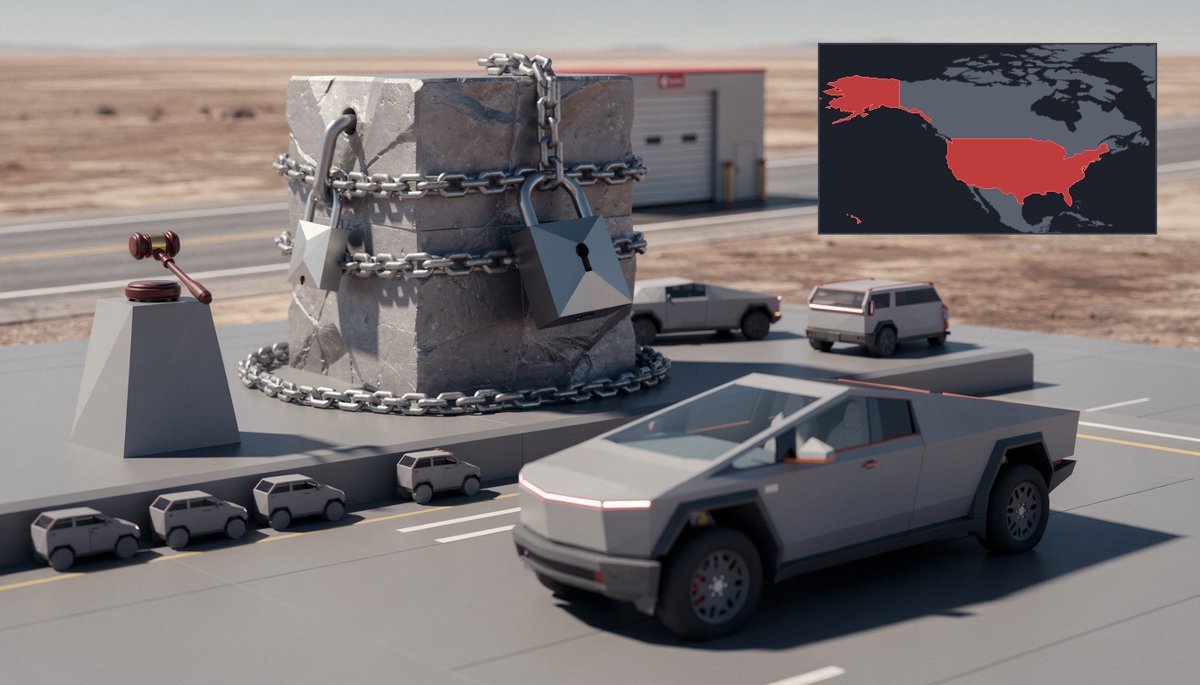
Tesla has taken one of its own suppliers to court, telling a federal judge that the company is sitting on tooling the Cybertruck line cannot run without. The dispute is a rare public glimpse into how fragile a modern car programme can be when a single vendor controls a single set of dies.
What Tesla is asking for
On 23 July 2026, Tesla filed suit in the US District Court for the Western District of Texas against Angstrom Automotive Group, seeking an emergency order that would force the supplier to open its plant in Troy, Texas so Tesla can haul out the multi-ton stamping tooling used to make Cybertruck body parts. The case is docketed as Tesla v. Angstrom Automotive Group LLC, No. 6:26-cv-0477.
According to the complaint, Angstrom told Tesla on 13 July that it intended to shut the Troy facility down, then refused to cooperate on a plan to retrieve the tooling. Tesla says the supplier is also holding 700 finished components that were scheduled to ship on 17 July and never left the building.
The money at the centre of the fight
Tesla's filing frames the standoff as an attempt to extract money. It says Angstrom demanded compensation for modifications made to the tooling and offered to keep the plant running only if Tesla paid $250,000 a week on top of the amounts already owed on purchase orders. Tesla characterises that as holding the parts "for ransom."
The relationship is a recent one. Angstrom acquired a company that had been supplying Tesla in early 2025, and the partnership deteriorated from there. Because the tooling is highly specialised, Tesla told the court it could not simply move production elsewhere — recreating the dies would take an estimated five to six months.
Why it matters for production
The stakes are concrete. Tesla says that without the dies it will be unable to build "several thousand Cybertrucks" currently in or planned for production, most of which already have buyers attached. A single supplier closing a single plant, in other words, is enough to stall deliveries of a vehicle Tesla builds in Texas.
That exposure is the real story here. The Cybertruck relies on unusually large stainless-steel stampings, which narrows the pool of vendors capable of making the parts and concentrates risk in a handful of tooling sets. When one of those vendors walks away, there is no quick second source.
The European angle
The Cybertruck is not sold in Europe and there is no confirmed plan to homologate it for European roads, so no European owner is waiting on one of these trucks. The relevance for European Tesla watchers is indirect but real: the case is a reminder that even Tesla's most vertically integrated programme depends on outside suppliers, and that supply-chain disputes can throttle output as effectively as any factory problem. How the court rules on Tesla's emergency request will show how much leverage a supplier holding critical tooling actually has.
Update: 2026-08-07
On 4 August 2026, Judge Christopher R. Wolfe granted Tesla's emergency request in full, issuing both a temporary restraining order and a writ of replevin that gave Tesla an immediate right of entry to Angstrom's Troy plant to recover its tooling and the parts held there. The effect showed up within a day. Aerial observer Joe Tegtmeyer counted roughly 100 Cybertrucks filling the Giga Texas outbound lot on 5 August, against the visibly suppressed output of the preceding weeks. The speed of that rebound is itself evidence: it indicates the Angstrom parts shortage, rather than any problem inside the factory, was what had been throttling Cybertruck production.