
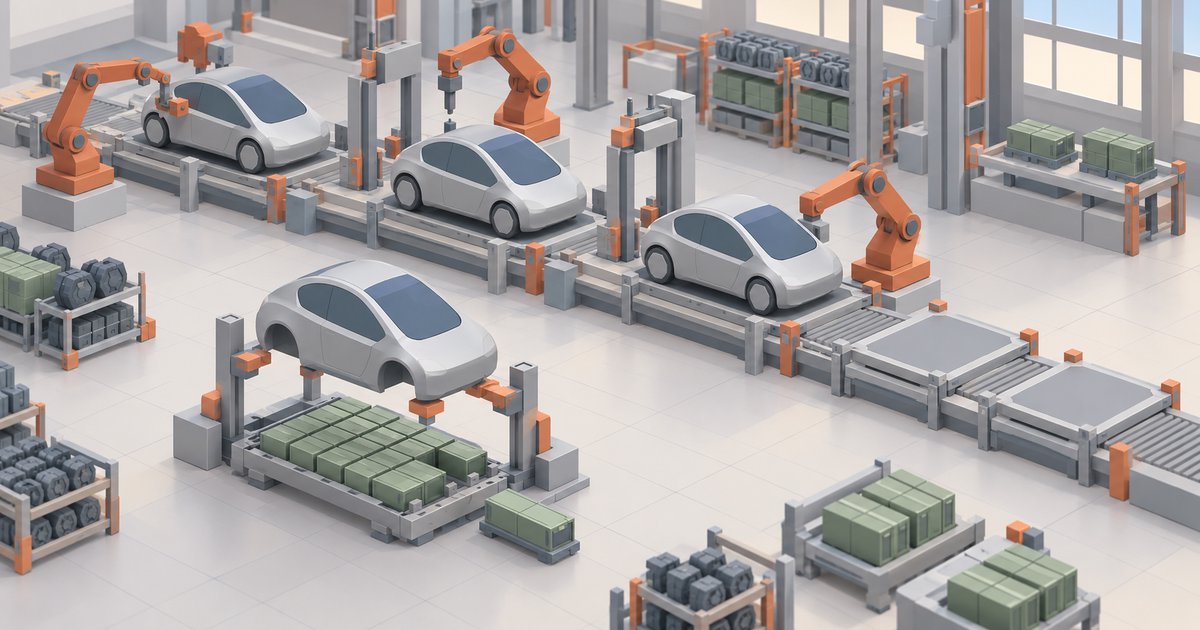
Tesla's Cybercab production line can build cars faster than Tesla can put them into service. "We actually, we don't run every day because the line can run so fast. It's currently outpacing our deployments," Lars Moravy, Tesla's vice president of vehicle engineering, said in a factory walkthrough with Munro Live published on 26 October 2026. Tesla's Robotaxi account shared the 87-minute video the same day as a "Cybercab engineering deep dive". The quotes and figures below are as reported by Drive Tesla, which published two write-ups of the video.
What Tesla said about the line
Tesla has not said how many Cybercabs it builds. In the video, it described how the line works:
| Figure | Cybercab line |
|---|---|
| Share of manufacturing automated | About 78% |
| Framing line | Fully automated, parts delivered by autonomous mobile robots |
| Final assembly | 25 stations |
| Factory floor space per car | About half that of a conventional line |
The floor-space saving comes from the "unboxed" process, in which the front, rear and battery sections are built in parallel and joined late. Tesla had already claimed that when it detailed the Cybercab's manufacturing in September. Drive Tesla puts a conventional Model Y line at five to ten times as many stations, depending on the factory.
On 26 October, Texas's register of automated vehicles, as compiled by the Texas Robotaxi Database, listed 463 Cybercabs, the same as on Sunday.
The battery pack is no longer fully structural
The second disclosure concerns the battery. According to Drive Tesla's account, the Cybercab does not use a fully structural pack, the design Tesla introduced on the Model Y, in which the cells are bonded into one assembly that forms part of the body. It uses individual modules that can be serviced or replaced separately.
Tesla's battery engineering director gave the Model Y's structural pack a "D" for how hard and costly it is to manufacture, and the Cybertruck's a "B minus". The Cybercab's pack got an "A minus". The Model Y pack worked well for customers, he said, but was harder and more expensive to build than Tesla wanted. A structural design leaves about 10% more space for cells. Tesla found the cost of an optimised modular pack comparable, and module-level repair counts for a car it designs to stay in service for at least 500,000 miles, about 800,000 km. The pack still adds strength in a side impact.
What it means for Tesla owners
For the Robotaxi network, the constraint Moravy describes is deployment, not manufacturing: where the cars are allowed to operate and how fast Tesla can put them into service. Austin is still the only city with public Cybercab rides. On Tesla's Q3 call, Moravy said Tesla was trying to get Cybercabs to customers by the end of 2026, and Ashok Elluswamy said Dallas would follow "next month". Musk has said the Cybercab will come to Europe but has given no date.
For Model Y owners, the "D" grade refers to Tesla's own cost of building the pack, not to how it performs. The modular approach matters for repairs: a failed module can be swapped without replacing the whole pack. Drive Tesla's account does not say whether future Model Y or Model 3 packs will follow the Cybercab's.
Update: 2026-10-26
Two more readings of the video, by Tesla North and in Drive Tesla's pieces on the drive unit and the battery, add hardware details the article above left out. Nick Verzini, Tesla's head of drive unit engineering, said the circuit board and power stage of the Cybercab's new inverter, which has far fewer electronic components than the unit in today's Model 3, enter Model 3 production this year. The inverter keeps the existing interface and would fit a Model Y drive unit, but he would not say whether Tesla will make that switch. The Cybercab's drive unit uses an 11:1 gear ratio, against about 9:1 in most Teslas. Its pack holds 4680 cells in an 88S6P layout inside a steel enclosure, with wireless battery-management boards and fast contactors in place of a pyrotechnic fuse. Tesla left room in the pack for lower-density chemistries and named LFP as one it wants to use as production grows.