
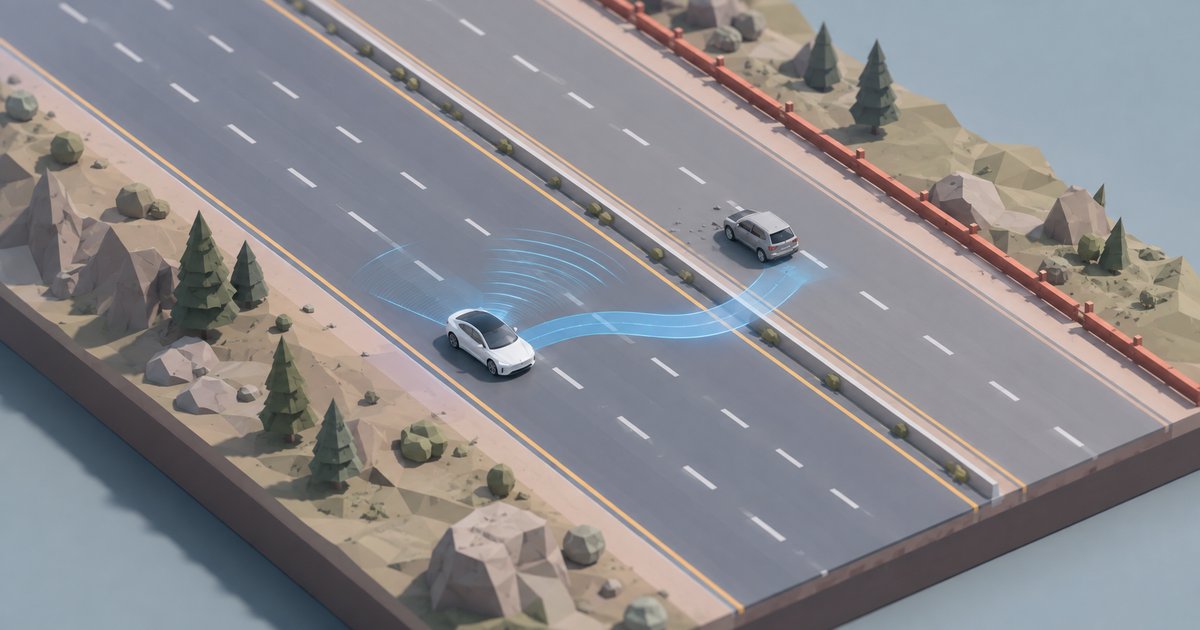
Tesla has added an active safety feature called Automatic Collision Evasion, which briefly engages Full Self-Driving (Supervised) to steer a car out of a crash while the driver is in manual control. It arrived without an announcement, and it is the first time Tesla has used the FSD stack as an emergency intervention rather than as a driving mode you choose.
What it actually does
Automatic Emergency Braking, which nearly every new car now has, does one thing: it brakes in a straight line. Automatic Collision Evasion adds the option of going around the obstacle instead.
When the car judges that a frontal collision is imminent and braking alone will not prevent it, the system enables FSD, steers around the hazard by changing lanes or moving onto the shoulder, brakes or accelerates as needed, and then carries on driving.
The conditions are narrow, and that is the point:
| Trigger | Conditions |
|---|---|
| Imminent frontal collision | Below 85 mph, controlled-access highways, no pedestrians or cyclists detected, functional steering, dry road |
| Driver attention lost | Between 22.5 and 85 mph — reaching into the back seat, looking away, an unintentional FSD disengagement |
The second trigger is the more unusual one. It is not about an obstacle at all. If the car decides the driver has stopped driving — including when FSD is switched off by accident — it takes over rather than continuing on the driver's last input.
Where to find it
The setting lives under Controls > Self-Driving, and the car needs FSD (Supervised) purchased and enabled. That is a meaningful limitation: this is a safety feature gated behind Tesla's most expensive option, not a fleet-wide addition like AEB.
Not in Europe
Automatic Collision Evasion is North America only at the moment. It is not available in the Netherlands, which already has approved FSD (Supervised), so this is not simply a case of the feature following FSD approval around the map.
The likely reason is regulatory rather than technical. European type approval treats steering interventions differently from braking ones, and a system that changes lanes on its own initiative to avoid a crash does not map cleanly onto the UN regulations that govern emergency steering function. Braking to a stop is well covered; being driven around an obstacle by software is not.
That gap matters more than it looks. European Teslas already run the same perception hardware, and the same neural networks are approved to drive the car in the Netherlands. The thing holding the feature back is the rulebook, not the car.
What to make of it
Tesla is arguing, in effect, that its autonomy software is now reliable enough to be trusted with a split-second steering decision that the driver has not asked for. Every other manufacturer's evasive-steering assist works by amplifying a swerve the driver has already begun. This one initiates it.
For European owners, the practical answer today is: nothing changes. The feature is not in the region and Tesla has not said when it might be. What is worth watching is whether it appears in a European release at all, because that will be the first real test of whether Tesla can ship FSD-derived safety interventions here without waiting for a separate approval for each one.