
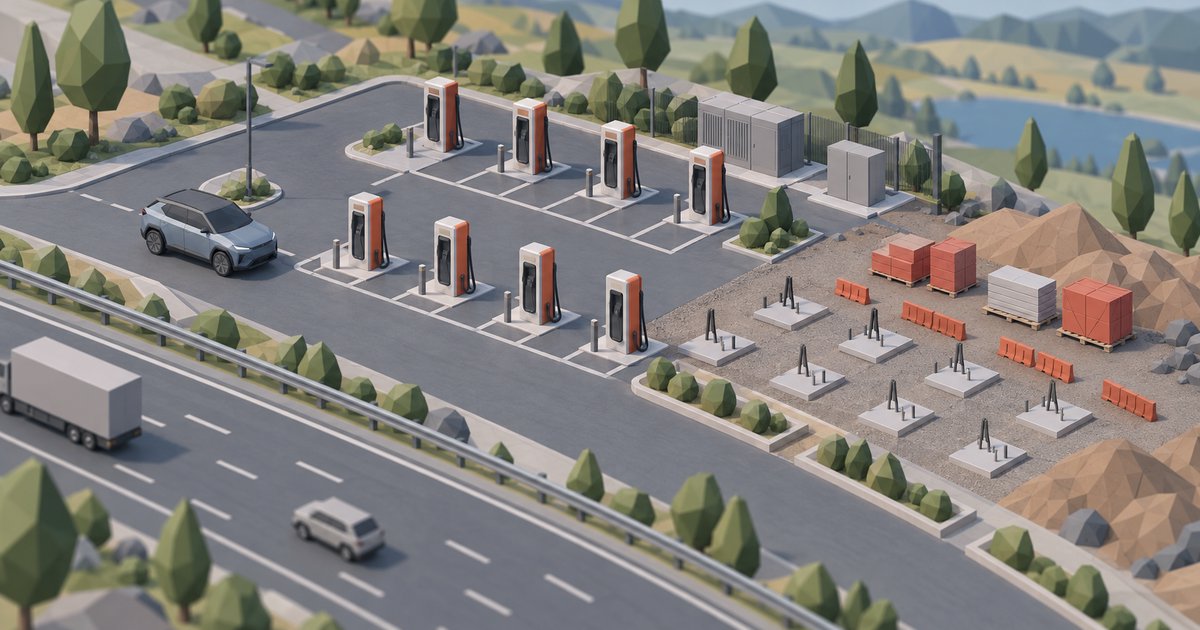
BP is selling its French fast-charging business. Sorégies, an energy utility based in Poitiers, announced on 25 September 2026 that it is acquiring bp pulse's network in France — 32 operating sites with more than 600 fast-charging points, plus 14 sites under development that will add roughly 200 more.
The deal covers more than the concrete. Charging hardware and transformer-station inventory transfer with the sites, and the bp pulse staff who develop, build and operate the network move to Sorégies Mobilités, the buyer's mobility subsidiary. The purchase price was not disclosed. Completion is expected by the end of 2026.
Where the chargers actually are
This is motorway infrastructure, which is what makes it relevant to anyone driving a Tesla across France on a long route. The sites sit on service areas along the A10, A11 and A71, alongside shopping-centre and retail locations, and the network is built around charge points above 100 kW.
| What transfers | Detail |
|---|---|
| Operating sites | 32, with 600+ fast-charging points |
| Under development | 14 sites, roughly 200 points |
| Typical power | Above 100 kW |
| Key corridors | A10, A11, A71 motorway service areas |
| Completion | Expected end of 2026 |
Sorégies already runs more than 1,000 charge points across two French departments and has committed over €100 million to electromobility by 2030. The acquisition lifts it into the ten largest fast-charging operators in France. The acquired parks will be rebranded under the group's Alterna énergie name, so the bp pulse signage on those motorway stops is going away.
What changes for a Tesla driver in France
Nothing about the plugs. These are CCS sites, and a Tesla charges at them the same way it did yesterday.
What changes is who sets the price and who runs the app. A network operator handover is the moment tariffs, subscription terms and roaming agreements get rewritten, and French motorway fast-charging is already among the more expensive ways to add range. Sorégies is a regional utility rather than an oil major, with a different cost base and a different reason to be in the business — it sells electricity. Whether that shows up as cheaper kWh on the A10 is not something the announcement says, and it would be a guess to claim it will.
For Tesla owners specifically, the practical effect is on route planning outside the Supercharger network. France has dense Supercharger coverage, but the A71 corridor and the retail sites in this package are the kind of stop a driver reaches for when a Supercharger is full or off-route.
BP keeps retreating from charging in Europe
The sale is a piece of BP's roughly $20 billion asset-disposal programme, and it continues a pattern: the company has been narrowing its charging footprint to the markets where it has scale. BP retains its charging operations in Germany under the Aral pulse brand, which remains one of the larger German fast-charging networks.
That is the wider signal worth noting. Charging networks in Europe are consolidating, and the buyers are increasingly utilities and regional energy groups rather than fuel retailers. Tesla sits on the other side of that trend — it built and still owns its network outright, and has been cutting Supercharger prices in some European markets while third-party operators change hands.