
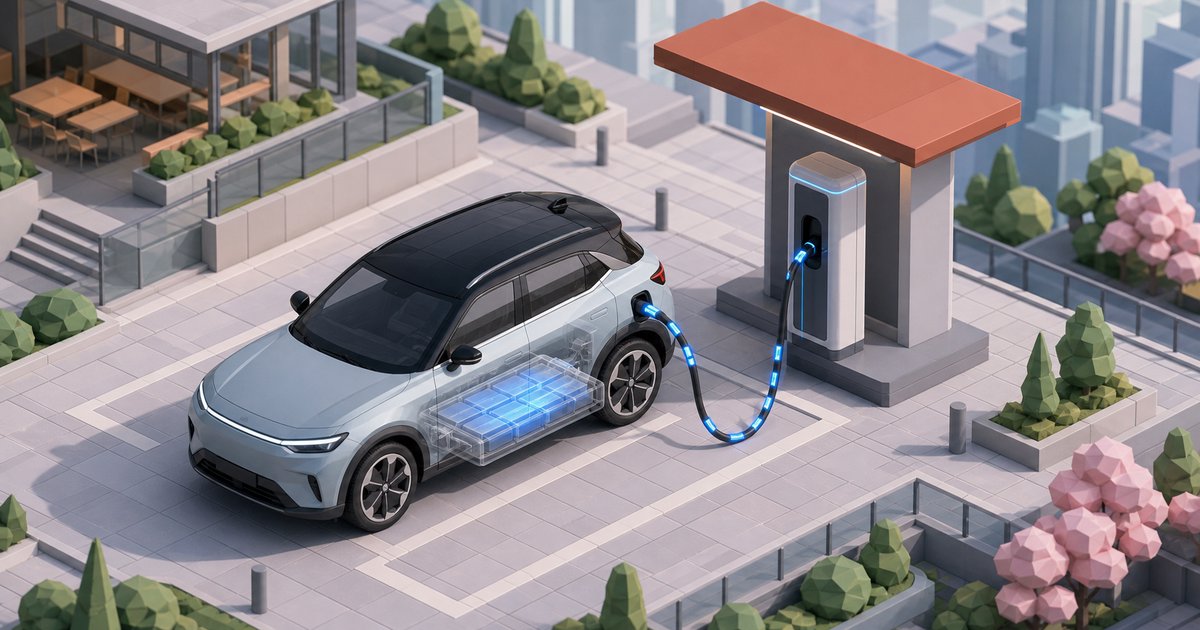
Smart launched the facelifted #1 in China on 6 August 2026, and the interesting change is not the styling. The car moves to an 800-volt silicon-carbide electrical architecture with a 6C battery, cutting a 10-80% DC charge from roughly thirty minutes to about twelve.
The specification
| Item | 2026 Smart #1 |
|---|---|
| Architecture | 800 V silicon carbide |
| Battery | 61.52 kWh LFP |
| CLTC range | 535 km |
| Rear motor | 245 kW / 320 Nm |
| 0-100 km/h | 6.7 s |
| Top speed | 200 km/h |
| DC charge 10-80% | ~12 minutes (6C) |
| Dimensions | 4,270 × 1,822 × 1,636 mm, 2,750 mm wheelbase |
| Boot | 313-976 litres |
Two trims are offered, 535 Max and 535 Ultra, priced from 152,900 to 172,900 yuan. Smart counts more than 200 product and equipment changes in the facelift. The drivetrain is Geely's 16-in-1 silicon-carbide unit, quoted at 93.8% efficiency; motor output rises from 200 kW to 245 kW. Equipment includes a roof-mounted lidar within a 31-sensor perception package, a 15.4-inch 2.5K centre display, a 10.2-inch cluster, a 10-inch head-up display and a 640-watt, 13-speaker Sennheiser system.
The smaller battery is the point
The pack has shrunk, from 66 kWh to 61.52 kWh, and Smart still quotes 535 km on the CLTC cycle — a famously generous test. Read past the range number and the engineering argument is clear: if a car can add most of a charge in the time it takes to buy a coffee, it does not need to carry as much energy. A smaller pack is lighter, cheaper and less material-intensive, and 6C charging is what makes that trade survivable.
This is the same bet several Chinese manufacturers are now making, and it is a different bet from the one most European models have taken, which is to add capacity until the range anxiety goes away.
What a European buyer should take from it
Smart sells the #1 in Europe, but this facelift launched in China only, and neither the specification nor the pricing for a European version has been confirmed. Treat the numbers above as the Chinese car until Smart says otherwise.
There is also a physical limit worth knowing before the marketing arrives. 6C on a 61.52 kWh pack means the car would need roughly 369 kW to charge at its rated rate. Very little of Europe's DC network can deliver that: the common fast standard is 150 kW to 400 kW, and only the newest sites reach the top of that band. On a typical European 150 kW charger, the twelve-minute figure is not achievable — the constraint is the charger, not the car.
That is not a criticism of the engineering. An 800-volt car on a 150 kW charger still charges faster and holds its peak longer than a 400-volt car does. But the headline number belongs to a Chinese charging network, and buyers should expect a European figure closer to twenty minutes than twelve.
Smart's other new model, the #2 that turned up undisguised in a Chinese regulatory filing, suggests the brand's product cadence is now set in China regardless of when Europe sees the result.