
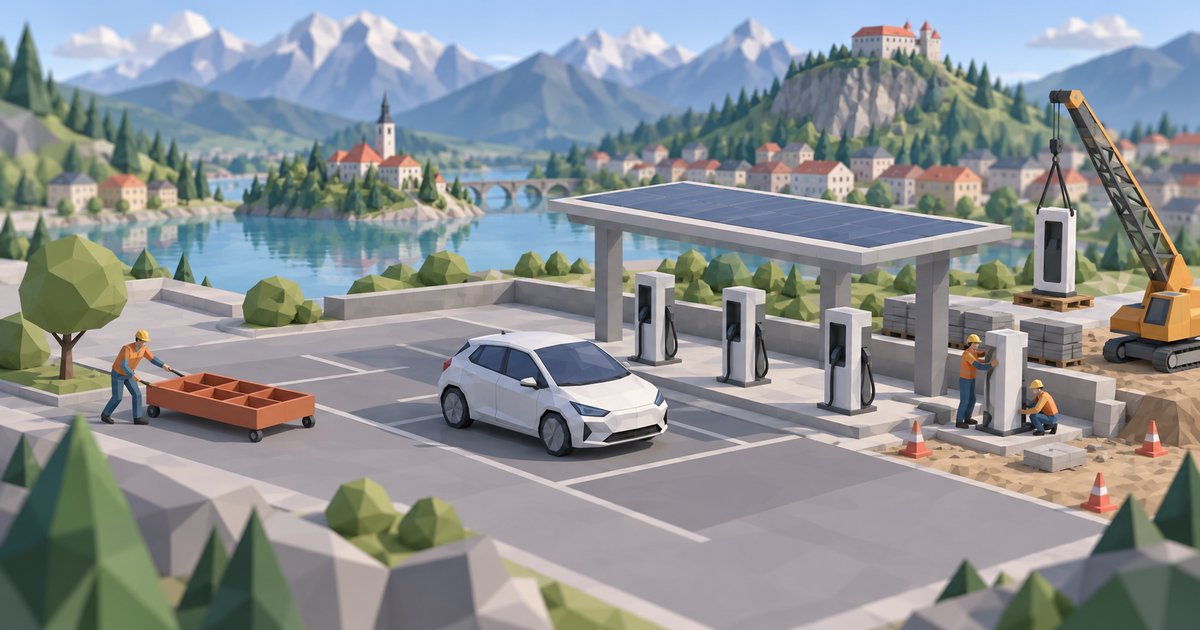
Slovenia has stopped subsidising electric car purchases. The Ministry of Energy and Infrastructure under Jernej Vrtovec confirmed this month that the scheme will not be refilled, and that the money goes to charging infrastructure instead. It is the first clear reversal of direction by a European government whose EV market was, on the latest figures, accelerating faster than almost anywhere else.
The timing is the story
The subsidy paid up to €7,200 on a car costing €35,000 or less, tapering to €4,500 at the top of the eligible range. The 2026 call was topped up to roughly €19 million in April and was exhausted by 30 May. What remained ran out in mid-August, and nothing has replaced it.
Meanwhile the market it was supporting did this:
| Period | Slovenian BEV share of new registrations |
|---|---|
| H1 2025 | 9.0% |
| H1 2026 | 16.5% |
| June 2026 | 25.3% |
Slovenia registered 6,062 electric cars in the first half of 2026, up 124.5% year on year. June alone was 1,690 BEVs. The incentive is being withdrawn from a market that had just doubled.
Why it ended
Less ideology than accounting, though the politics are visible. The scheme leaned on the EU Recovery and Resilience Facility — €43.9 million earmarked for 2024 to 2026 — and that funding expired in May. Anything further has to come from the national budget, and the government that took office in May 2026 under Janez Janša has chosen not to find it.
What it is funding instead is smaller and slower: about €2.5 million now for lower-power charging points, and roughly €25 million next year for charging within and outside the TEN-T network, according to Urška Kalan, deputy director of the market operator Borzen. That is a real infrastructure budget. It is not a demand subsidy, and it does not reach a buyer at the point of purchase.
What it costs a Tesla buyer
Directly and immediately: up to €7,200, depending on the car. A Model 3 or Model Y in Slovenia sits above the €35,000 line where the full grant applied, so the relevant figure for most Tesla buyers was nearer the €4,500 end — still the difference between a Model 3 and a mid-spec compact.
Slovenia matters to Tesla out of proportion to its size for a separate reason. It approved FSD (Supervised) in early September, becoming the sixth European market to do so. Tesla has a growing software proposition in a country that has just removed the purchase incentive underneath it.
What it signals for the rest of Europe
European EV policy has been moving one way, and Germany is currently arguing about how to target its €6,000 bonus rather than whether to keep it — the made-in-EU local content test is a debate about conditions, not existence. Slovenia is the counter-example: a government deciding the subsidy phase is over at 16.5% BEV share rather than at 50% or 80%.
Whether that holds is the thing to watch. Slovenia's surge was subsidy-driven by construction, and the next few months of registration data will show how much of it was pull-forward. If the share holds near 20% without support, other finance ministries will notice. If it collapses, they will notice that instead.