
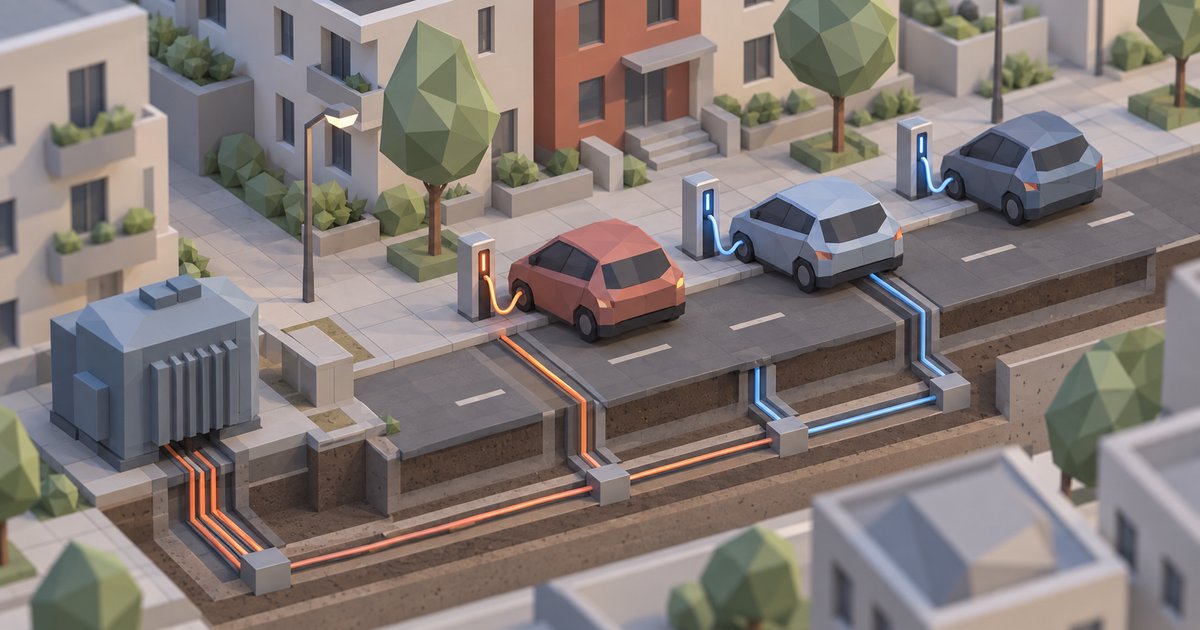
Europe's limit on electric driving is moving from the charger to the cable behind it. A study published on 15 September 2026 puts a price on the difference between digging that cable in and making better use of the one already there.
Electricity Grids in Europe was modelled by Siemens and commissioned jointly by EIT Urban Mobility, ACEA and the European EV-charging industry association. It assesses what projected growth in battery-electric cars and light vans does to electricity distribution grids across the EU27 and three EEA countries, modelling six urban archetypes across 64 cities.
The two numbers
| Scenario to 2030 | Distribution grid investment |
|---|---|
| Charging left unmanaged | about €24.7 billion |
| With EV load management | about €14.1 billion |
| Difference | €10.6 billion |
Load management here means adjusting charging power in near real time so that a street's cars do not all pull maximum power in the same hour. It is not a new idea, but the study's contribution is to price the alternative: the €10.6 billion is what Europe pays to avoid coordinating.
The money is in the street, not the substation
This is the part that decides how hard the saving is to capture. 77.7% of the physical investment falls on low-voltage networks — the cabling between a local transformer and a front door.
That is the slowest and most disruptive category of grid work. It is not one big project that a regulator approves; it is thousands of small ones, dug up road by road, each needing its own permission. A saving in low-voltage reinforcement is therefore worth more than the same saving on a transmission line, because the constraint there is time and disruption as much as money.
The averages hide most of the story
The study's national BEV shares for 2030 do not describe one European market.
| Country | Projected BEV share of the fleet by 2030 |
|---|---|
| Italy | 4.6% |
| Germany | 15.7% |
| Sweden | 27.3% |
A grid plan that suits Sweden is roughly six times oversized for Italy, and the pressure arrives in different decades. Between 55% and 62% of EV owners across the 64 urban areas studied are expected to have access to home charging by 2030 — which means the majority of the load the grid must absorb appears overnight, at a kerb or in a garage, rather than at a public fast charger.
Why this reaches a Tesla owner
Because the consumer half of load management is already in the car. Scheduled departure and off-peak charging windows do exactly what the study models, and a Tesla parked on a timer is a managed load whether or not anyone calls it that.
What has been missing is a reason to use it, and that is arriving through tariffs rather than through firmware: Tibber's intraday grid rewards in Germany and the Octopus vehicle-to-grid tariff Audi launched there both pay drivers to shift load off the peak.
The warning in the study is what happens if they do not scale. Distribution investment is recovered through network charges, and network charges sit inside the per-kWh price on every public charger and every home bill. If the €10.6 billion is not saved, it is spent — and it is spent by everyone who plugs in, including the drivers who were charging off-peak anyway.