
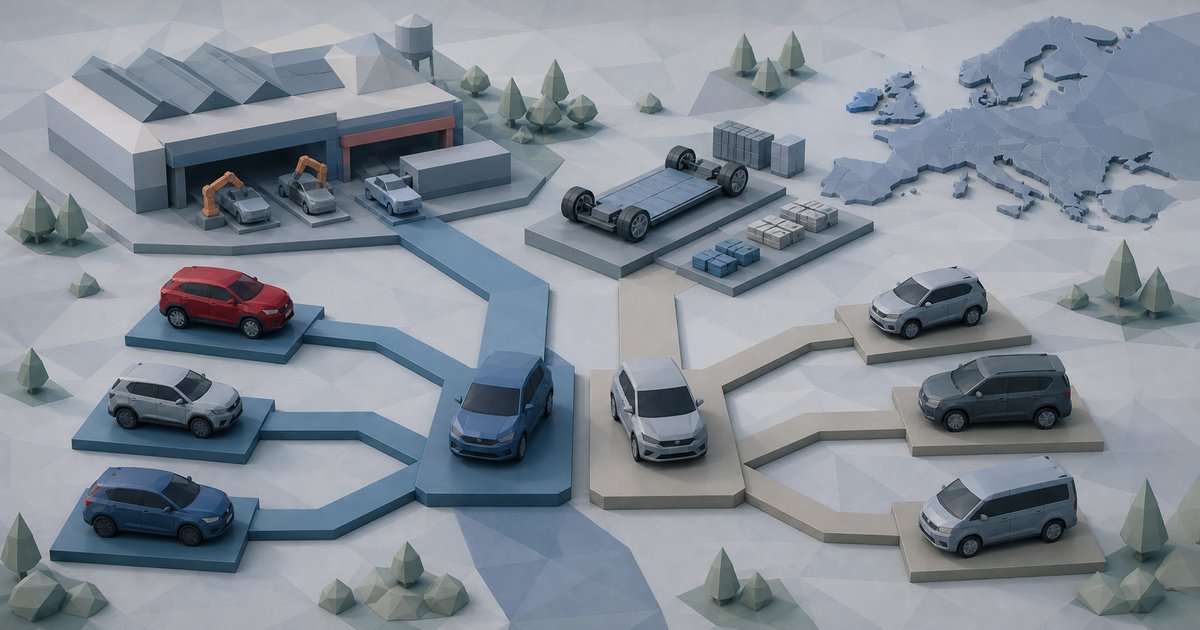
Peugeot has set out what it will sell in Europe between now and 2030: seven new or updated models. The list is a straightforward product offensive. What makes it notable is a promise that is no longer in it.
Five years ago Peugeot said its European portfolio would be zero-emission only by 2030. That is not the plan any more. The new one has combustion and electric versions of the same car sitting on the price list at the same time, deliberately.
What is coming
| Model | Powertrain | Built at | Timing |
|---|---|---|---|
| 208, third generation | Electric only, STLA One | Figueruelas, Spain | Debuts 2027 |
| 208, current generation | Combustion, restyled | Figueruelas, Spain | Continues alongside |
| 2008, next generation | Electric | Vigo, Spain | A year after the 208 |
| 308, 308 SW, 408 | Replacements | — | By 2030 |
The third-generation 208 is the one that carries the strategy. It moves to STLA One, a dedicated electric platform, and drops combustion entirely — while the outgoing petrol 208 is restyled and kept in production at the same Spanish plant, Figueruelas near Zaragoza, which also builds the next Opel Corsa. The 2008 follows the same pattern a year later, staying at Vigo.
That is the whole shape of the retreat, in one model line: Peugeot still believes in the electric supermini enough to build it a dedicated platform, but no longer believes it can stop selling the petrol one.
Global-brand status is what pays for this
Peugeot has been promoted to one of Stellantis's four global brands, alongside Jeep, Ram and Fiat. Between them those four take about 70% of the group's product and brand investment, which is the mechanism that gets a dedicated platform funded for a supermini — historically a segment too thin-margined to justify one.
It sits inside Stellantis's wider FaSTLAne 2030 plan: roughly €60 billion of investment over five years, more than 60 new vehicle launches and around 50 major model updates by 2030. Separately, Stellantis has committed over €1 billion in France to build three Peugeot electric and hybrid models at Mulhouse from 2029.
The pledge that went away, in Europe and beyond
Peugeot is not alone in this and it is worth being precise about why. The 2030 all-electric commitments made across the industry in 2020 and 2021 assumed a demand curve and a policy backdrop that has since moved, and the EU's own 2035 engine rules are under active revision. A brand that keeps a petrol supermini on sale into the late 2020s is hedging against exactly that.
What it means if you are buying
The practical upside is real. The current e-208 shares its architecture with combustion versions, which costs it packaging and efficiency; a dedicated electric platform should give the next one more usable range from the same battery.
The other consequence is where the cars come from. Both of Peugeot's next electric superminis are Spanish-built, which puts them on the right side of the argument over whether EV purchase subsidies should be restricted to European-made vehicles and components — a distinction that could be worth several thousand euros a car in the markets that adopt it.