
NHTSA opened Preliminary Evaluation PE26007 into comma.ai on 21 September 2026. It covers roughly 30,000 aftermarket driver-assistance devices — the comma three, comma 3X and comma four — and cites five crashes in which three people died and eleven were injured, some seriously.
One failure mode, three fatalities
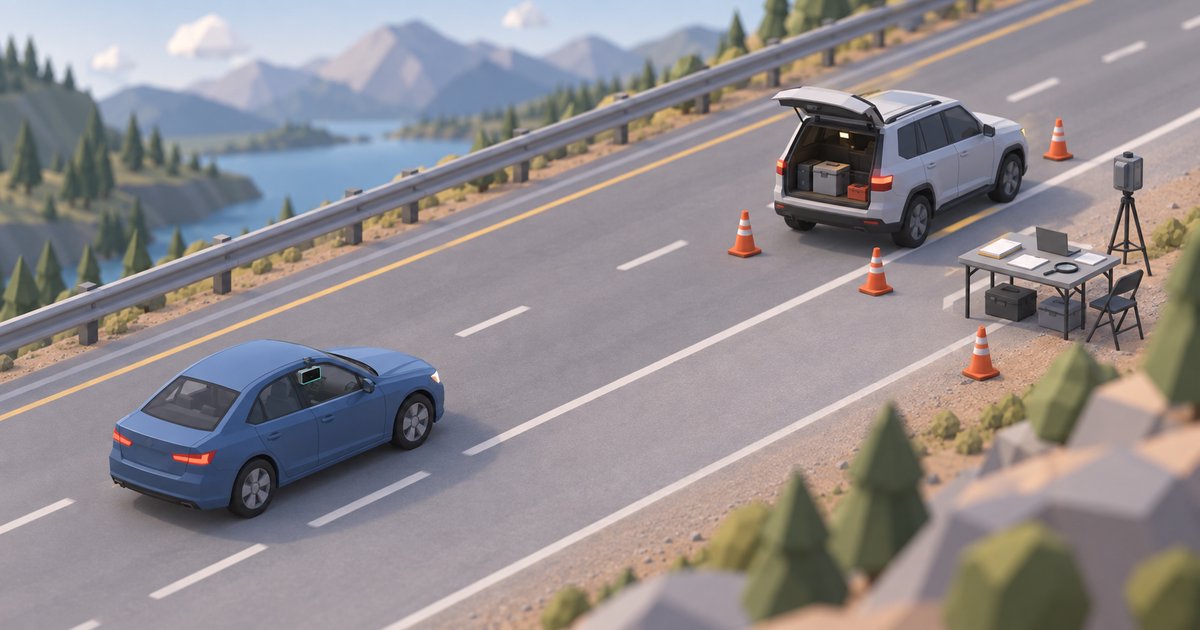
Every crash named in the opening has the same shape: a car running openpilot struck a stopped or slow-moving vehicle in its own lane, at speed, on a road where the obstacle was there to be seen.
| Date | Location | Vehicle | What happened |
|---|---|---|---|
| September 2025 | Missouri | 2020 Honda Accord | struck a stopped car at 82 mph |
| February 2026 | Ascension Parish, Louisiana | 2022 Toyota RAV4 | struck a stopped first-responder vehicle |
| July 2026 | Mona, Utah | 2021 Toyota Corolla | struck a stopped car at 56 mph |
Tesla owners have read this file before
The pattern is not new, and it is not comma.ai's alone. In August 2021 NHTSA opened PE21-020 into Autopilot for precisely this failure: Teslas striking stationary first-responder vehicles attending existing collision scenes. Twelve incidents were on record when it opened. It was upgraded to Engineering Analysis EA22-002 in 2022, and the reasoning NHTSA gave then reads like a description of the comma crashes — whether a Level 2 system tuned for moving traffic can be relied on to see what is not moving, and whether the way it is supervised undermines the driver who is supposed to catch it.
That is the value of this investigation to a Tesla driver. It establishes stationary-object collision as the defining weakness of driver assistance as a category, not a quirk of one manufacturer's stack. Different sensors, different companies, open source or proprietary: the same cars keep getting hit.
comma.ai's position is its own problem
The company has repeatedly disclaimed any obligation to answer NHTSA's General Order on crash reporting, and in one of the fatal cases argued that the device "appears to have been running 3rd party non-comma software".
openpilot is open source, which makes that both a genuine defence and a structural difficulty. A regulator investigating a defect needs to know what code was running; a product whose users can replace that code cannot always say.
The history rhymes too. In 2016 NHTSA sent George Hotz a special order about the comma one. He cancelled the product rather than comply.
What it means in Europe
Not much directly — openpilot is a US aftermarket product, and NHTSA has no jurisdiction here. The contrast in method is the point.
The United States lets a driver-assistance system reach the road and investigates defects afterwards, which is why a probe like this arrives after three deaths. Europe decides first, through type approval, and grants nothing until a system is homologated. That is the machinery deciding FSD's fate on 6 October, when the Technical Committee on Motor Vehicles votes on extending approval across the bloc.
Neither order is obviously better. One tolerates harm to gather evidence; the other withholds a system while the evidence is argued about. A European Tesla owner waiting on an approval is on the slower side of that trade, and PE26007 is a reminder of what the faster side costs.