
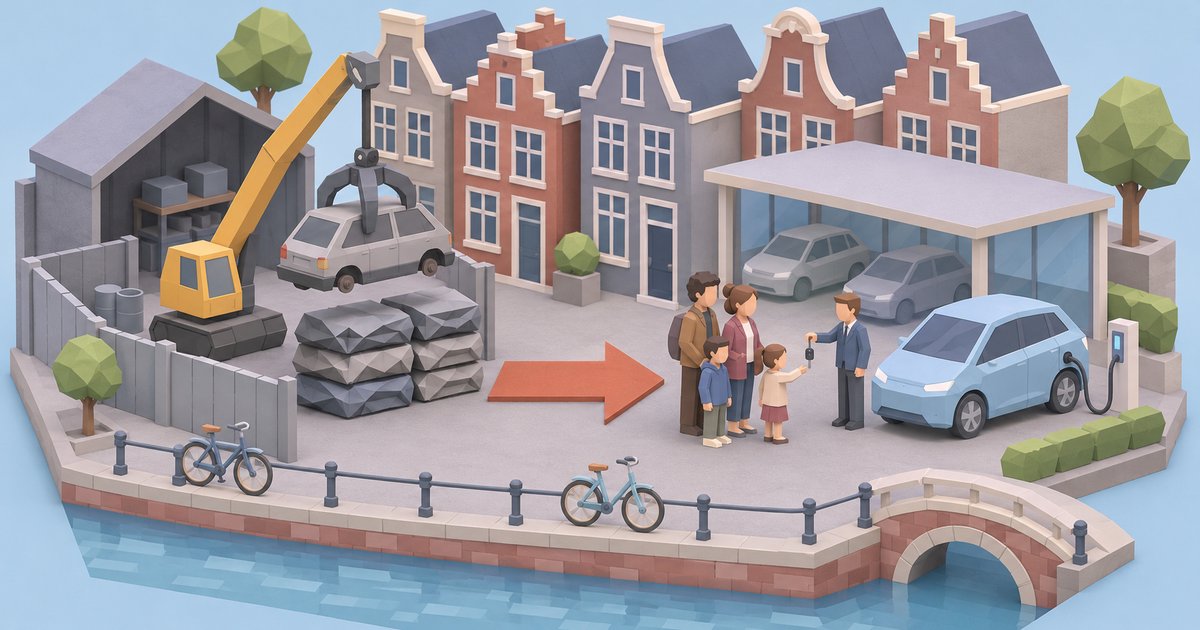
The Dutch government has put numbers on the trade-in scheme it announced with its 2027 budget. A draft regulation from the Ministry of Infrastructure and Water Management, open for public consultation since 5 November 2026, pays €6,000 or €4,000 towards a used electric car to drivers on a low or lower-middle income who have an old petrol or diesel car scrapped. Comments can be submitted until 3 December.
What the draft pays, and to whom
| Income two years before applying | Grant |
|---|---|
| €13,300 to €28,800 | €6,000 |
| €28,800 to €37,400 | €4,000 |
For applications in 2027, the income that counts is the applicant's 2025 aggregate income or taxable wage. The other conditions in the draft text:
- The car scrapped must run on petrol or diesel, sit in emission class 0 to 4, have been registered to the applicant for at least a year before the regulation is published, and go to an RDW-recognised dismantler.
- The applicant may have only one car registered when applying.
- The replacement must be a used, fully electric car bought from an RDW-recognised dealer or private-leased under the Keurmerk Private Lease quality mark. Private sales do not count, nor do cars previously registered to anyone at the applicant's address.
- The contract may not be signed before the regulation is published, so a car bought today earns nothing.
- A bought car must stay registered to the applicant for a year. For a lease, the grant is paid in 48 monthly instalments and the car must stay in the lessee's name for 48 months.
The price window
The used car's catalogue price when it was first registered must be between €12,000 and €60,000. That is the price recorded for that specific car, not what it is worth today. The ministry says it wants to support the middle of the market, and that the floor stops the grant from paying for most of a very cheap car.
RDW's open vehicle register, refreshed on 7 November, shows where that leaves the Teslas registered in the Netherlands:
| Model (not exported) | €12,000 to €60,000 | Above €60,000 |
|---|---|---|
| Model 3 | 40,061 | 12,207 |
| Model Y | 50,623 | 8,280 |
| Model S | 1 | 4,491 |
| Model X | 0 | 3,208 |
About three in four Model 3s and six in seven Model Ys fall inside the window. The Model S and Model X, in practice, do not.
Later than the budget said
When TeslAnt covered the 2027 budget's used-EV measures in September, the trade-in scheme was due to open in the fourth quarter of 2026, and the budget gave no per-car amounts or income limits. The draft supplies both and moves the opening into 2027, with the application dates still blank. The government agency RVO will take applications first come, first served, and draw lots among those received on the day the money runs out.
The 2027 ceiling is €49.3 million. The ministry estimates that the full €52.4 million covers about 10,000 applications. Statistics Netherlands counted 758,500 cars in emission classes 0 to 4 owned by the target group on 1 January 2026.
What it means for Tesla owners
The ministry expects the scheme to slow the export of used electric cars and possibly draw in imports. Exports have already taken a share of the Dutch Tesla fleet: the RDW register flags 13,495 Dutch-registered Model 3s as exported, against 52,285 that are not. From 2027, an owner selling a Model 3 or Model Y to a dealer could find more domestic buyers for it.
The terms are a draft and can still change after the consultation.