
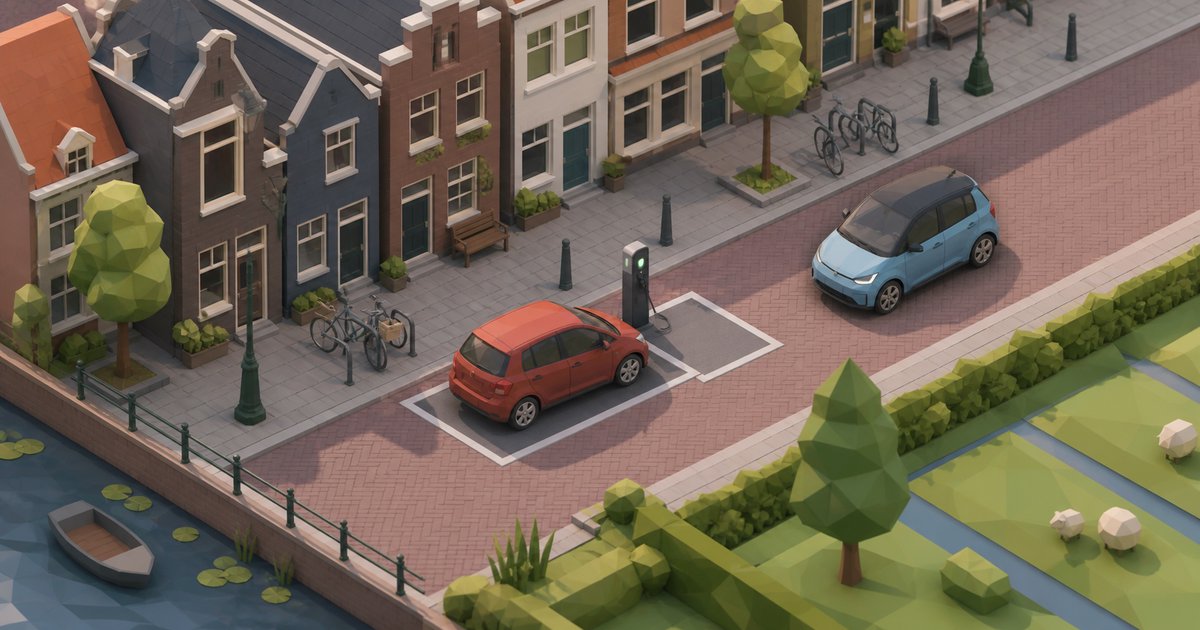
On 1 August 2026, Vattenfall InCharge began installing public charge points in the Netherlands whose parking bays are not reserved for electric cars. A driver in a petrol or diesel car can park in one, leave the car there all day and face no penalty — because at these locations there is no rule to break.
The pilot covers 19 municipalities across Noord-Brabant and Limburg: Alphen-Chaam, Asten, Baarle-Nassau, Bergen op Zoom, Eersel, Etten-Leur, Geldrop-Mierlo, Gilze en Rijen, Goirle, Landgraaf, Moerdijk, Oisterwijk, Oosterhout, Reusel-de Mierden, Tilburg, Valkenswaard, Vught, Weert and Zundert. Vattenfall is placing 150 of these shared posts between August 2026 and January 2027, alongside a control group of 150 conventional charge points where the bay stays reserved for charging vehicles.
Why a charging bay is slow to create
Reserving a public parking space for EVs in the Netherlands is not a matter of painting the tarmac. It requires a verkeersbesluit — a formal traffic decision that must be published and is open to objection from residents. Every bay is its own procedure with its own timeline, and any neighbour who resents losing a parking space can contest it.
Dropping the reservation removes that step entirely. A municipality can put a charge point on the street without first running the process that converts the bay into EV-only space. The premise being tested is blunt: if the paperwork is what holds up the rollout, remove the paperwork and the chargers arrive sooner.
The two arms of the trial differ in exactly one respect.
| Shared bays | Control group | |
|---|---|---|
| Charge points | 150 | 150 |
| Bay reserved for EVs | No | Yes |
| Traffic decision required | No | Yes |
| Petrol car parked there | Legal | Enforceable offence |
Two physical variants are being used to mark the shared posts — either adapted traffic signage or charging tiles set into the parking space — so the operator can see whether drivers read one better than the other.
What EV owners give up
The cost of this lands squarely on the EV owner. At a shared post, arriving to find a diesel estate in the bay is not something a parking warden can act on. There is no priority, no fine and no tow. For Dutch drivers without a driveway — the people kerbside charging exists for — that is a real loss, and it is the reason the idea has been contentious since it was floated.
What they may get in return is more posts, sooner. A charge point that exists and is occasionally blocked can still be worth more than a reserved one that spends nine months in an objection procedure.
What is being measured
Vattenfall and the two provinces will track how the bays are actually used, whether charge points remain available when drivers need them, how many complaints residents file, and — the point of the exercise — whether the rollout genuinely goes faster without the traffic decision.
"This pilot helps us understand how shared charging and parking spaces work in practice," said Alied Wessels Boer, director of Vattenfall InCharge.
The monitoring runs for months after the last post goes in, so a verdict is not due until well into 2027. If the shared bays fill with combustion cars, the answer will be easy. If they do not, other European countries with the same permitting bottleneck will have a cheap fix worth copying.