
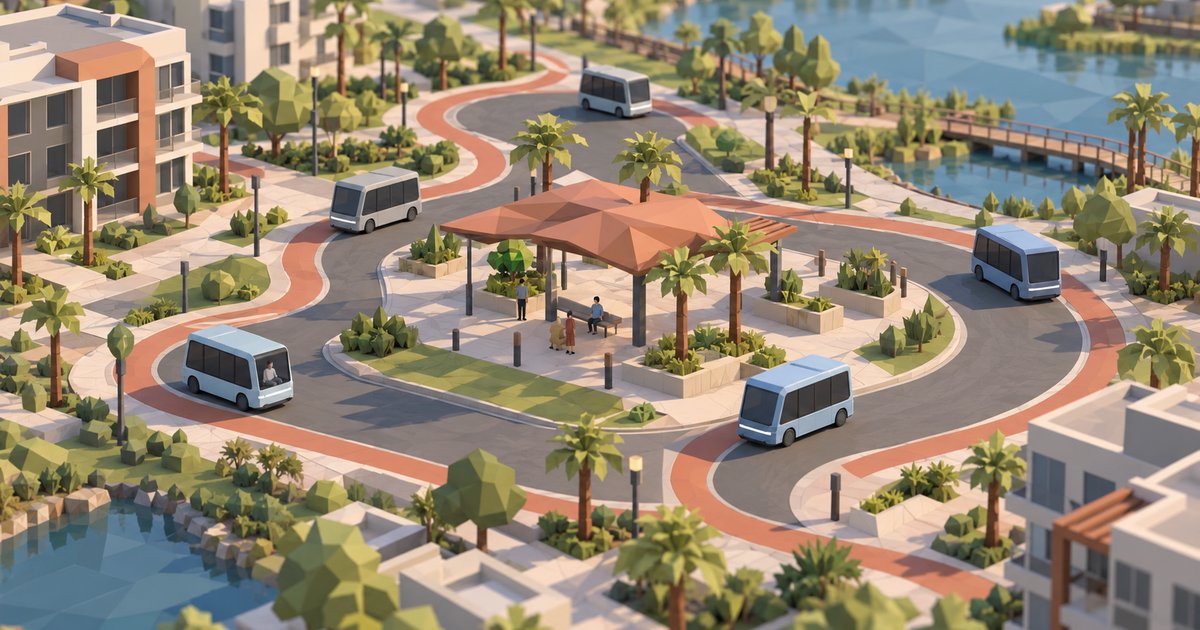
MOIA America and Beep started carrying passengers in autonomous Volkswagen ID. Buzz vans in Lake Nona, a planned community in Orlando, Florida, on 5 October 2026. It is MOIA's first passenger-carrying operation in the United States, and Beep's chief executive calls it the company's first public-facing autonomous mobility service.
It is also happening in a city where Tesla already runs a robotaxi service, which makes the comparison unusually direct.
What is actually running
Six four-seat ID. Buzz AD vans are in the trial. They run three fixed routes with designated pick-up and drop-off points, riders book through Beep's app, and for now the riders are invited test participants rather than the general public. Trained personnel ride along and can intervene in the driving. The autonomous driving itself is Mobileye's system, not Volkswagen's.
Beep operates the service; MOIA supplies the vehicles and the autonomy stack. The agreement between them targets up to 5,000 vehicles across Florida, the wider south-east and eventually the rest of the United States. No date has been attached to that figure.
The same city, two different products
| MOIA / Beep | Tesla Robotaxi | |
|---|---|---|
| Vehicle | VW ID. Buzz AD, four seats | Model Y |
| Route | three fixed routes, set stops | door to door |
| Who can ride | invited test participants | app users inside the service area |
| Human aboard | trained attendant who can intervene | safety monitor in most cars |
| Autonomy supplier | Mobileye | Tesla |
Orlando is one of six US metros where Tesla's paid robotaxi runs, alongside Austin, Dallas, Houston, Miami and Tampa. The two services are not in the same category yet, and it is worth being blunt about the gap: a fixed route with set stops and an attendant on board is a shuttle, while an app-hailed door-to-door ride is a taxi. Tesla has also already removed the human from some cars — the bollard incident in Austin involved a genuinely empty vehicle — and has just put the Robotaxi app in European app stores, even though the nearest car you can hail is in Texas.
What MOIA has that Tesla does not is a route into public transport: Beep's business is municipal microtransit, and a city buying a shuttle circulator is a different customer from a consumer opening an app.
Why it matters that this happened at all
Three weeks ago MOIA looked like Volkswagen's problem child. Its search for an outside investor collapsed after both Uber and Lyft walked away from the table, and this site noted at the time that the autonomous ID. Buzz had no obvious commercial path.
Lake Nona is the answer. Rather than run its own ride-hailing service against Waymo and Tesla, MOIA is selling vehicles and autonomy to an operator that already holds municipal contracts — a narrower, less glamorous business, and one whose buyers sign multi-year agreements.
What a European reader takes from this
The ID. Buzz is built in Hannover, but none of this is happening in Europe. The autonomy is being validated in Florida, under American rules, on Mobileye's stack — while Volkswagen's European autonomy work runs on a different technical track with Wayve.
Two caveats belong on the end. There is no stated date for removing the attendants, and public rides are promised only vaguely for later this year. Until the attendant goes this is a supervised trial, and the distance from there to a driverless service is the one Tesla has spent eighteen months covering.