
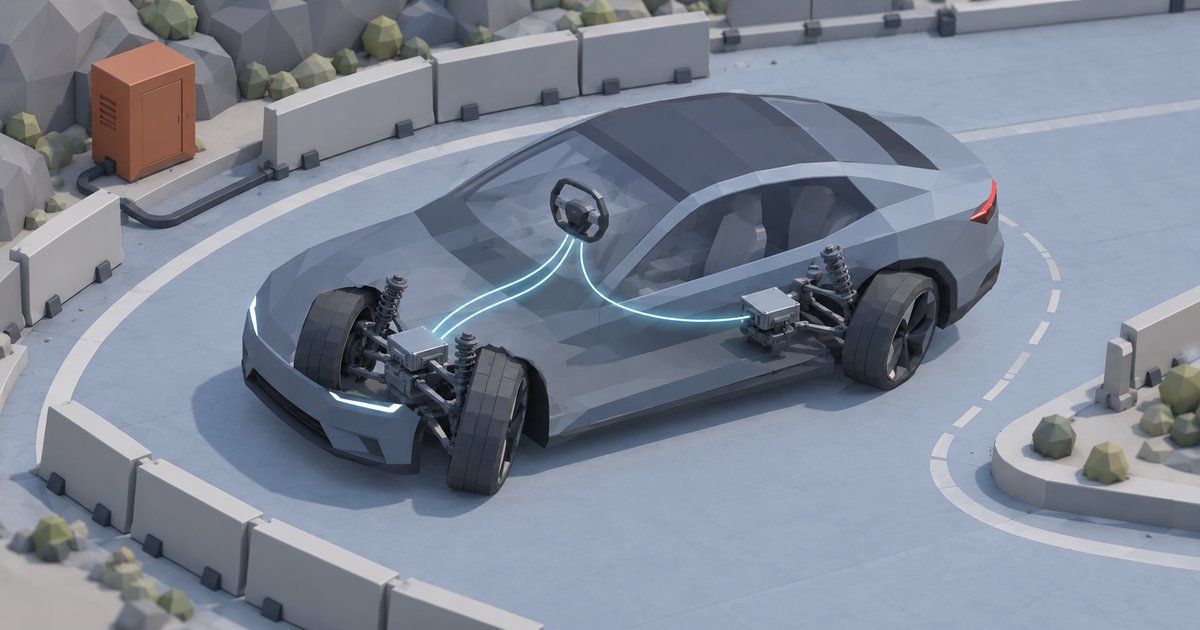
Mercedes-Benz opened orders on 6 October 2026 for steer-by-wire on the electric EQS saloon. It is the first series-production car from a German manufacturer sold without a mechanical connection between the steering wheel and the front wheels.
What the option costs and what it contains
| Item | Figure |
|---|---|
| Price, Germany | €2,975 incl. VAT (€2,500 net) |
| Orders opened | 6 October 2026 |
| Lock to lock | 170 degrees |
| Rear-axle steering | up to 10 degrees |
| Availability | every market that sells the EQS |
The number that does the work is 170 degrees lock to lock. A conventional car needs somewhere between two and three full turns of the wheel to go from one steering extreme to the other. The EQS needs slightly less than half of one, so the driver never crosses their hands — and that is possible only because the ratio is now a software variable rather than a fixed property of a steering rack.
The price also buys rear-axle steering with up to 10 degrees of angle, and a new steering wheel: flatter, with a redesigned airbag structure, offered in black or beige. Mercedes is selling the three as one package rather than as separate boxes.
Mercedes left the mechanical option on the table
Making it a €2,975 extra rather than standard equipment is the detail worth noting. A buyer who wants a physical link between their hands and the road can still have one, on the same car, at a lower price. That is a different posture from building a car that has no column at all.
With the column gone, there is no mechanical fallback if the electronics stop. Mercedes describes the answer as "high-precision sensors, powerful control units and a redundant system architecture with independent signal paths" — redundancy in place of linkage. The company has not published a failure-rate figure, and no manufacturer selling steer-by-wire has.
What this means for a European Tesla buyer
Tesla reached series steer-by-wire first, on the Cybertruck, and European buyers have never been able to buy it. The other Tesla designed around the idea is the Cybercab, which pairs it with brake-by-wire and does away with brake fluid entirely — also not a car in a European showroom. Neither the Model 3 nor the Model Y offers it.
So the practical position as of this week is that a European driver who wants to buy a car with no mechanical steering link has exactly one way to do it, and it is a Mercedes. The technology is not scarce — China's IM LS6 fits steer-by-wire and brake-by-wire across its whole range, not just the expensive trim — but availability in Europe has been.
That matters less as a product comparison than as a regulatory one. Every steer-by-wire car sold in Europe is a car type-approved without a steering column, and each one makes the next approval more ordinary. For Tesla, whose Cybercab has no steering wheel at all, the useful part of this week is not that Mercedes got there first. It is that a German manufacturer has now put the architecture through European type approval and priced it at under €3,000.