
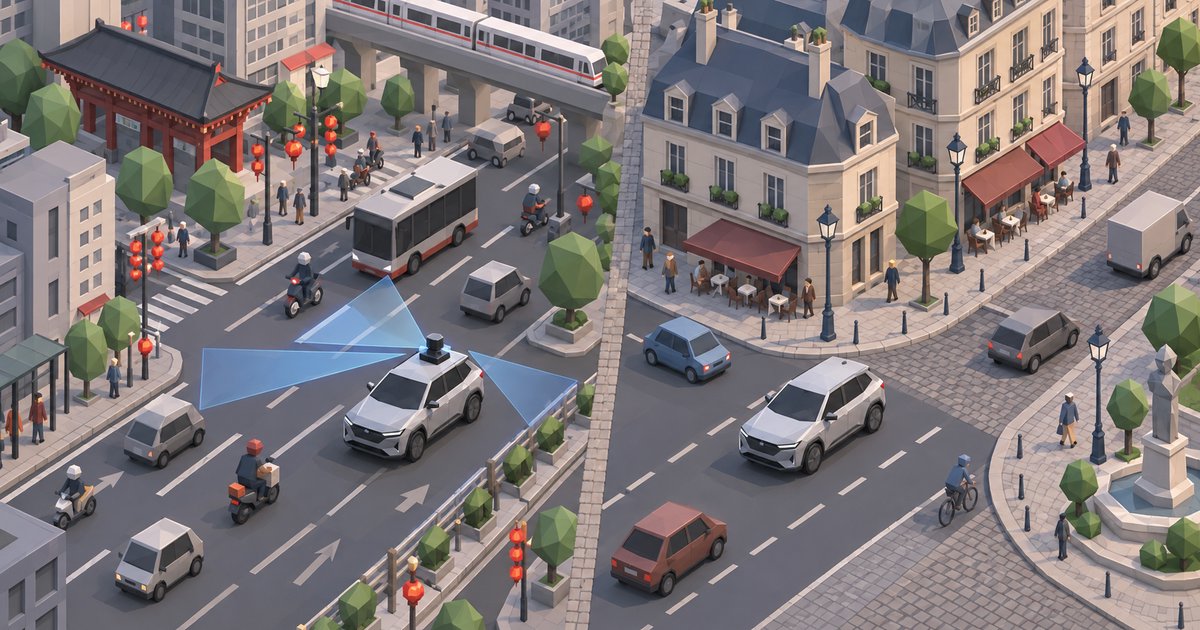
Changan Mazda launched the updated EZ-60 in China on 26 September 2026, a year to the day after the original. The refresh adds four variants carrying a roof-mounted LiDAR unit and, with it, an assisted-driving system that does urban navigation as well as motorway navigation.
The car is not a curiosity for European readers. It is the same vehicle Mazda sells here as the CX-6e — built in China by the Changan joint venture, shown at the Brussels Motor Show in January 2026 and on sale in Germany since the summer. The European car does not have the LiDAR system.
What the Chinese car now has
| Component | Specification |
|---|---|
| LiDAR | 1 Hesai ATX, roof-mounted, 200 m maximum detection range |
| Radar | 3 millimetre-wave units |
| Cameras | 11 |
| Ultrasonic sensors | 12 |
| Motorway navigation assist | 0-130 km/h |
| Urban navigation assist | 0-80 km/h |
| Parking | recognises more than 300 types of parking space |
The system runs an end-to-end architecture and leans on Tencent's lane-level navigation for the urban case. Mazda lists 25 active safety functions, and says further capability will be unlocked over the air.
Mazda also put the system through a set of government-sanctioned tests, covering 11 high-risk scenarios from narrow mountain roads to rainy-night motorway driving, and came away with a TOP Intelligence Intelligent Safety Challenge certificate from CATARC, China's state automotive research body.
The price is the other half of the story
The LiDAR variants cost 12,000 yuan more than the equivalent standard versions. That is the entire premium for the sensor and the software stack behind it.
| Market | Entry price |
|---|---|
| China, guide price | 119,900 yuan (range to 172,900) |
| China, limited-time launch offer | 113,900 yuan |
| Germany | 49,990 euros (Takumi Plus 52,990) |
The German entry price is more than three times the Chinese guide price. Some of that gap is structural rather than scandalous — EU import tariffs on China-built EVs, VAT, shipping, homologation and a different warranty and dealer cost base all sit inside it, and a domestic Chinese price is never a like-for-like comparison. But the mechanical car is largely the same: 4,850 mm long on a 2,902 mm wheelbase in both markets, a rear motor of 190 kW, and a 78 kWh LFP pack that gives 600 km on China's CLTC cycle and 484 km on Europe's stricter WLTP.
What does not cross the border is the autonomy hardware.
Why this matters to a Tesla buyer in Europe
Tesla's argument for FSD has always been that cameras and neural networks beat sensor stacks, and that the company is years ahead of anyone trying the harder problem. The first half of that is a real engineering position. The second half is the part this launch tests.
A conservative Japanese brand, through a Chinese joint venture, is now shipping supervised urban navigation on a mid-size SUV for a sensor premium of 12,000 yuan. Tesla's FSD Supervised, meanwhile, is still working through European approval and has so far arrived only via national routes such as the Czech recognition of the Dutch approval.
Two cautions before reading too much into it. "Advanced L2" in China is a supervised driver-assistance system, not autonomy, and the marketing language around it is looser than European regulators would permit. And a system validated on Chinese roads with Chinese map data has not been shown to work here.
But the direction is worth noticing. European buyers are being offered a Chinese-built car with its most advanced software removed, at more than three times the price it carries at home — and the reason it is removed is regulatory, not technical. That is the same wall FSD is up against, seen from the other side.