
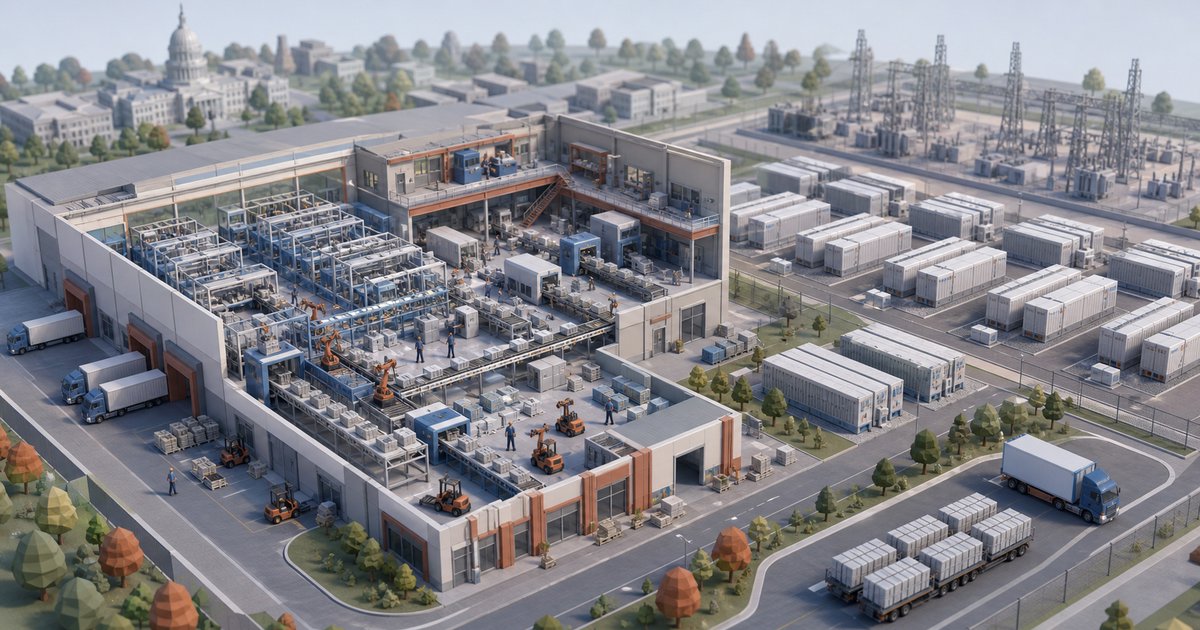
LG Energy Solution has started production at its battery plant in Lansing, Michigan. The plant matters to Tesla for a specific reason: from 2027 it becomes the American source of the lithium iron phosphate cells that go into Megapack 3.
What the plant is
| Detail | LGES Lansing |
|---|---|
| Production start | 18 August 2026 |
| Site | 91.5 hectares (about 226 acres) |
| Investment | Over $2 billion since 2022 |
| Capacity at full scale | More than 35 GWh a year |
| Employment | About 900 now, around 1,700 at full scale |
| Cell types | LFP prismatic for storage, NMC for EVs |
The site was originally planned as a third Ultium Cells joint-venture plant with General Motors. LGES bought out GM's stake in a deal finalised in May 2025, when construction was already 98% complete, and repurposed the half-built factory for a broader customer list. That is the strategic point of the site: it no longer depends on one carmaker's ramp-up.
The Tesla contract
Tesla is the LFP customer, and the arrangement is unusually well documented for a cell supply deal. The US government confirmed in March 2026 that Tesla was the previously unnamed buyer behind LGES's $4.3 billion LFP order. The contract runs from 1 August 2027 to 31 July 2030, with provisions for an extension as far as 2037.
The cells are prismatic LFP built for stationary storage rather than for cars, and they are destined for Megapack 3 units built at Tesla's Megafactory in Brookshire, Texas, west of Houston — the plant that started Megapack 3 production on 6 August and is designed for 50 GWh a year. Tesla cell sourcing from Lansing begins in 2027, so nothing ships to Tesla on day one of production.
The motivation is supply chain, not chemistry. LFP for grid storage has been overwhelmingly a Chinese business, with CATL the dominant supplier, and US tariffs on Chinese cells have been climbing. Michigan-built cells keep Megapack costs predictable and help the product qualify under domestic-content rules. It is the storage-side counterpart to LGES expanding its Nanjing lines for Model Y demand — the same supplier, serving Tesla from opposite ends of the tariff wall.
Tesla is not the only Lansing customer. The utility DTE Energy also takes LFP cells, and NMC production for Toyota is planned, feeding the 2027-model-year electric Highlander that Toyota assembles in Georgetown, Kentucky.
Why European readers should care
Megapack is not a European consumer product, and no Model Y gets a Lansing cell. The relevance is what the deal says about Tesla's energy business and about LFP capacity outside China.
Tesla's storage division has become the part of the company that grows without depending on vehicle demand, and it has been supply-constrained rather than demand-constrained. Put the two plants side by side and the constraint is visible: Tesla can assemble 50 GWh of Megapack 3 a year in Texas, and Lansing is a 35 GWh cell source feeding it. A three-year contract with an option running to 2037 is Tesla locking that supply down. LGES says it is targeting more than 50 GWh of North American LFP capacity by the end of 2026 across five sites, wholly owned and joint venture.
For Europe the read-across is competitive. Every gigawatt-hour of non-Chinese LFP capacity that comes online sets a reference price for the cells European storage and, eventually, European entry-level EVs will be built from. Tesla is underwriting a large slice of that capacity — and doing it in Michigan rather than Grünheide.