
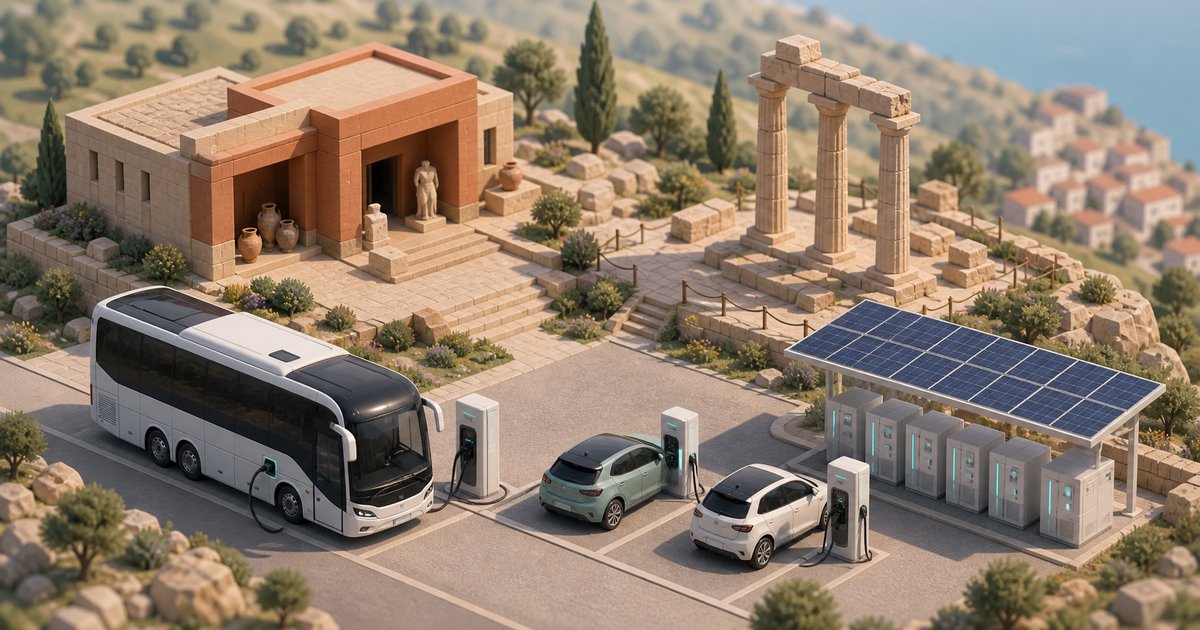
Italy's Ministry of Culture is putting €14 million into electric vehicle charging at cultural sites — museums, libraries and monuments — across seven regions in the south of the country, with fast charging specified for the tourist coaches that bring visitors to them.
The money comes through the ministry's Piano della Cultura and targets places that share a useful property for charging: they attract a lot of visitors, and those visitors stay long enough for a car to take on meaningful energy.
The coach is the point
The part of the scheme that goes beyond ordinary destination charging is the provision for heavy vehicles. The funding covers infrastructure of the CCS (Combined Charging System) or MCS (Megawatt Charging System) type for rapid charging during stops, explicitly to power shuttles and tourist buses.
Coaches serving cultural sites are close to an ideal electric duty cycle: they run predictable routes of a few hundred kilometres, they return to the same points, and they sit parked for hours while passengers tour a site. What has been missing is somewhere to plug in at the destination end.
Weak grids get V2G and solar
Southern cultural sites are frequently in places where the grid connection is thin — the Valle dei Templi is the kind of location the programme has in mind. Rather than treating that as disqualifying, the scheme funds intelligent charging stations using vehicle-to-grid technology, integrating photovoltaic panels and storage systems.
That is a notable choice. It means a site that cannot support a fast charger on its grid connection alone can still get one, buffered by local generation and batteries, with the vehicles themselves able to feed power back. Grid capacity is the binding constraint on European charging rollout far more often than money is, and this is a programme designing around it rather than waiting for reinforcement.
Eligible costs run beyond the hardware: the purchase of chargers, construction work, connection to the electricity grid, and measures to integrate the installations visually into sites where appearance is not a secondary consideration.
Who benefits besides tourists
The ministry's framing includes residents and site staff, not only visitors. A charge point at a museum in a southern town is public infrastructure in a place that may have very little of it, and it stays there when the coaches leave.
That matters for the geography. Charging investment in Italy has concentrated where EV density is already high, which means the north. Aiming a programme at seven southern regions selected partly for their low existing coverage inverts the usual logic — it puts chargers where the cars are not yet, on the theory that the visitors arriving in them will be.
Dates
Applicants have until 31 October 2026 to prepare submissions, with the call closing on 23 December 2026.
For European owners planning southern Italian trips, the relevant horizon is beyond that: these are chargers that will be commissioned after the call closes, not this season. The signal for now is directional — Italy's charging map has a real gap below Rome, and this is public money aimed squarely at it.