
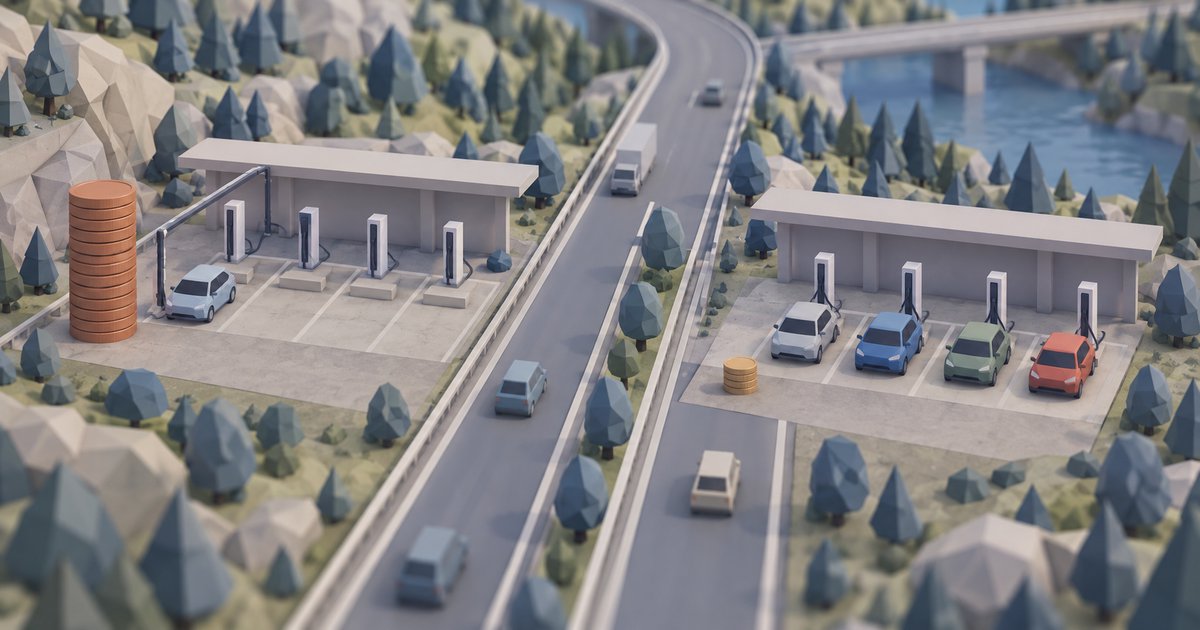
Ionity charges for electricity by the country, not by the network. On 15 September 2026 the Italian outlet Vaielettrico put two of its own receipts side by side: 0.87 euro per kWh at an Ionity site on Italy's A8, and 0.59 euro per kWh at an Ionity site on the French E80. Same operator, same 350 kW cabinets, same plug. A 47% difference.
That is not a one-off. It is what Ionity publishes.
The two tariffs
| Italy | France | |
|---|---|---|
| Direct payment, per kWh | up to 0.91 euro | up to 0.62 euro |
| Cheapest subscription rate, per kWh | from 0.48 euro | from 0.31 euro |
Those are Ionity's own figures, from its June 2026 pricing explainer. The gap holds at both ends of the range: an Italian driver paying ad hoc pays roughly half again what a French driver pays, and an Italian driver on the most expensive subscription still pays more than a French driver on the cheapest.
Ionity raised prices across much of its European network on 1 July 2026, by an average of about 4%, citing electricity procurement costs.
What Ionity says, and what it leaves out
Ionity's explanation is that "energy prices and operating costs can develop very differently from one country to another", and it lists infrastructure, maintenance, grid connection and operating costs as the variables. That is true as far as it goes. Italian wholesale and retail electricity is genuinely among the most expensive in the EU, and France's nuclear fleet genuinely makes its power cheaper.
What the explanation leaves out is volume. A fast charger's cost is dominated by capital and grid connection, both of which are fixed whether the cabinet delivers 10 MWh a month or 100. The fewer cars that use it, the more each kWh has to carry — and Italy has far fewer cars to spread it over. Across January to July 2026 the ICCT put France's share of new cars that were fully electric at 29%, against 8% in Italy.
That is the loop worth naming: thin usage keeps prices high, and high prices keep usage thin. Ionity's Italian network is roughly 45 ultra-fast sites, and the tariff is doing part of the work of keeping them empty.
What it means for a Tesla owner in Europe
Ionity is not a Tesla network, which is exactly why this matters. A Tesla driving a European motorway route uses whatever high-power charger the route provides, and on Italian and French motorways that is frequently Ionity.
The subscription is where the decision sits. Ionity's Power plan costs 11.99 euro a month in Italy and brings the rate to about 0.47 euro per kWh — roughly a 0.40 euro saving per kWh against ad hoc. On a 60 kWh fill that is about 24 euro, so the plan repays itself inside a single motorway charge. For anyone driving Italian motorways more than once a month, paying ad hoc is the expensive mistake.
The contrast with Tesla's own pricing is instructive. When Tesla cut German Supercharger prices in September, the cheapest site in the country fell to 20 cents per kWh against a German ad-hoc DC average near 62 cents. Tesla prices by site and by hour and moves the numbers without announcement; Ionity prices by country and publishes a tariff table. Neither approach is generous. But a driver can plan around a published table, and in Italy the table says to buy the subscription before leaving home.