
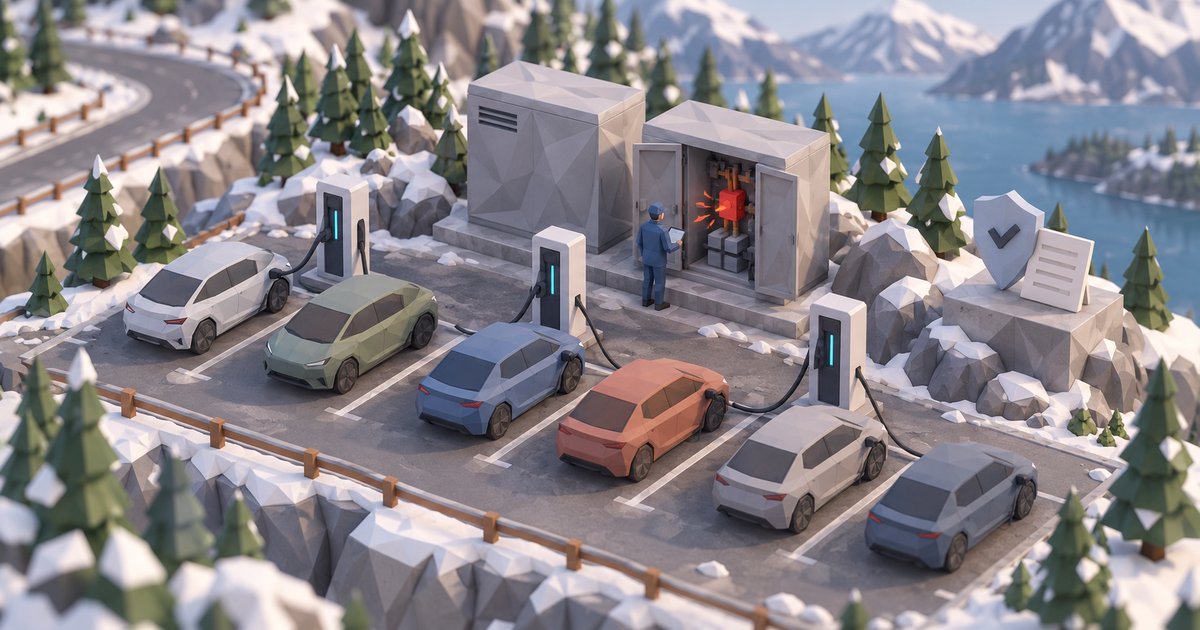
Six electric cars that charged at Ionity's site in Elverum, Norway, were left unable to drive after the charger caused them to fire their pyro-fuses, the explosive safety fuses that cut a car's high-voltage battery off from the rest of the vehicle. Ionity has admitted that its equipment was at fault and is replacing the chargers. On 16 October 2026 it told the Polish site Elektrowoz that its insurer, Zurich, had finished investigating, had confirmed that the chargers caused the damage, and will pay for the cars to be repaired.
What happened at Elverum
Elverum, on the Østerdalen route between Oslo and Trondheim, is Ionity's only Norwegian site with hardware from the Polish manufacturer Ekoenergetyka. It opened as a pilot in December 2025: two power cabinets with 800 kW between them feed three dispensers with six CCS connectors, sharing power in 66.7 kW steps and giving a car that charges alone up to 500 kW.
The Trondheim newspaper Adressa reported the incidents, and they reached an international audience on 15 October, when William Jarbeaux of the Out of Spec channel posted on X that six cars in total had been affected and that all of the site's Ekoenergetyka chargers were showing as unavailable. Ionity told Adressa, in Jarbeaux's translation: "The investigation uncovered a fault in the charging equipment, and the manufacturer of the chargers has confirmed the fault. We have therefore decided to replace the affected chargers. The replacement is planned for this week."
Neither company has said what the fault was, and the makes and models of the six cars have not been published.
Why a fired pyro-fuse is expensive
A pyro-fuse contains a small explosive charge. When the car's electronics detect a crash or a dangerous electrical fault, the charge fires and physically separates the high-voltage battery from the rest of the car, so that no cable carrying several hundred volts stays live. It is a single-use part: once fired, it has to be replaced.
That is rarely a quick job. As Elektrowoz points out, most workshops treat a fired pyro-fuse like accident damage, with a series of costly high-voltage checks; some manufacturers require the car or its battery to go to a specialist centre, and some will only offer a paid battery replacement. For the six owners, the open question since mid-October has been who pays. The insurer's finding answers it. Ionity says the affected customers have been told the outcome and will be contacted about their claims, and it apologised for how long the process took.
What it means for Tesla drivers in Europe
The same charging hub in Elverum has 28 Tesla Superchargers, and Ionity's network is open to any car that charges over CCS, which includes every new Tesla sold in Europe. Nothing published so far says a Tesla was among the six cars.
For any EV owner, the useful part is the precedent. A public charger damaged cars, the operator accepted the fault, and its insurer is paying for the repairs, instead of leaving drivers to argue with their own insurers or carmakers. Ionity has not said what will replace the Ekoenergetyka units, or whether its 500 kW pilot will continue in another form.