
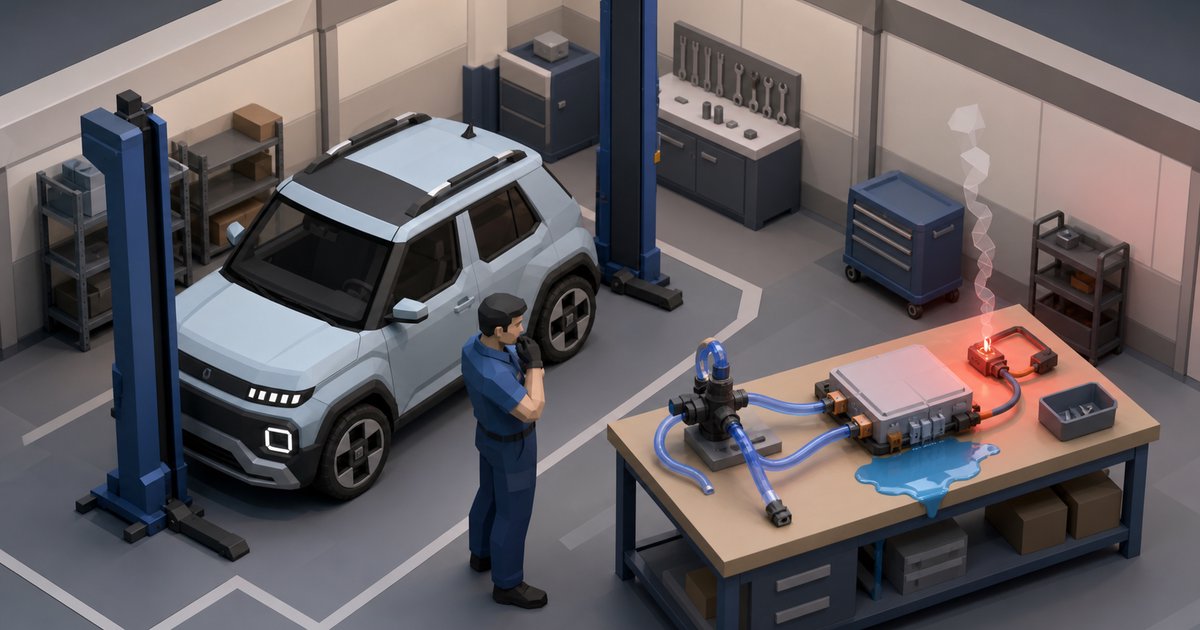
Hyundai is recalling 40,045 Inster electric city cars because a defective valve in the thermal management system can leak coolant onto live electrical components, creating a short-circuit and fire risk. Roughly 14,610 of the affected vehicles are registered in Germany.
The defect
The fault sits in the central three-way valve that directs coolant around the Inster's thermal management circuit. An internal defect in that valve can allow coolant to escape over time. Coolant is electrically conductive once it picks up contaminants, so if it reaches nearby electrical components it can bridge them — producing a short circuit and, in the worst case, a fire.
The failure mode is gradual rather than sudden, which is why the recall covers a long production window instead of a specific batch. Cars built between 14 February 2024 and 14 April 2026 are affected.
| Item | Detail |
|---|---|
| Model | Hyundai Inster (AX) |
| Vehicles recalled | 40,045 |
| Of which in Germany | ~14,610 |
| Build dates | 14 Feb 2024 – 14 Apr 2026 |
| Defect | Internal fault in thermal management three-way valve |
| Risk | Coolant leak → short circuit → fire |
| Remedy | Valve replaced with revised part, free of charge |
What owners need to do
Affected owners will be contacted to book a workshop visit, where the three-way valve is replaced with an optimised component at no cost. On the information released so far, Hyundai has not reported any injuries or property damage linked to the faulty valve.
Owners who have not yet had a letter can check their vehicle identification number against the recall with a Hyundai dealer. There is no advice to stop driving the car, but a coolant warning, a visible leak or a drop in coolant level are worth acting on promptly rather than waiting for the appointment.
Why this is worth reading even if you drive a Tesla
Thermal management is the part of an EV that owners think about least and that fails most consequentially. Every electric car circulates coolant through a battery pack and power electronics, and every one of them therefore has valves, pumps and seals that are a single component failure away from putting conductive fluid somewhere it should not be. This is not a Hyundai-specific class of problem — it is the class of problem EV platforms share.
The Inster is also one of the more affordable EVs on sale in Europe, which is exactly the segment that has to grow for electric share to keep climbing. A fire-risk recall on 40,045 cars in a price bracket where buyers are least tolerant of ownership friction is unhelpful timing, arriving as European BEV share hit 25.6% in June.
The part that actually reads well
A recall is a system working, not a system failing. The defect was identified before it produced injuries, the affected build window is bounded, and the fix is a component swap rather than a battery replacement or a software mitigation that degrades the car. Compare that with defects that get addressed through a quiet reduction in charging speed, and a valve replacement is the outcome an owner should want.
The number to watch is completion rate. European recall campaigns routinely stall well short of every affected car, particularly on vehicles that have changed hands. A recall only removes risk from the fleet once the cars actually arrive at the workshop.