
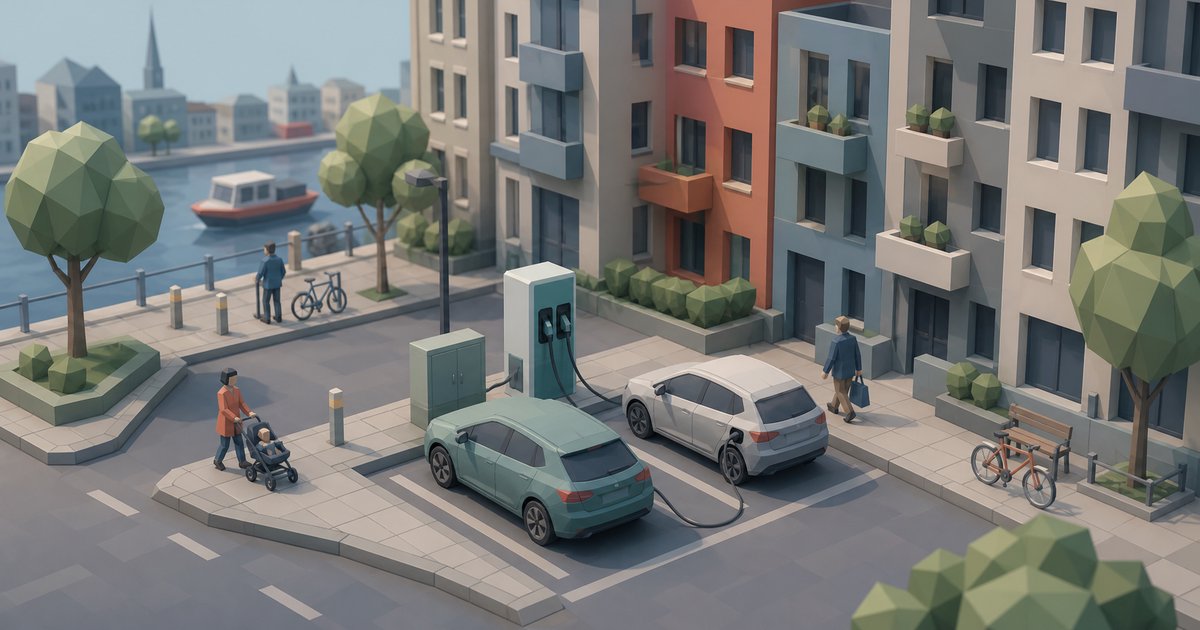
Hamburger Energiewerke Mobil, the mobility arm of the city's municipal utility, has begun installing something Germany has very little of: public DC chargers that are deliberately not fast. Two are live, on Paul-Sorge-Straße in Niendorf and on Grünebergstraße, with 13 further locations in planning or construction. The hardware is the Alpitronic Hypercharger 50, with two connectors per unit and up to 50 kW of DC output.
The interesting part is not the power rating. It is the price. According to NDR, charging at these units costs the same per kWh as AC charging on the same network — which, if you do not have a driveway, quietly makes them the best public charging deal in Hamburg.
What "Low-DC" actually means
European public charging is a barbell. At one end, AC street charging at 11 or 22 kW: cheap and slow. At the other, high-power charging at 150–400 kW: fast, expensive, clustered on motorways and retail parks. Low-DC is the missing middle — direct current, but at 50 kW rather than 300.
| AC street charging | Low-DC | HPC | |
|---|---|---|---|
| Typical power | 11–22 kW | up to 50 kW | 150–400 kW |
| Grid connection | Light | Moderate | Heavy, often needs reinforcement |
| Typical siting | Residential kerbside | Dense districts, points of interest | Motorways, retail |
| Onboard charger dependency | Yes | No | No |
That last row matters more than the headline number. AC speed is capped by the car's onboard charger, not the post — a car limited to 11 kW gets 11 kW from a 22 kW post. DC bypasses the onboard charger entirely, so a 50 kW unit delivers close to 50 kW to almost anything. For cars with weak AC charging, Low-DC is not a modest gain over a 22 kW post; it can be four times the rate.
Why a city utility picks 50 kW over 300
HEnW Mobil's stated rationale is siting. Densely built urban quarters and "points of interest" — where people park for an hour or two rather than overnight or for ten minutes — are exactly where AC is too slow to be useful and HPC is impossible to install. A 50 kW unit needs far less from the local grid, so it can go where the cable already is, without a substation upgrade and the years that come with one.
The expensive constraint on urban charging is rarely the charger; it is the grid connection and the civil works. Low-DC trades peak speed for the ability to actually get built.
What it means for drivers, and for other European cities
For Tesla owners the Supercharger network already covers the fast end, so the comparison that matters is against kerbside AC — and there, 50 kW DC at AC prices is straightforwardly better for a Model 3 or Model Y topping up during errands.
The wider signal is the pricing decision. Operators normally charge a premium for DC because the hardware and grid connection cost more. Hamburg has chosen not to, and it is a municipal utility rather than a commercial network, which is precisely why it can. Whether commercial networks across Europe follow is the open question; the pre-authorisation holds that make charging look worse than it is are a reminder that headline prices and what lands on the card differ.
Hamburg is targeting more than 2,800 charging points by mid-2027, on the way to roughly 10,000 by 2030. It says it is about halfway there.